



 Close Menu
 World
World
 Biography
 Health
 Education
 Business
 Lifestyle
 Sports
 Technology
 Animals
 History
 Food
Food
 Religious
 Startups
 Movies
 Politics
 Fashion
 Covid
Covid
 Diet
Diet
 Fitness
 Marketing
 Travel
 Science
 Reviews
 Social media
 Stories
 Facts
Facts
 Art
Art
 Entertainment
bnb india

Education
How to Choose a Robotics Winter Camp for Kids Bangalore
 bnb india
Winter holidays give children a welcome break from their regular school routine. It is a time when they can relax, explore new interests, meet other children, and discover activities that may not fit into their everyday schedule. For many parents, however, the question is simple: how can we turn this free time into something both enjoyable and useful?
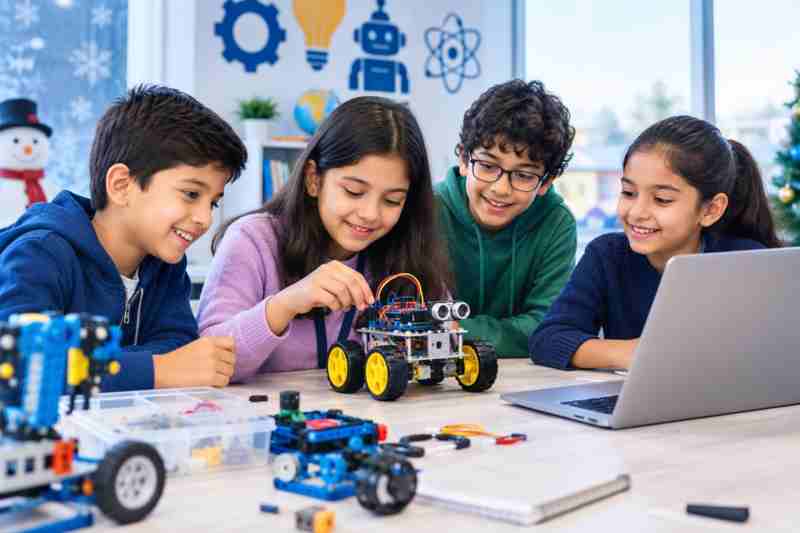
A robotics camp can be an exciting answer. Unlike traditional classroom learning, robotics allows children to build, test, program, and improve things with their own hands. They are not just learning what a robot is; they are discovering how technology, engineering, coding, mathematics, and creative thinking work together.
If you are searching for a winter camp for kids Bangalore, you will find many options. But choosing the right robotics program requires more than looking at a colorful advertisement or a list of activities. You need to understand what your child will actually learn, how the sessions are conducted, whether the program matches their age and experience, and whether the environment encourages curiosity.
This guide explains how parents can choose a suitable robotics-focused winter camp and what to look for before enrolling their child.
Why Choose a Robotics Winter Camp for Kids?
Robotics combines several STEM disciplines in one practical learning experience. Children can encounter programming, electronics, engineering, mathematics, design, logic, and problem-solving while working toward a single project.
That makes robotics especially engaging for young learners. Instead of simply reading about a concept, they can see an instruction produce an action. If something does not work, they can investigate why and try another approach.
Robotics Turns Learning Into a Practical Experience
Think about the difference between reading about how a robot moves and actually programming one to move.
The second experience is much more interactive. Children can observe the result of their decisions immediately, which makes the learning process feel more like exploration than a conventional lesson.
Robotics Encourages Children to Solve Problems
A robotics project rarely works perfectly on the first attempt. A wheel may not move correctly, a sensor may respond unexpectedly, or a program may contain an error.
Instead of seeing these moments as failures, children can learn to treat them as clues. They begin asking questions, testing possibilities, and improving their designs.
What Should Parents Look for in a Winter Camp for Kids Bangalore?
When comparing a winter camp for kids Bangalore, start by looking at the educational structure rather than focusing only on the number of activities advertised.
A good camp should have clear learning objectives, age-appropriate projects, supportive instructors, practical sessions, and enough time for children to experiment.
Check the Robotics Curriculum
Ask what children will actually learn during the camp.
Will they build robots? Will they program them? Will they learn about sensors or simple automation? Will they complete a project? A clear curriculum gives parents a better idea of what their child will experience.
Look for Project-Based Learning
Robotics becomes much more meaningful when children have something to build.
A project provides a purpose for learning. Instead of learning coding commands in isolation, children can use those commands to make a robot perform a specific task.
Consider Your Child’s Age and Experience
One of the most important factors when choosing a robotics camp is whether the program matches your child's current skill level.
A beginner may need simple explanations and guided activities. A child with previous coding or robotics experience may want more challenging projects.
Beginner-Friendly Robotics Programs
Children who are completely new to robotics should not feel pressured to understand everything immediately.
A beginner-friendly program can introduce concepts gradually, starting with simple construction, logic, movement, and programming before progressing toward more complex challenges.
Advanced Activities for Experienced Kids
Older children or students who already have robotics experience may benefit from more challenging tasks.
They might explore more complex programming, sensors, automation, engineering design, or advanced project development. The goal should be to keep the child challenged without making the experience frustrating.
Look at the Winter Camp Activities Offered
The phrase winter camp activities can mean many different things. Some camps concentrate mainly on recreation, while STEM-focused programs may combine robotics with coding, AI, science experiments, engineering, and creative technology.
Parents should look for a balanced program that keeps children engaged without overwhelming them.
Robotics Building Challenges
Building activities allow children to understand how different components work together.
They may need to think about structure, balance, movement, wheels, gears, sensors, or other components depending on the program. This can introduce basic engineering concepts in a way that feels tangible.
Programming and Coding Tasks
Programming gives children a way to control what their robot does.
They may begin with simple commands and gradually learn about sequences, conditions, loops, or other programming concepts. These skills can also support future learning in broader computer science.
Engineering Design Challenges
Engineering activities encourage children to think beyond simply following instructions.
They can be given a problem and asked to create their own solution. This approach gives them an opportunity to plan, test, identify weaknesses, and make improvements.
Make Sure the Camp Is More Than Screen Time
Technology-based education does not have to mean sitting in front of a computer for hours.
A good robotics camp should ideally combine digital programming with physical construction, testing, teamwork, discussion, and hands-on experimentation.
Balance Coding With Physical Projects
When children write code and then see a physical robot respond, they can understand the connection between digital instructions and real-world actions.
This combination makes the learning experience more engaging and gives children an opportunity to move, build, test, and experiment.
Evaluate the Instructors
Even a well-designed robotics curriculum can become ineffective if it is not taught well.
Parents should look for instructors who can communicate technical concepts clearly and patiently. Children need teachers who understand that mistakes and repeated questions are normal parts of learning.
Choose Teachers Who Encourage Questions
Children should feel comfortable saying, “I don't understand,” or “What happens if I change this?”
When instructors welcome questions, children become more willing to explore unfamiliar ideas. That curiosity can become one of the most valuable outcomes of the camp.
Look for Supportive Guidance
A good instructor does not necessarily solve every problem for the child.
Instead, they can provide hints, ask guiding questions, and encourage children to find solutions themselves. This helps develop independence and confidence.
Ask About Class Size and Student Interaction
Class size can influence the quality of a robotics learning experience.
If too many children share limited equipment or receive very little individual guidance, some students may spend more time watching than participating.
Smaller or appropriately managed groups can make it easier for instructors to observe each child's progress and provide support when needed.
Why Hands-On Participation Matters
Imagine five children working around one robot while only one child gets to control it.
The others may learn something by watching, but their experience will be different from actually participating. A good program should give children meaningful opportunities to build, program, test, and discuss.
Look for Team-Based Robotics Challenges
Robotics can be an excellent way to teach collaboration.
Children can work together to design a solution, divide tasks, test ideas, and present their final project. This can develop communication skills alongside technical knowledge.
Children Can Learn From Different Strengths
One child might enjoy programming, another may prefer construction, while another may be good at explaining the project.
Team-based activities help children understand that successful projects often depend on combining different strengths.
Check Whether the Camp Includes STEM Beyond Robotics
Robotics is only one part of STEM. A broader program can expose children to science, technology, engineering, mathematics, coding, artificial intelligence, and creative problem-solving.
This can help children discover interests they did not know they had.
Coding and Artificial Intelligence
Coding can provide the logical foundation behind many robotics projects, while age-appropriate AI activities can introduce children to concepts behind modern intelligent systems.
The activities should be presented in a way that children can understand rather than being overloaded with complex terminology.
Science and Engineering Experiments
Science experiments can complement robotics by encouraging observation, prediction, testing, and analysis.
Engineering challenges can then help children apply those ideas to practical problems. Together, these activities can create a richer STEM experience.
Why Brainy n Bright Can Be a Strong Choice for Robotics Learning
For parents searching for a winter camp for kids Bangalore with a strong STEM and technology focus, Brainy n Bright offers STEM and robotics training designed for children.
Its focus on robotics, coding, AI, and practical technology learning can give children opportunities to explore modern technical concepts through projects and hands-on activities.
Rather than treating STEM as a collection of textbook subjects, Brainy n Bright can help children experience technology as something they can create, control, test, and improve.
Hands-On STEM and Robotics Training
Hands-on learning can make technology easier for children to understand.
When a child physically builds a project and then programs it, they can see how multiple concepts connect. This can turn abstract ideas into something visible and understandable.
Learning Through Creativity and Experimentation
Every child approaches a project differently.
Giving children room to experiment allows them to discover their own solutions. They can make changes, compare results, and learn why one approach works better than another.
Think About the Learning Environment
The physical and emotional environment matters just as much as the curriculum.
Children should feel comfortable asking questions, making mistakes, collaborating with peers, and trying again. A stressful environment can make even an exciting subject feel difficult.
A Positive Environment Builds Confidence
When children are encouraged rather than criticized for mistakes, they become more willing to take intellectual risks.
That matters in robotics because experimentation is part of the process. A child who is afraid of making mistakes may avoid trying new solutions.
Check the Duration and Daily Schedule
Parents should also consider how long the camp runs and how sessions are structured.
Longer does not automatically mean better. Children need enough time to understand concepts and complete projects, but they also need breaks and changes in activity.
Avoid Overloading Children
A schedule packed with continuous technical lessons can quickly become tiring.
Good winter camp activities should include variation, allowing children to switch between building, programming, discussions, challenges, teamwork, and other suitable activities.
Ask What Children Will Create by the End
One useful question to ask a camp provider is: “What will my child actually make?”
A final project gives children something tangible to demonstrate and discuss. It can also give parents a clearer picture of what their child learned.
Project Demonstrations Can Be Valuable
At the end of a robotics program, children may have the opportunity to demonstrate their project.
Explaining how their creation works can strengthen communication skills and give children a sense of accomplishment.
Consider the Benefits Beyond Robotics
The value of a robotics camp goes beyond learning how to assemble or program a machine.
Children can develop patience, logical reasoning, creativity, collaboration, communication, attention to detail, and problem-solving skills.
Problem-Solving Skills
Robotics naturally creates problems that require solutions.
When children encounter an obstacle, they have to analyze the situation and determine what could be changed. Repeating this process can strengthen their ability to approach unfamiliar problems systematically.
Creativity and Innovation
There may be several ways to complete a robotics challenge.
Allowing children to explore alternatives encourages creativity. They learn that innovation is not always about finding the first possible solution; sometimes it is about finding a better one.
Why Winter Camp Can Be a Great Time to Explore Robotics
School holidays provide children with more flexibility than their regular academic schedule.
They can spend time exploring a subject without worrying about examinations or homework. This makes winter a useful opportunity to discover whether robotics is something they genuinely enjoy.
For families across India, a winter camp for kids India can combine holiday fun with meaningful skill development.
How Parents Can Support Robotics Learning at Home
The camp does not have to be the end of the learning journey.
If your child becomes interested in robotics, encourage them to talk about their projects and explain what they learned. Ask questions instead of immediately providing answers.
You can also encourage small creative projects at home, depending on the tools and resources available to your child.
Let Children Explain What They Built
Ask your child to explain how their robot works.
If they can teach you the basic idea, they are not simply remembering instructions—they are developing an understanding of the concept.
Celebrate Progress, Not Perfection
Perhaps the first project does not work perfectly. That is okay.
The important achievement is that the child tried, identified a problem, and learned something from the experience. Celebrating this process can encourage a growth-oriented approach to learning.
Questions to Ask Before Enrolling in a Robotics Winter Camp
Before choosing a winter camp for kids Bangalore, parents can prepare a short list of questions.
Ask about the curriculum, age groups, instructor experience, project work, class size, equipment, session structure, and expected learning outcomes.
You can also ask whether children with no previous robotics experience can participate comfortably.
How to Compare Different Robotics Camps
Rather than choosing a program based on one feature, compare several factors together.
Look at the quality of hands-on activities, teaching approach, age suitability, project opportunities, instructor support, STEM coverage, and overall learning environment.
A camp that offers fewer activities but provides deeper hands-on learning may give children a more meaningful experience than a program that simply lists dozens of topics.
The Role of Robotics in Future-Ready Learning
Children growing up today will encounter technology in almost every area of life.
Learning robotics does not mean every child needs to become an engineer. Instead, robotics can provide a practical way to develop logical thinking, creativity, collaboration, and confidence with technology.
These skills can remain useful even if a child's future interests eventually move toward completely different fields.
Conclusion
Choosing a robotics-focused winter camp for kids Bangalore requires more than checking the camp name and dates. Parents should consider the curriculum, age suitability, instructors, hands-on opportunities, class size, project work, teamwork, and overall learning environment.
The best winter camp activities are those that make children curious and give them opportunities to build, test, solve problems, and create something meaningful. Robotics is particularly powerful because it connects coding, engineering, mathematics, technology, creativity, and problem-solving in one practical experience.
For parents looking for STEM and robotics training in Bangalore, Brainy n Bright provides a technology-focused learning environment where children can explore robotics, coding, AI, and STEM concepts through practical learning. A well-planned winter program can help children enjoy their holidays while discovering new interests and developing skills that can support their future learning.
Whether your child is completely new to robotics or already fascinated by technology, the right camp can become more than a holiday activity. It can be the first step toward a lifelong habit of asking questions, experimenting with ideas, and creating solutions.
Frequently Asked Questions
1. What should I look for in a robotics winter camp for kids in Bangalore?
Look for an age-appropriate curriculum, hands-on robotics projects, experienced instructors, suitable class sizes, teamwork opportunities, and practical learning. It is also useful to check whether children will complete a project during the camp.
2. Can beginners join a robotics winter camp?
Yes. Many robotics programs are designed for beginners and introduce concepts gradually. Parents should confirm that the camp offers beginner-level activities if their child has no previous experience with coding or robotics.
3. What winter camp activities are useful for STEM learning?
Useful activities can include robotics building, coding challenges, engineering projects, science experiments, AI concepts, mathematics-based challenges, design tasks, and collaborative problem-solving activities.
4. Why is robotics useful for children's development?
Robotics can help children develop logical thinking, creativity, problem-solving, patience, collaboration, and confidence with technology. It also allows them to learn through experimentation instead of relying only on theoretical instruction.
5. Why choose Brainy n Bright for STEM and robotics training?
Brainy n Bright focuses on STEM and robotics training for children in Bangalore, with learning areas that include robotics, coding, artificial intelligence, and practical technology projects. Its hands-on approach can give children an engaging way to explore STEM while developing creative and problem-solving skills.
Source:
Click for the: Full Story
You might like








You Might Like this