Close Menu
 World
World
 Biography
 Health
 Education
 Business
 Lifestyle
 Sports
 Technology
 Animals
 History
 Food
Food
 Religious
 Startups
 Movies
 Politics
 Fashion
 Covid
Covid
 Diet
Diet
 Fitness
 Marketing
 Travel
 Science
 Reviews
 Social media
 Stories
 Facts
Facts
 Art
Art
 Entertainment
Techora Systems

Technology
How to Integrate AI Into Existing Business Software Without Rebuilding Everything
 Techora Systems
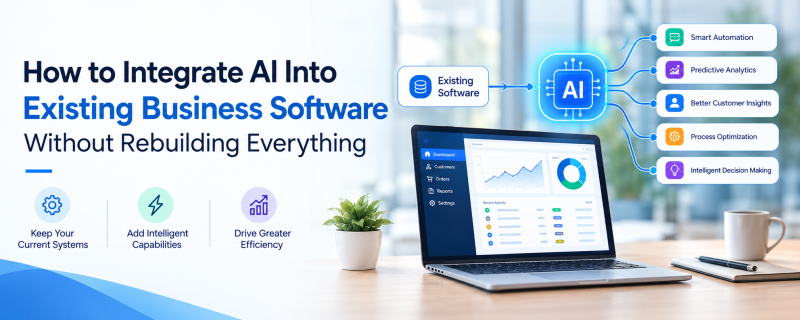
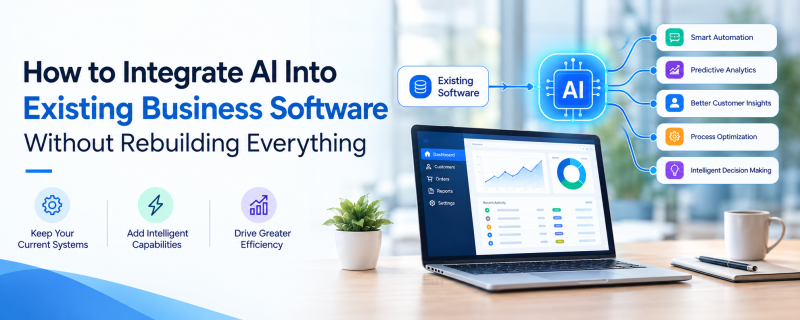
Artificial intelligence is rapidly becoming part of everyday business operations. From customer support and sales forecasting to document processing, fraud detection, workflow automation, and personalized recommendations, AI Development Services can help organizations introduce intelligent capabilities that improve how they use their existing software.
However, integrating AI does not necessarily mean replacing an established technology stack or rebuilding applications from the ground up. In many cases, businesses can introduce AI capabilities on top of existing software, allowing them to modernize gradually while protecting previous technology investments.
The key is to identify where AI can add measurable value, connect it with existing systems through appropriate interfaces, and introduce intelligent capabilities without disrupting critical business processes.
Can AI Be Added to Existing Business Software?
Yes. Most modern business applications can incorporate AI without requiring a complete rebuild.
Existing software typically contains valuable data, established workflows, user interfaces, business rules, and integrations. Rather than replacing these components, organizations can introduce an AI layer that works alongside the current application.
For example, an enterprise resource planning system may already manage orders, inventory, suppliers, and financial information. AI can be added to analyze historical transactions, identify unusual purchasing patterns, predict inventory requirements, or provide natural-language insights.
Similarly, a CRM platform can continue managing customer records while AI analyzes those records to identify sales opportunities, predict customer churn, summarize interactions, or recommend the next action for sales teams.
This approach makes AI integration services particularly useful for businesses that want modernization without unnecessary disruption.
Start With Existing Business Processes
Successful AI integration begins with business processes rather than technology.
Instead of asking, "Where can we use AI?" organizations should examine existing workflows and identify repetitive, data-intensive, time-consuming, or decision-heavy activities.
Common opportunities include:
- Automated document classification
- Customer service assistance
- Predictive analytics
- Sales forecasting
- Intelligent search
- Recommendation engines
- Data extraction
- Email and communication summarization
- Fraud and anomaly detection
- Demand forecasting
- Workflow automation
- Personalized customer experiences
- Natural-language reporting
The objective should be to identify specific processes where AI can improve speed, accuracy, productivity, or decision-making.
A focused AI use case is usually easier to implement and measure than attempting to introduce AI throughout an entire application simultaneously.
Assess the Existing Software Architecture
Before integrating AI, we need to understand how the existing software works.
This includes reviewing the application's:
- Programming languages and frameworks
- Database architecture
- APIs and integrations
- Authentication mechanisms
- Data structures
- Business rules
- Cloud or on-premise infrastructure
- Third-party services
- Security controls
- User workflows
- Data quality
Legacy applications may not have modern APIs or clearly separated services. In these situations, integration may require an intermediary service, middleware layer, database connector, event-based architecture, or API gateway.
This assessment helps determine where AI should connect to the existing application without unnecessarily modifying its core architecture.
Use APIs to Connect AI With Existing Applications
APIs are one of the most practical ways to introduce AI into established business software.
Instead of embedding an AI model directly into the core application, businesses can create an AI service that communicates with existing systems through APIs.
For example: Existing CRM → API → AI service → Recommendation → CRM
A sales application can send relevant customer information to an AI service. The AI system can analyze the information and return a recommendation, summary, classification, or prediction. The existing CRM then displays the result to the user.
This architecture provides flexibility because the AI component can evolve independently of the primary business application.
It also allows organizations to replace or upgrade AI models without rebuilding the entire application.
Create an AI Integration Layer
For larger organizations, an AI integration layer can provide a structured way to connect multiple applications with AI capabilities.
This layer can manage:
- AI model communication
- Authentication
- Data transformation
- Prompt management
- Business rules
- Logging
- Monitoring
- Security controls
- Rate limiting
- Model selection
- Response validation
For example, an organization may have separate CRM, ERP, HR, customer support, and document management systems.
Instead of creating completely independent AI integrations for every application, a centralized architecture can provide reusable AI capabilities across multiple systems.
This reduces duplication and makes future AI initiatives easier to manage.
Connect AI to Business Data Carefully
AI is only as useful as the information it receives.
Existing business software often contains years of valuable information, but that information may be distributed across databases, spreadsheets, documents, emails, APIs, and third-party applications.
Before connecting AI to these sources, organizations should evaluate:
- Data accuracy
- Data completeness
- Data consistency
- Data ownership
- Data accessibility
- Data privacy
- Data retention requirements
- Duplicate records
- Outdated information
Data should be transformed into a structure that the AI system can reliably understand.
For generative AI applications, businesses may also use techniques such as retrieval-augmented generation (RAG) to allow AI systems to retrieve relevant information from approved business data sources before generating responses.
This can be particularly useful for internal knowledge assistants, customer support applications, document analysis, and enterprise search.
Add AI Features Without Changing the Core Application
One of the biggest advantages of incremental AI integration is that organizations can introduce new capabilities without modifying critical business logic.
Consider an existing customer support application.
Instead of rebuilding the platform, an organization could add:
- AI-Powered Ticket Classification: AI can analyze incoming support requests and automatically categorize them based on topic, urgency, product, or department.
- AI Response Suggestions: AI can generate suggested responses that support agents review before sending.
- Conversation Summarization: Long customer conversations can be summarized automatically so agents can understand the context faster.
- Knowledge Search: AI can help agents locate relevant information across internal documentation and approved knowledge sources.
- Customer Sentiment Analysis: AI can analyze customer communications to identify sentiment or potential escalation signals.
The existing support platform remains in place while AI improves specific parts of the workflow.
Use Microservices for AI Capabilities
Microservices can be useful when AI functionality needs to remain independent from the core application.
For example, an organization could create separate services for:
- Document processing
- Recommendation generation
- Forecasting
- Natural-language processing
- AI search
- Customer classification
- Fraud detection
Each service can communicate with existing business software through APIs or events.
This architecture makes AI components easier to update, scale, monitor, and replace.
It also minimizes the risk of making extensive changes to a stable legacy application.
Modernize Legacy Software Incrementally
Businesses often hesitate to introduce AI because their existing software is old.
However, legacy software does not automatically need to be replaced before AI can be introduced.
A practical modernization strategy can involve several stages:
Legacy application → Integration layer → AI services → Modern APIs → Gradual modernization
For example, an organization might initially connect its legacy system to an AI document-processing service. Later, it could expose additional APIs, migrate selected functions to cloud services, and eventually modernize individual components.
This approach allows legacy application modernization and AI adoption to happen together rather than requiring a single large transformation project.
Keep Humans in the Loop
AI should not automatically make every business decision.
For many applications, a human-in-the-loop model provides a more practical approach.
For example, AI can:
- Analyze information.
- Generate a recommendation.
- Assign a confidence level.
- Present the result to an employee.
- Allow the employee to approve, modify, or reject it.
- Record the final decision.
This approach is particularly useful for financial operations, customer service, compliance workflows, document processing, and other areas where incorrect decisions may have significant consequences.
The objective is to augment employees rather than unnecessarily remove human oversight.
Protect Business Data During AI Integration
Security should be considered before connecting AI with existing enterprise systems.
Organizations should determine exactly what information an AI service can access and what information it should never receive.
Important controls may include:
- Role-based access control
- Encryption
- Authentication
- Authorization
- Audit logging
- Data masking
- Secure API gateways
- Input validation
- Output validation
- Access monitoring
- Data retention controls
Sensitive information should only be exposed to AI systems when there is a legitimate business requirement and appropriate safeguards are in place.
AI integration should also follow the organization's existing security, privacy, compliance, and governance requirements.
Monitor AI Performance After Deployment
AI integration does not end when the feature goes live.
AI systems need ongoing monitoring because business data, customer behavior, workflows, and models can change over time.
Organizations should monitor:
- Response accuracy
- Processing time
- API usage
- Error rates
- Model costs
- User feedback
- Data quality
- False positives
- False negatives
- Security events
For generative AI applications, monitoring should also consider the quality and relevance of generated responses.
Regular evaluation helps identify problems before they affect larger portions of the business.
Measure the Business Impact
AI initiatives should have measurable objectives.
Depending on the use case, useful metrics may include:
- Reduction in manual processing time
- Faster customer response times
- Improved employee productivity
- Reduced operational costs
- Increased conversion rates
- Improved forecast accuracy
- Lower support workloads
- Reduced document-processing time
- Improved customer satisfaction
For example, if AI is introduced to classify support tickets, the organization could compare average classification time before and after implementation.
If AI is introduced for document processing, the organization could measure processing speed and manual intervention rates.
Clear metrics make it easier to determine whether an AI integration is delivering practical business value.
Common Mistakes to Avoid When Integrating AI
Businesses can reduce implementation problems by avoiding several common mistakes.
- Rebuilding Everything at Once: A complete rebuild can introduce unnecessary cost, complexity, and operational risk. Incremental integration is often more manageable.
- Starting With the AI Model Instead of the Business Problem: Technology should support a defined business requirement. Selecting an AI model before understanding the workflow can lead to unnecessary complexity.
- Ignoring Data Quality: Poor-quality data can produce unreliable AI outputs. Data preparation should therefore be part of the implementation strategy.
- Giving AI Excessive Access: AI systems should have only the permissions necessary to perform their assigned tasks.
- Skipping Human Review: For important workflows, human oversight can provide an additional layer of control.
- Failing to Plan for Scalability: An AI prototype may work with hundreds of requests but behave differently at enterprise scale. Infrastructure, API limits, latency, and cost should be considered early.
A Practical Roadmap for AI Integration
A structured roadmap can make AI adoption easier to manage.
- Phase 1: Identify the Use Case: Select a specific business process where AI can provide measurable value.
- Phase 2: Assess Existing Systems: Review applications, APIs, databases, infrastructure, workflows, and security requirements.
- Phase 3: Prepare the Data: Identify relevant data sources, clean the data, define access permissions, and establish data governance.
- Phase 4: Design the Integration: Determine whether APIs, microservices, middleware, event-driven architecture, or another approach is appropriate.
- Phase 5: Build a Pilot: Implement the AI capability in a controlled environment with a clearly defined scope.
- Phase 6: Test and Validate: Evaluate accuracy, security, performance, usability, and business outcomes.
- Phase 7: Deploy Incrementally: Release the capability to a limited group before expanding it across the organization.
- Phase 8: Monitor and Improve: Use performance data and user feedback to continuously refine the solution.
The Future of AI-Enabled Business Software
AI is increasingly becoming an additional capability within business applications rather than a completely separate technology.
Organizations can gradually transform traditional software into intelligent platforms by adding capabilities such as predictive analytics, natural-language interfaces, intelligent automation, recommendations, document intelligence, and AI-assisted decision-making.
The most practical approach is not necessarily to replace everything that already works. Instead, businesses can connect AI with existing software strategically, modernizing individual capabilities while preserving valuable systems and processes.
This incremental approach allows organizations to experiment, measure results, manage risk, and expand successful AI initiatives over time.
Conclusion
Integrating AI into existing business software does not have to mean rebuilding an entire application.
With the right architecture, organizations can introduce AI software development capabilities through APIs, integration layers, microservices, data pipelines, and carefully designed workflows. Existing applications can continue handling core business operations while AI provides additional intelligence where it creates measurable value.
The strongest approach is to start with a specific business problem, understand the existing technology environment, prepare reliable data, implement a focused AI capability, establish appropriate security and governance, and expand gradually based on measurable results.
By treating AI as an intelligent layer that can complement existing software, organizations can modernize their technology environment without unnecessarily discarding the systems and investments they already depend on.
Source:
Click for the: Full Story
You might like