Close Menu
 World
World
 Biography
 Health
 Education
 Business
 Lifestyle
 Sports
 Technology
 Animals
 History
 Food
Food
 Religious
 Startups
 Movies
 Politics
 Fashion
 Covid
Covid
 Diet
Diet
 Fitness
 Marketing
 Travel
 Science
 Reviews
 Social media
 Stories
 Facts
Facts
 Art
Art
 Entertainment
Zara Noah

Business
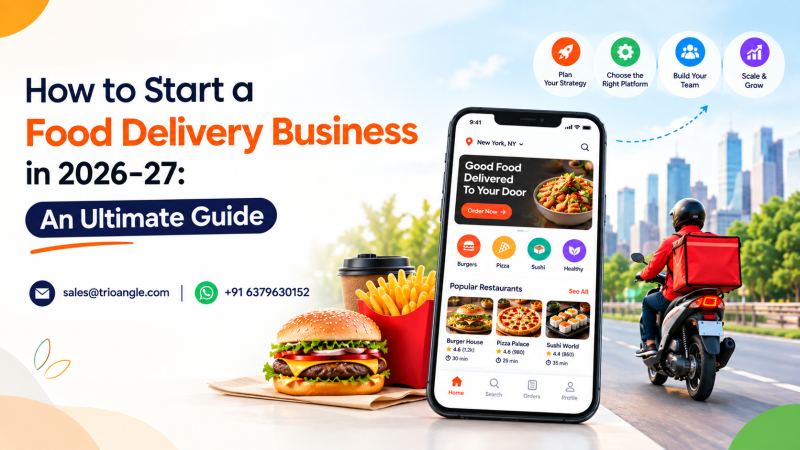
How to Start a Food Delivery Business in 2026-27: An Ultimate Guide
 Zara Noah
The food delivery industry continues to grow rapidly, creating exciting opportunities for entrepreneurs in 2026-27.
Hence, starting a thriving food delivery business is much more challenging than just delivering food to customers. It involves choosing an appropriate business model and technology, identifying revenue sources, performing delivery operations, and preparing a plan for the customer experience.
So, this ultimate guide explains how to start a food delivery business seamlessly and ensure its growth.
What is the Growing Prospect of the Food Delivery Business in 2026-27?
Food delivery is growing quickly in recent times; this is because people want convenient and easy meals. Restaurants are also joining delivery platforms to reach more customers. Based on reports from a business research company, the online food delivery market is projected to grow rapidly, reaching $314.84 billion by 2030, with a 12.2% CAGR.
Hence, with good service, affordable prices, and quick delivery, businesses can attract loyal customers.
Steps to Launch a Food Delivery Business: Detailed Process
Let’s dive deep into the process involved in building a food delivery business.
Assess the Business Model
Start by selecting a suitable food delivery model. Common business models include restaurant-owned food delivery, multi-restaurant delivery platform, delivery service for restaurants, specialized food delivery services, or grocery delivery service.
A food marketplace consists of three primary elements: clients who place food orders, restaurants or food companies that fulfill orders, and delivery workers who deliver the food. Every element has its own expenses, challenges, and risks.
The chosen business model should answer the following questions effectively.
- Who will accept the order?
- Who will deliver it?
- Who will handle customer support?
- Will customers order through a website, mobile app, telephone, or messaging service?
- What problem will your business solve better than existing services?
Start with a clear model. Trying to serve every type of customer and restaurant from the beginning can increase costs and create operational problems.
Research Local Market
Before spending money on different software, branding, and vehicles, it is important to examine local demand.
Research existing food businesses and delivery services deeply. Look at their menus, delivery areas, ordering methods, popular food categories, and customer reviews.
Use surveys, Internet research, questionnaires, discussions with customer owners, and many other techniques to do the market research. Intensive research is required to analyze real customer needs rather than replicating just another service in the market.
Define Target Customer
A target customer is the main group a business wants to serve.
Knowing the target customer helps in choosing restaurants to work with, planning the menu, setting delivery hours, and deciding where to advertise. Possible customer groups include:
- Office workers
- Customers seeking specific cuisines
- Customers located in areas with fewer delivery options
- Students looking for affordable meals.
- Residents of apartment communities
- People looking for dietary-specific meals.
Evaluate important customer characteristics, including location, age demographic, food preferences, average spending, and common delivery problems.
However, initially target the first customer group within a three-kilometer area, rather than targeting all at once.
Revenue Generation Options
A food delivery business may use one or more revenue sources. Each option affects customers, restaurants, and delivery workers differently.
- Restaurant commission
- Featured Listings
- Catering or business contracts
- Service fees
- Subscription charges
Revenue planning should include a calculation of revenue per order and the cost of fulfilling each order.
The important point is to understand the economics of each order rather than focusing only on total sales.
Estimate the costs
Prepare a basic financial plan before launching the platform. This detailed cost estimate helps establish realistic financial requirements. The possible costs to launch a food delivery platform include,
- Website and Mobile development
- Hosting
- Insurances
- Legal services
- Staff requirements and training
- Restaurant onboarding
- Customer support
- Delivery operations
- Accounting and tax services
- Payment processing
The cost aspects vary greatly depending on the location and business model opted for. So, it is key to create three budgets: emergency budgets, expected/Planned budgets, and minimum budgets.
- Planned Budgets: A proper and realistic estimate
- Minimum Budgets: The least expensive version that can operate safely.
- Emergency budgets: Money reserved for delays, refunds, or slow sales
Plan accordingly and keep enough working capital to operate for several months.
6. Set up Legal Structure
Select a legal structure that suits your country and expected size. Food businesses have responsibilities that ordinary online businesses may not have. Requirements vary depending on the country, state, city, and type of operation.
Based on the business model and location, check the following,
- Business registration.
- Local licences and permits.
- Packaging and labeling requirements
- Data protection and privacy requirements
- Commercial vehicle insurance
- Insurance and liability
- Consumer refund and cancellation rules
Professional legal and accounting advice can help identify applicable requirements before launch.
7. Build the technology
Technology should support the delivery process rather than create complexity.
A basic food delivery system should cover
- Customer registration
- Menu listings
- Restaurant profiles
- Order status
- Order confirmation
- Delivery tracking
- Online or cash payment options, where legally permitted.
- Delivery address collection
- Refund and cancellation handling
- Basic reporting, in case of different experiences
Build only features needed to test the business. A small initial system can contain only essential features. Additional features can follow after customer feedback and operational testing.
8. Test the Business with a small launch
Begin with a limited pilot instead of opening across an entire city. A test launch can involve one neighborhood, a limited delivery area, a specific customer group, and a controlled number of delivery orders.
A small launch can reveal operational problems before expansion.
9. Measure the results and improve gradually
Track performance from the first day. Consider useful metrics like total orders, delivery time, cancellation rate, refund rate, revenue, operating costs, retention of restaurants, and other key metrics.
In most cases, order volume alone does not indicate business performance. High order volume combined with high delivery and operating costs can still result in financial loss.
A couple of formulas to check out these metrics are,
- Customer acquisition cost (CAC)= Total Sales and Marketing Cost / Number of New Customers Acquired
- Repeat-order rate = Number of customers who place another order / Total no. of customers
Regular measurement can help identify areas requiring improvements.
Impact of AI in Food Delivery Business
AI has a deep impact on the food industry. With the help of AI functionalities, business owners can uplift their services seamlessly.
Better Food Recommendations
AI helps food delivery services to find out the customer preferences and suggest them accordingly. It simply analyzes the customer’s previous orders, their favorite cuisine, location, and their browsing history.
Superior Customer Service
AI can help answer common customer questions and suggest similar dishes they might like. This makes ordering faster and keeps customers coming back to the app.
Faster Delivery
The best part of AI is that it can study traffic, distance, location of delivery workers. A recent survey also demonstrates that AI-based systems can enhance order matching and route planning for a smooth user experience.
Final Thoughts
Establishing a food delivery business like UberEats Clone Script in 2026-2027 can be an excellent opportunity for those entrepreneurs who have a good understanding of their local marketplace and are devoted to providing high-quality food, reliable services, and competent customer service.
With sufficient planning, you can turn an idea for a food delivery business into a functioning version and take your first steps in the chosen industry.
Source:
Click for the: Full Story
You might like