Close Menu
 World
World
 Biography
 Health
 Education
 Business
 Lifestyle
 Sports
 Technology
 Animals
 History
 Food
Food
 Religious
 Startups
 Movies
 Politics
 Fashion
 Covid
Covid
 Diet
Diet
 Fitness
 Marketing
 Travel
 Science
 Reviews
 Social media
 Stories
 Facts
Facts
 Art
Art
 Entertainment
Ailoitte Technologies

Technology
How to Validate Your Startup Idea and Launch an MVP Quickly
 Ailoitte Technologies
Most startups don't fail because of bad execution they fail because they build something nobody wants. In fact, according to CB Insights, 35% of startups cite "no market need" as their top reason for shutting down. The fix? Validate before you build, then launch an MVP quickly to test real demand.
Whether you're a first-time founder or a seasoned entrepreneur spinning up a new venture, knowing how to validate your startup idea and get an MVP in front of users fast is the single most important skill you can develop. This guide breaks it down into clear, practical steps you can start using today.
What Is MVP Development and Why Does It Matter?
A Minimum Viable Product (MVP) is the simplest version of your product that delivers enough value to attract early users and generate real feedback. The term was popularized by Eric Ries in The Lean Startup and has since become a cornerstone of modern product development.
The idea is straightforward: instead of spending 12–18 months building a fully featured product, you ship a lean version in weeks, learn what your users actually need, and iterate. Companies like Dropbox, Airbnb, and Buffer all started with stripped-down MVPs before growing into billion-dollar products.
Why does it matter? Because time and money are finite. The faster you validate, the less you risk.
How Does the MVP Validation Process Work?
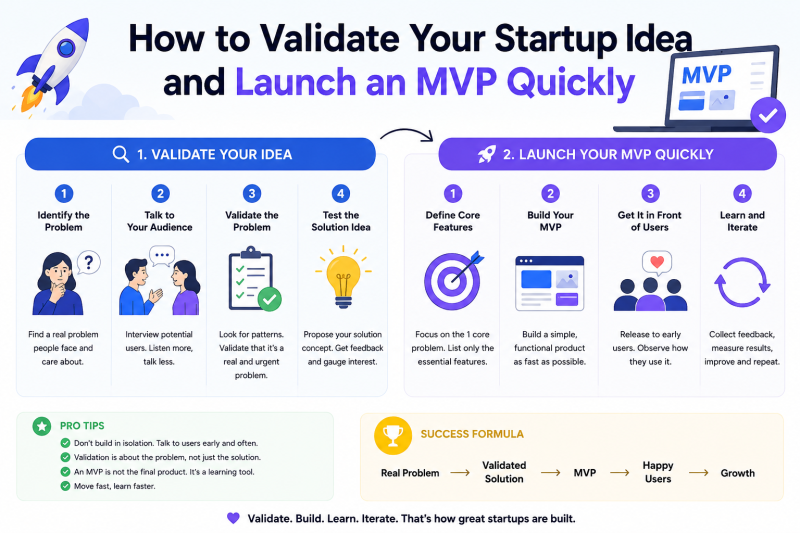
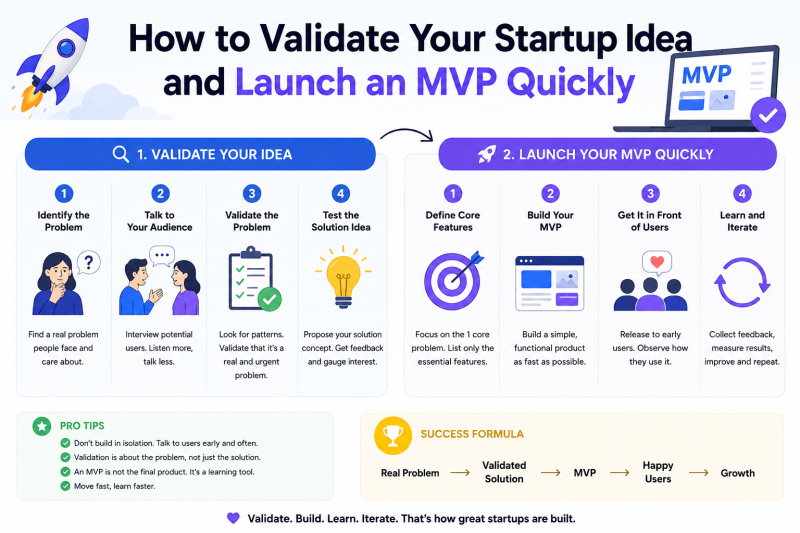
Validating a startup idea and launching an MVP isn't guesswork it follows a repeatable process:
Step 1: Define the core problem Start with the problem, not the solution. Who has this problem? How often do they experience it? How are they solving it today? Talk to at least 15–20 potential customers before writing a single line of code. Use structured interviews, not surveys.
Step 2: Identify your riskiest assumptions Every startup idea rests on assumptions. Maybe you assume people will pay for your solution, or that they'll switch from a current tool. List your top three assumptions and design experiments to test them.
Step 3: Build the smallest possible version Strip your product down to its single core value proposition. Ignore the nice-to-haves. A landing page with a waitlist, a concierge MVP where you manually deliver the service, or a no-code prototype any of these can validate demand before heavy development begins.
Step 4: Get it in front of real users Launch to a small group of target users. Set clear success metrics upfront sign-up rate, activation rate, willingness to pay. Don't measure vanity metrics.
Step 5: Learn and iterate Collect feedback systematically. Use tools like Hotjar, Mixpanel, or simple user interviews. Then decide: pivot, persevere, or kill.
What Are the Benefits of Launching an MVP Quickly?
Speed isn't just a competitive advantage it's a survival mechanism for startups.
- Reduced financial risk. Building a full product without validation can cost $100K–$500K or more. An MVP lets you test for a fraction of that.
- Faster market feedback. Real users reveal truths no focus group ever will.
- Investor appeal. Traction, even small traction, is far more convincing to investors than a slide deck.
- Team alignment. A working prototype focuses your team around a shared, tangible goal.
Many founders aim to build an MVP in 4 weeks and it's entirely achievable when you ruthlessly prioritize scope and work with experienced developers who understand lean product development.
Is a 4-Week MVP Timeline Worth It for Startups?
Absolutely if you plan it right. The goal of a 4-Week MVP isn't perfection; it's speed-to-learning. Here's what a realistic 4-week sprint looks like:
- Week 1: Finalize requirements, user stories, and tech stack. Design wireframes and get sign-off.
- Week 2: Core feature development begins. Build the one thing that proves your value proposition.
- Week 3: Integration, basic testing, and bug fixes. Onboard 3–5 beta users for early feedback.
- Week 4: Final QA, soft launch, and metrics tracking setup.
Teams that launch MVPs in 4 weeks typically use no-code tools (like Webflow, Bubble, or Glide) for front-end speed, or partner with agile development teams that specialize in rapid delivery. The key is having a clearly defined scope going in scope creep is the biggest killer of fast launches.
What Should You Look for When Choosing an MVP Development Partner?
If you're not technical, choosing the right development partner is critical. Look for:
- Proven track record of shipping products in compressed timelines
- Experience with your industry or similar product types
- Transparent communication and daily or weekly progress check-ins
- Fixed-scope MVP packages avoid open-ended engagements early on
- Post-launch support for iteration based on user feedback
Ask to see past MVPs they've shipped. Ask how they handle scope changes. Ask what their handoff process looks like. A partner offering a 4-Week MVP Guarantee should be able to show you exactly how they've delivered that for previous clients.
Common Mistakes to Avoid When Building an MVP
Even experienced founders fall into these traps:
1. Building too much. The "M" in MVP stands for minimum. If you're debating a feature, cut it.
2. Skipping customer discovery. Talking to users before building is not optional. It's the whole point.
3. Waiting for perfect. "Done" beats "perfect" at the MVP stage. Ship and learn.
4. Measuring the wrong things. Vanity metrics like page views mean nothing. Track retention, activation, and revenue signals.
5. Building for imaginary users. Your MVP should solve a real problem for a specific, identifiable group not "everyone."
Frequently Asked Questions About Validating Startup Ideas and Launching MVPs
Q1: How long does it really take to build an MVP? It depends on complexity, but most well-scoped MVPs can be built in 4–8 weeks. With the right team and clear requirements, launching an MVP in 4 weeks is realistic for most SaaS, marketplace, or mobile app ideas.
Q2: Do I need to know how to code to launch an MVP? No. No-code and low-code tools like Bubble, Webflow, and Glide have made it possible for non-technical founders to launch MVPs without writing code. Alternatively, partnering with a development agency that offers a build an MVP in 4 weeks service is a common path.
Q3: How much does an MVP cost to build? Costs vary widely from a few thousand dollars using no-code tools to $20,000–$50,000+ for a custom-built product. The key is defining scope tightly before you start to avoid budget overruns.
Q4: What's the difference between an MVP and a prototype? A prototype is a non-functional model used to visualize design. An MVP is a functional product with real users. Prototypes test design assumptions; MVPs test market assumptions.
Q5: How do I know if my MVP is successful? Define success metrics before you launch. Common signals include: users completing the core action (activation), returning to use the product (retention), and willingness to pay or refer others (monetization potential).
Conclusion
Validating your startup idea and shipping an MVP quickly isn't about cutting corners it's about being smart with the resources you have. The founders who succeed are rarely those with the biggest budgets; they're the ones who learn fastest.
Start with customer conversations, trim your scope ruthlessly, and get something real in front of users as soon as possible. The feedback you collect in the first four weeks of a live product will be worth more than months of internal planning.
If you're looking for a development partner to help you go from idea to launch fast, Ailoitte offers a structured 4-Week MVP Guarantee built for startups, combining lean methodology with experienced engineering to help you ship, learn, and grow without wasting time or capital.
Source:
Click for the: Full Story
You might like