



 Close Menu
 World
World
 Biography
 Health
 Education
 Business
 Lifestyle
 Sports
 Technology
 Animals
 History
 Food
Food
 Religious
 Startups
 Movies
 Politics
 Fashion
 Covid
Covid
 Diet
Diet
 Fitness
 Marketing
 Travel
 Science
 Reviews
 Social media
 Stories
 Facts
Facts
 Art
Art
 Entertainment
samiksha

Business
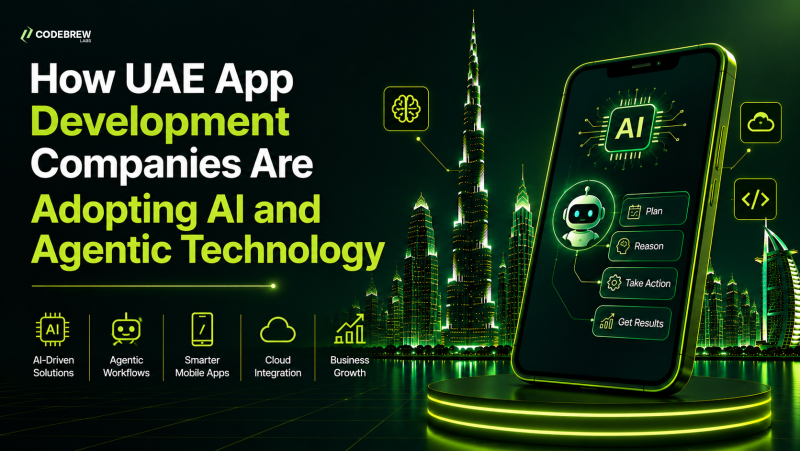
How UAE App Development Companies Are Adopting AI and Agentic Technology?
 samiksha
Artificial intelligence is rapidly changing the way businesses build, operate, and improve digital products. In the UAE, where organizations across industries are accelerating digital transformation, AI is becoming an increasingly important part of modern app development.
Mobile applications are no longer limited to predefined menus, forms, and basic workflows. Businesses are exploring generative AI, intelligent automation, predictive analytics, conversational interfaces, computer vision, and agentic technology to create applications that can understand users, automate tasks, and deliver more personalized experiences.
For UAE businesses, this shift creates an opportunity to build applications that do more than provide digital access. Intelligent applications can become powerful platforms for customer engagement, operational efficiency, and business growth.
The Shift From Traditional Apps to Intelligent Applications
Traditional mobile applications generally operate according to predefined rules. A user selects an option, enters information, and receives a predetermined result.
AI-powered applications introduce a more flexible interaction model.
Instead of forcing users to navigate multiple screens, an intelligent application can understand natural-language requests, analyze information, identify patterns, and provide context-aware responses.
For example, an e-commerce application can recommend products based on customer behavior, while a healthcare platform can use AI to help users navigate appointments and services.
This does not mean every application needs advanced AI. The technology should be introduced where it can solve a genuine customer or business problem.
Generative AI Is Becoming Part of App Experiences
Generative AI has become one of the most influential technologies in modern software development.
Businesses can integrate generative AI into applications for:
- Intelligent customer support
- Content generation
- Smart search
- Document summarization
- Personalized recommendations
- Natural-language interfaces
- Data analysis
- Automated responses
An application could allow users to ask questions naturally instead of navigating complicated menus.
For internal business applications, generative AI can also help employees find information, summarize reports, create content, and interact with company data more efficiently.
The real opportunity lies in connecting generative AI with useful business processes rather than treating it as an isolated feature.
Agentic Technology Is Changing the Role of Apps
Agentic AI is taking intelligent applications a step further.
Traditional AI assistants primarily respond to user requests. Agentic systems are designed to understand goals and potentially perform a sequence of actions to achieve them.
For example, instead of simply answering a question about a meeting, an AI-powered application could potentially identify available schedules, suggest an appropriate time, prepare relevant information, and initiate the required workflow.
Similarly, an enterprise application could help employees gather information, analyze data, prepare reports, and complete repetitive operational tasks.
This shift could transform applications from passive tools into active digital assistants.
Why Agentic AI Matters for UAE Businesses
The UAE has a highly competitive and digitally connected business environment. Organizations are looking for ways to improve customer service while maintaining operational efficiency.
Agentic technology can support these objectives by automating repetitive workflows and reducing the number of manual steps users need to complete.
Potential applications include:
- Automated customer service
- Appointment scheduling
- Travel planning
- Property recommendations
- Order management
- Business reporting
- Lead qualification
- Employee assistance
- Workflow automation
However, businesses need to determine where autonomy is appropriate.
Not every task should be completely automated. Sensitive processes may still require human approval, especially when financial, legal, healthcare, or other high-impact decisions are involved.
AI-Powered Personalization
Personalization is another major area where AI is influencing app development.
Applications can analyze user behavior, preferences, interactions, and other relevant data to create more customized experiences.
For example, a retail application can recommend products based on previous activity. A content platform can personalize what users see, while a financial application can provide relevant insights based on spending patterns.
The objective should be to make the application more useful without becoming intrusive.
Businesses must also ensure that personalization follows appropriate privacy and data-management practices.
Arabic and Multilingual AI Experiences
For applications targeting UAE and GCC audiences, language is an important consideration.
Arabic-first experiences can help businesses create more accessible and locally relevant applications.
AI can support Arabic natural-language processing, intelligent search, conversational interfaces, voice commands, translation, and content generation.
Rather than simply translating an existing English interface, businesses can design Arabic experiences from the beginning.
This can include right-to-left layouts, localized terminology, culturally relevant content, and voice interactions designed for Arabic-speaking users.
AI and Customer Support
Customer support is one of the most practical areas for AI integration.
Businesses can embed AI assistants directly into their applications to answer common questions, explain services, guide users, and provide support throughout the customer journey.
AI can handle repetitive questions while more complex issues are transferred to human representatives.
This hybrid approach can help businesses improve response times without removing human involvement where it matters.
For UAE businesses serving customers across different languages and time zones, intelligent support can also provide greater availability.
AI, Data, and Application Integration
AI-powered applications depend heavily on data.
To provide useful responses and recommendations, AI systems often need access to reliable business information.
This may require integration with:
- CRM platforms
- ERP systems
- Payment gateways
- Cloud databases
- Inventory systems
- Customer-support platforms
- IoT devices
- Third-party APIs
Strong backend architecture and secure APIs therefore play a critical role in AI app development.
Poor-quality or disconnected data can limit the effectiveness of even the most advanced AI system.
Security and Responsible AI
AI adoption also creates new security and governance considerations.
Applications may process sensitive customer information, business records, financial data, or proprietary content. Developers must therefore consider authentication, authorization, encryption, API security, access controls, monitoring, and data governance.
Businesses should also establish clear rules for how AI is used.
AI-generated information should be evaluated for accuracy, particularly in applications where incorrect information could have significant consequences.
Human oversight can remain an important part of the architecture, especially for high-impact workflows.
How UAE App Development Companies Are Adapting
App development companies are increasingly expanding their capabilities beyond traditional mobile development.
Modern development teams may work across mobile platforms, cloud infrastructure, AI models, APIs, data systems, automation frameworks, and emerging technologies.
This means businesses need development partners who understand the entire technology ecosystem rather than focusing only on front-end application development.
Code Brew Labs combines expertise across mobile app development, AI, IoT, blockchain, and other emerging technologies to help businesses create digital products that align technology choices with practical business requirements.
How Businesses Can Start With AI
Businesses do not need to transform their entire application at once.
A phased approach can be more effective.
Step 1: Identify a Business Problem
Start by identifying a specific customer or operational challenge.
Step 2: Evaluate AI Opportunities
Determine whether AI can solve the problem more efficiently than traditional technology.
Step 3: Define the Required Data
Identify what information the AI system needs and whether reliable data is available.
Step 4: Build a Focused MVP
Start with a limited use case that can be tested with real users.
Step 5: Measure Results
Track metrics such as engagement, conversion, response time, operational efficiency, and customer satisfaction.
Step 6: Scale Gradually
Once an AI feature demonstrates measurable value, expand it into additional workflows.
This approach can reduce unnecessary investment while allowing businesses to validate the technology before scaling.
The Future of AI-Powered App Development in the UAE
The next generation of applications will likely become increasingly intelligent and proactive.
AI assistants will become more capable, agentic workflows will automate more complex tasks, and applications will become better at understanding natural-language interactions.
At the same time, businesses will need to maintain strong security, privacy, transparency, and human oversight.
The competitive advantage will not come simply from having AI inside an application. It will come from using AI in ways that genuinely improve the customer experience or business operation.
Conclusion
UAE app development is entering a new phase where artificial intelligence and agentic technology are becoming important components of digital product strategy.
Generative AI can make applications more conversational and useful, while agentic technology can help automate multi-step workflows. Personalization, Arabic-first experiences, intelligent customer support, and connected data systems can further improve the value of modern applications.
For businesses, the priority should be to adopt AI strategically rather than following every emerging trend. Working with an experienced technology partner such as Code Brew Labs can help businesses identify practical AI opportunities and develop secure, scalable applications aligned with their specific goals.
The most successful applications will combine intelligent technology, intuitive UX, strong security, reliable data, and measurable business value.
As the UAE continues to strengthen its position as a global technology and innovation hub, businesses that build thoughtful AI-powered applications today can establish stronger digital foundations for the future.
Source:
Click for the: Full Story
You might like









You Might Like this