


 Close Menu
 World
 Biography
 Health
 Education
 Business
 Lifestyle
 Sports
 Technology
 Animals
 History
 Food
 Religious
 Startups
 Movies
 Politics
 Fashion
 Covid
 Diet
 Fitness
 Marketing
 Travel
 Science
 Reviews
 Social media
 Stories
 Facts
 Art
 Entertainment
Antonio Mendes

Technology
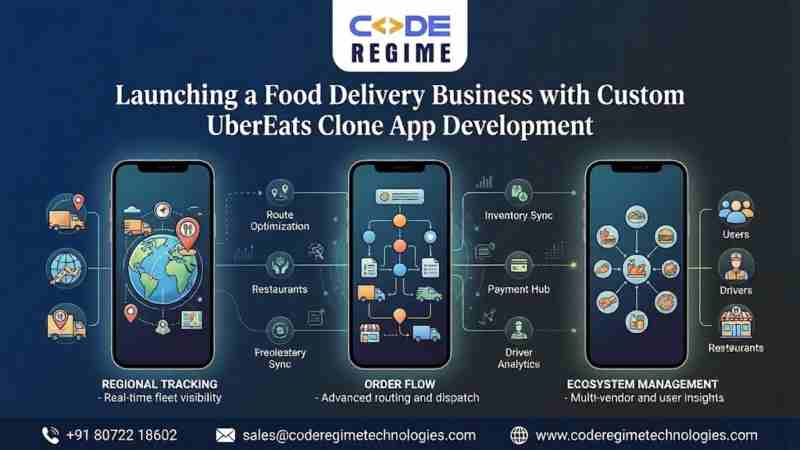
Launching a Food Delivery Business with Custom UberEats Clone App Development
 Antonio Mendes
Introduction
The food delivery industry has created new opportunities for entrepreneurs and businesses looking to connect restaurants with customers through digital platforms. With more people choosing to order meals online, launching a food delivery business can be a practical way to enter the growing online food market. However, building a successful platform requires more than simply allowing customers to order food. Businesses also need an efficient way to manage restaurants, delivery partners, orders, payments, and customer support.
Custom UberEats Clone App Development provides a starting point for building a food delivery application with features designed around a business's specific requirements. Instead of developing every function from scratch, entrepreneurs can use a clone app solution as a foundation and customize its design, features, and workflows to suit their business model.
A well-planned food delivery app can make ordering easier for customers, help restaurants manage incoming orders, and support delivery partners throughout the delivery process. With the right development approach, businesses can establish an online food delivery platform that meets local market needs and supports future expansion.
What Is an UberEats Clone App?
An UberEats Clone App is a food delivery application developed using the general concept and functionality of platforms such as Uber Eats. It allows businesses to create their own online food ordering and delivery service with features for customers, restaurants, delivery partners, and administrators.
A typical solution includes separate interfaces for each user group. Customers can browse restaurants, explore menus, place orders, and make payments. Restaurant partners can manage menus and incoming orders, while delivery partners can view assigned deliveries and update their progress. Administrators can monitor platform activities, manage users, and oversee order operations.
Customizing the application allows businesses to choose features according to their target audience, service area, and operating model. The solution can support a single restaurant, a local food delivery service, or a multi-restaurant marketplace.
The goal is to create a convenient ordering experience while giving business owners the tools needed to manage daily operations effectively.
1. Start Your Food Delivery Business with a Ready Foundation
Developing a food delivery platform involves several components, including customer applications, restaurant management tools, delivery interfaces, payment integration, and an administrative panel. Building every component separately can require considerable time and planning.
An UberEats clone app provides a foundation that businesses can adapt to their requirements. Entrepreneurs can select the essential functions for their initial launch and introduce additional features as the business grows.
For example, a startup serving a particular city may begin with restaurant listings, digital menus, order placement, online payments, and delivery tracking. After establishing its customer base, the business can consider adding subscriptions, loyalty programs, promotional campaigns, or additional delivery options.
This approach helps businesses plan their launch around their immediate needs without losing sight of future development.
2. Provide a Smooth Food Ordering Experience
A simple ordering process is important for attracting customers and encouraging repeat orders. If users find it difficult to browse menus, compare restaurants, or complete payments, they may abandon their orders.
A custom Food Delivery App can include restaurant categories, food images, search filters, menu descriptions, pricing, customer reviews, and a shopping cart. Customers can select their preferred dishes, add special instructions, choose a delivery address, and confirm their orders through a straightforward interface.
The application can also provide order summaries and status updates so customers know what happens after placing an order.
By focusing on clear navigation and convenient ordering, businesses can make the platform easier to use and provide customers with a more satisfying experience.
3. Help Restaurants Manage Orders Efficiently
Restaurants are an essential part of any food delivery business. They need a convenient way to receive orders, update menus, manage availability, and communicate order progress.
A restaurant management panel can allow partners to accept or reject incoming orders, update preparation times, mark items as unavailable, and manage menu information. These features can help restaurants organize their delivery operations without relying entirely on phone calls or manual order records.
For example, if a restaurant runs out of a popular dish, its staff can update the menu availability so customers are less likely to order an unavailable item.
A well-organized restaurant interface can simplify daily tasks and help food businesses manage online orders alongside their regular operations.
4. Improve Delivery Management and Order Tracking
Timely delivery is an important part of the customer experience. Businesses need a reliable way to coordinate restaurant preparation, delivery assignments, and order progress.
An UberEats clone app can include delivery partner profiles, order assignment, pickup details, delivery addresses, and status updates. Depending on the selected features, GPS-based location tracking and route information can also be integrated.
Customers may be able to view delivery progress, while administrators can monitor active orders and identify delays that require attention.
These functions help businesses coordinate the delivery process more clearly. Actual delivery performance will still depend on factors such as traffic, restaurant preparation times, delivery partner availability, and the accuracy of order information.
5. Integrate Secure Payment Options
A convenient payment process can make it easier for customers to complete their food orders. Businesses may need to support different payment methods depending on their target market.
A custom food delivery platform can integrate suitable payment gateways to support options such as debit cards, credit cards, digital wallets, and other locally available payment methods. Cash on delivery may also be included where appropriate for the business model.
The application can provide order totals, delivery charges, discounts, payment status, and transaction details before and after checkout.
Businesses should select payment providers based on their supported regions, transaction fees, settlement processes, and security requirements. Proper payment integration and transaction verification can help create a more reliable checkout experience.
6. Customize Features for Your Business Model
Every food delivery business has different goals. Some entrepreneurs want to serve independent restaurants in a local area, while others may focus on a particular cuisine, a restaurant chain, or meal subscriptions.
Custom UberEats clone app development allows businesses to choose features that support their intended service.
For example, a local delivery platform may prioritize nearby restaurant discovery and delivery scheduling. A healthy meal delivery service may need dietary filters, subscription plans, and recurring orders. A multi-restaurant marketplace may require restaurant commissions, promotional tools, and partner management.
The design, branding, pricing structure, and operational workflows can also be customized. This gives businesses greater control over how the platform serves customers and generates revenue.
7. Support Business Growth and Scalability
A food delivery business may start in a small service area and expand to additional neighborhoods or cities as demand increases. Its technology should be planned to accommodate changing operational requirements.
A scalable application can be extended with new restaurant partners, additional delivery zones, multiple languages, promotional features, and more advanced reporting tools. Businesses can also introduce additional integrations as their operations become more complex.
For instance, an entrepreneur may initially manage a limited number of restaurant partners. As the platform grows, the business may need improved restaurant onboarding, delivery assignment, customer support, and administrative reporting.
Planning for expansion during development can make future improvements more manageable and help the platform adapt to new business opportunities.
8. Use Promotions to Attract and Retain Customers
Attracting customers is only one part of building a food delivery business. Encouraging them to return is equally important for developing a stable customer base.
A custom food delivery application can include discount coupons, referral programs, loyalty points, special offers, and promotional banners. Businesses can use these features to introduce new restaurants, promote selected menu items, or reward repeat customers.
For example, a new platform may offer a first-order discount to encourage customers to try its service. Later, loyalty rewards or personalized offers can provide customers with reasons to order again.
Promotional strategies should be planned around customer preferences and business costs. The aim is to create genuine value while maintaining a sustainable operating model.
9. Manage Business Operations Through an Admin Panel
Running a food delivery platform involves coordinating multiple activities. Business owners need to manage customers, restaurants, delivery partners, orders, payments, promotions, and customer complaints.
An administrative dashboard can bring these activities together in one place. Depending on the application, administrators can manage user accounts, review orders, monitor platform activity, update commissions, configure service areas, and generate business reports.
Reporting features can help owners understand order volumes, popular restaurants, customer activity, and other useful performance indicators.
Having access to this information can support better operational planning and help business owners identify areas that need attention as the platform develops.
10. Why Choose Custom Development for Your Food Delivery App?
A ready-made application may provide basic functionality, but a growing business may require features that match its particular operating model. Custom development makes it possible to adjust the platform's functionality, integrations, user experience, and administrative workflows.
Businesses can prioritize the features that matter most to their customers and partners rather than including unnecessary functions. They can also plan integrations with suitable payment providers, mapping services, notification systems, and business management tools.
Working with an experienced development team can help businesses define their requirements, plan the application structure, test important workflows, and prepare for deployment.
The development process should also consider ongoing maintenance, user feedback, performance monitoring, and future updates to keep the platform aligned with business needs.
Conclusion
Launching a food delivery business with Custom UberEats Clone App Development can provide entrepreneurs with a practical foundation for entering the online food ordering market. From customer-friendly ordering and restaurant management to delivery tracking, payment integration, promotions, and administrative controls, the right application can support the different activities involved in running a food delivery platform.
However, the success of the business depends on more than the application itself. Restaurant partnerships, delivery operations, customer service, pricing, and local market demand also play important roles. Businesses should therefore select features that solve real operational challenges and create value for customers and restaurant partners.
Code Regime Technologies helps businesses plan and develop custom food delivery applications based on their specific goals and requirements. Whether you are launching a local food delivery startup, building a multi-restaurant marketplace, or expanding an existing restaurant business, the development process can be tailored to your preferred business model. With suitable features, thoughtful customization, and a plan for future growth, your food delivery platform can provide a convenient ordering experience and establish a strong foundation for your digital business.
Source:
Click for the: Full Story
You might like




You Might Like this