Close Menu
 World
World
 Biography
 Health
 Education
 Business
 Lifestyle
 Sports
 Technology
 Animals
 History
 Food
Food
 Religious
 Startups
 Movies
 Politics
 Fashion
 Covid
Covid
 Diet
Diet
 Fitness
 Marketing
 Travel
 Science
 Reviews
 Social media
 Stories
 Facts
Facts
 Art
Art
 Entertainment
Deliverable Services

Technology
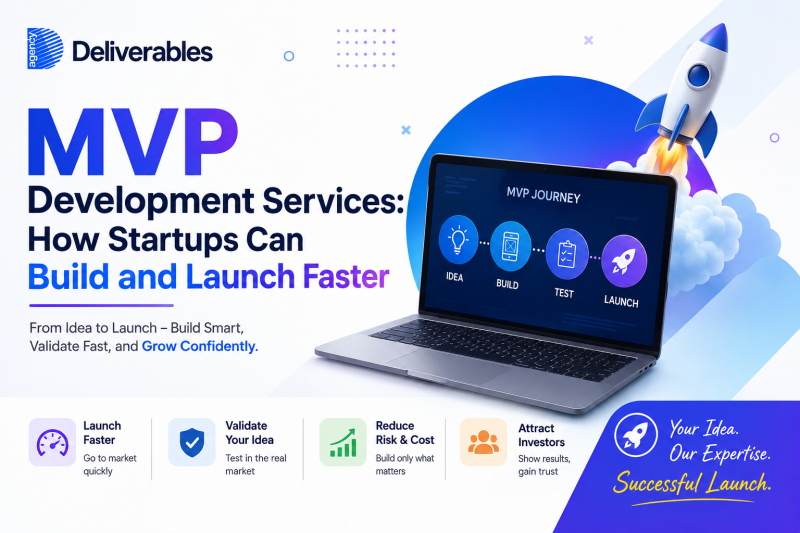
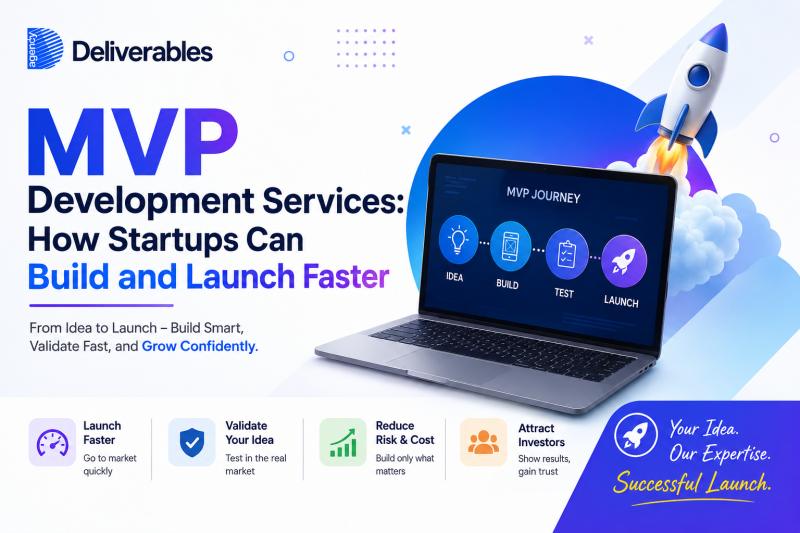
MVP Development Services: How Startups Can Build and Launch Faster
 Deliverable Services
A startup idea can look perfect during the planning stage. The real challenge starts when it is time to turn that idea into a product. Many founders want to build a complete application with every feature they can imagine. The problem is that this approach can take months, require a large budget, and still leave the business unsure about what customers actually want.
This is where MVP development services offer a practical alternative.
A Minimum Viable Product, or MVP, is an early version of a product built around its most important purpose. It gives a startup something real to put in front of users instead of spending a long time developing features that have not been tested.
The goal is simple: build the important part, launch it, learn from customers, and improve it.
What Makes an MVP Different?
An MVP is not simply a smaller version of a finished product. It is a focused version designed to answer an important business question.
For example, suppose an entrepreneur wants to create a platform that connects home-service professionals with customers. The final product might include live tracking, automated recommendations, subscriptions, loyalty rewards, advanced analytics, and several payment options.
The first version may only need customer registration, service listings, booking, payments, and basic notifications.
That is enough to test whether customers are interested and whether service providers are willing to use the platform.
Once there is real feedback, the startup has a clearer idea of where to invest next.
Why Building Smaller Can Be a Better Strategy
Startups often operate with limited resources. Time and money spent on development need to create measurable value.
A focused MVP can help in several ways.
Launch Before the Idea Gets Old
Markets change quickly. A product that takes a year to build may enter a market that looks very different from the one the founder originally researched.
A smaller product can reach users earlier. This gives the business a chance to learn while there is still time to adjust the direction.
Spend Money Where It Matters
Every feature adds development, testing, maintenance, and support work. If a feature does not contribute to the main purpose of the product, adding it too early may not be worthwhile.
MVP development keeps the initial investment focused on the functions that matter most.
Learn From Real Users
Founders can make assumptions about how customers will use a product. Actual users may behave differently.
An MVP creates an opportunity to observe real usage, collect opinions, identify problems, and discover features customers are genuinely interested in.
What Do MVP Development Services Include?
Professional MVP development services can cover the complete journey from an early idea to the first working release.
The exact process depends on the product, but it often includes business analysis, feature planning, UI/UX design, software development, testing, deployment, and post-launch improvements.
The first stage should be about understanding the idea rather than immediately writing code.
The development team needs to know who the users are, what problem the product solves, what makes the solution different, and what the business wants to achieve.
After that, the core features can be identified and arranged according to priority.
MVP Software Development Services for Digital Products
Not every startup needs a mobile application. Some ideas are better suited to web platforms, SaaS products, internal business tools, or online marketplaces.
This is where MVP software development services become useful.
For example, a startup building a SaaS platform for small businesses may initially need account management, a dashboard, basic reporting, and one or two core workflows.
There may be dozens of additional features planned for the future, but they do not necessarily need to be part of the first release.
A well-planned software MVP allows the business to test its core value proposition without creating unnecessary complexity.
MVP App Development Services for Mobile Startups
Mobile products have their own requirements. Screen sizes, navigation, performance, notifications, device compatibility, and app-store guidelines all need attention.
With MVP app development services, a startup can focus on creating the mobile experience around its most important user journey.
For instance, a fitness startup may want to build an application with workout plans, nutrition tracking, community features, AI recommendations, wearable integration, and progress reports.
Instead of developing everything at once, the MVP could begin with workout plans, basic progress tracking, and user profiles.
If users engage with those features, the startup can confidently expand the application.
Choosing an MVP Development Company
The development partner you choose can influence both the quality of the product and the speed of the launch.
A reliable MVP development company should be able to understand the business objective, not just the technical requirements.
Before hiring a company, ask questions such as:
- Have they worked on similar products?
- Can they help prioritize features?
- How do they handle UI/UX design?
- What technology will they recommend?
- How will testing be managed?
- What happens after the MVP is launched?
- Can the product be improved as the user base grows?
A good partner should be comfortable saying that a feature can wait when it does not belong in the first version.
What to Expect From an MVP App Development Company
If your idea is primarily mobile-based, finding an experienced MVP app development company is especially important.
The team should understand mobile-first design and know how to keep the initial application simple without making it feel unfinished.
A good mobile MVP should have clear navigation, useful features, stable performance, and a smooth experience for the target audience.
The development team should also think about future updates. While the first version should remain focused, its foundation should allow the application to evolve.
Building an MVP Without Overengineering
One common mistake is building too much technology too soon.
Startups sometimes invest in complex architecture, advanced automation, numerous integrations, and extensive customization before they have enough users to justify them.
This can slow down development and increase costs.
An experienced MVP software development company can help find the right balance between speed and technical quality.
The product should be reliable and secure, but it does not need every advanced feature from day one.
The best MVP is usually the simplest product that can provide genuine value and generate useful feedback.
From MVP Launch to Product Growth
Launching the MVP is not the end of development. It is the beginning of the learning process.
After launch, the startup can monitor important information such as user registrations, feature usage, retention, conversions, and customer feedback.
This information can help answer practical questions:
Are users returning to the product?
Which features are being used most?
Where do users stop?
What problems are customers reporting?
What feature requests appear repeatedly?
The answers can guide the next development cycle.
Instead of guessing what to build next, the business can use actual evidence.
Common MVP Mistakes Startups Should Avoid
A few mistakes can reduce the value of an MVP.
Trying to satisfy everyone: A product should start with a clearly defined target audience.
Adding too many features: More features do not automatically create more value.
Ignoring design: A basic product can still provide a clean and professional user experience.
Launching without testing: Even a small MVP should be tested before reaching customers.
Ignoring feedback: User feedback should influence future product decisions.
Choosing a development partner only by price: Low initial cost may not mean lower overall cost if the product needs major rework later.
Final Thoughts
The purpose of an MVP is not to build a perfect product on the first attempt. It is to create a useful starting point and learn what should come next.
For startups, MVP development services can make the journey from idea to market more manageable. Instead of spending months building an untested product, businesses can focus on the core problem, launch sooner, gather customer feedback, and make informed improvements.
Whether the project requires MVP software development services or MVP app development services , the same principle applies: start with what matters most and build from there.
With the support of the right MVP development company, MVP app development company, or MVP software development company, startups can create a strong first version without losing sight of the larger product vision.
A successful MVP does not try to prove everything at once. It proves that the core idea is worth building further.
Source:
Click for the: Full Story
You might like