



 Close Menu
 World
World
 Biography
 Health
 Education
 Business
 Lifestyle
 Sports
 Technology
 Animals
 History
 Food
Food
 Religious
 Startups
 Movies
 Politics
 Fashion
 Covid
Covid
 Diet
Diet
 Fitness
 Marketing
 Travel
 Science
 Reviews
 Social media
 Stories
 Facts
Facts
 Art
Art
 Entertainment
Kamlesh Thakur

Business
Offshore Accounting Services: How Businesses Can Build a More Efficient Finance Function
 Kamlesh Thakur
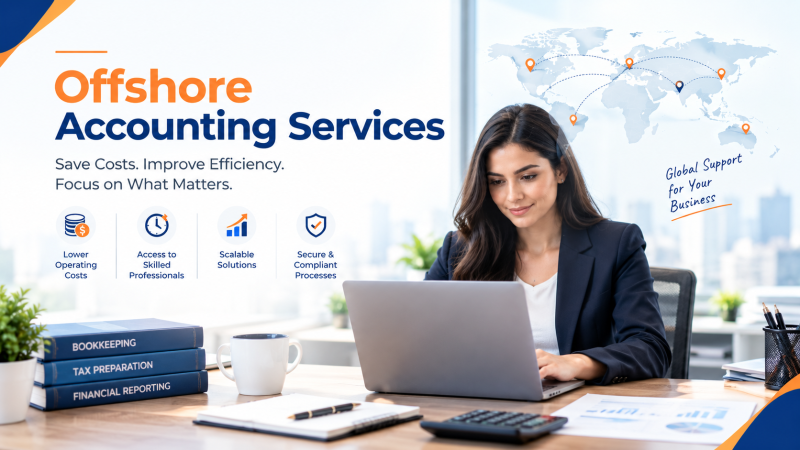
Accounting is one of those parts of a business that has to be done accurately, consistently, and on time. Yet as a company grows, keeping up with every financial task can become difficult. From recording transactions and reconciling accounts to preparing reports and managing invoices, the workload can quickly add up. This is why many US companies are exploring Offshore Accounting Services as a way to get additional support without putting all of the responsibility on their internal finance teams.
Outsourcing accounting does not necessarily mean giving up control over financial operations. In many cases, it simply means dividing responsibilities between an in-house team and an external accounting team. When that arrangement is planned carefully, businesses can create a smoother workflow and make better use of their internal resources.
Understanding the Offshore Accounting Model
Offshore accounting is a form of outsourcing in which accounting work is handled by professionals located outside the company's home country.
The services can vary considerably. A small business might outsource basic bookkeeping, while a larger organization could delegate several processes, such as accounts payable, accounts receivable, reconciliations, payroll support, and financial reporting.
The business still decides how its finances are managed. The external team works according to agreed procedures, deadlines, and reporting requirements.
This model has become easier to manage as cloud accounting platforms, video meetings, secure file-sharing systems, and other digital tools have become part of everyday business operations.
Why Accounting Work Becomes Difficult to Manage
Accounting departments often face a simple problem: the amount of work grows faster than the available time.
A business may start with a few employees and relatively straightforward financial activity. As sales increase, however, the number of invoices, transactions, payments, vendors, and financial records also increases.
At some point, employees may find themselves spending most of their time on routine processing instead of reviewing financial information or helping management make decisions.
This is where external accounting support can make a difference.
1. Creates Additional Accounting Capacity
One of the most straightforward reasons to consider outsourcing is the ability to add capacity.
Instead of asking the existing finance team to absorb every new responsibility, a company can assign selected tasks to an external team.
For instance, routine bookkeeping and account reconciliation can be handled externally while the company's finance manager reviews the results and focuses on higher-level financial activities.
This approach can be useful during periods of rapid growth when hiring and training additional full-time employees may take longer than expected.
2. Makes It Easier to Handle Fluctuating Workloads
Not every business has the same accounting workload throughout the year.
Some periods may be relatively quiet, while others can bring a significant increase in transactions, reporting requirements, or tax-related activity.
Maintaining a large internal team throughout the year may not be practical if the additional workload is temporary.
An outsourced accounting arrangement can provide greater flexibility. Businesses can determine which functions require additional support and adjust the scope of work as their needs change.
That flexibility can be particularly valuable for growing companies that are still figuring out the right size for their permanent finance team.
3. Reduces Time Spent on Repetitive Tasks
Many accounting activities are essential but repetitive.
Entering transactions, matching payments, organizing invoices, reconciling accounts, and maintaining records all require attention, but they may not require the same level of strategic involvement as financial planning or business analysis.
When routine work is delegated, internal employees can spend more time on activities that require judgment.
That might include analyzing cash flow, monitoring business performance, preparing budgets, or discussing financial results with company leadership.
The goal is not to eliminate routine accounting work. It is to make sure the right people are spending their time on the right responsibilities.
4. Gives Businesses Access to Specialized Skills
Another potential advantage is access to a larger pool of accounting professionals.
A business looking only within its local area may have difficulty finding people with experience in specific accounting functions. Working with an offshore provider expands the geographic range from which accounting expertise can be accessed.
This can be helpful when a company needs support with a particular process but does not want to create a permanent position for it.
Of course, businesses should verify the experience and capabilities of any provider before sharing financial information or assigning important responsibilities.
5. Supports Consistent Accounting Processes
Consistency matters in accounting.
When different employees handle the same task in different ways, errors and confusion can become more likely. A clearly documented workflow gives everyone a common process to follow.
An external accounting team can work from established procedures covering tasks such as transaction recording, reconciliations, invoice processing, and reporting.
The internal team can then review completed work according to predefined quality checks.
This kind of structure can make accounting operations easier to monitor, especially when a company has several people involved in its financial processes.
6. Can Help Businesses Use Resources More Efficiently
Every company has limited resources.
Management has to decide where employees should spend their time, where technology should be invested, and which activities can be handled internally or externally.
Outsourcing allows businesses to reconsider how accounting resources are allocated.
Rather than building a large department to perform every function, a company can maintain a smaller core team and use outside support for selected activities.
The best arrangement will vary from business to business. Some organizations may outsource only bookkeeping, while others may use external support across several accounting functions.
7. Provides Support Without Immediate Expansion
Hiring a new employee involves more than finding someone with accounting experience.
There is recruitment, interviewing, onboarding, training, payroll, benefits, equipment, and ongoing management. The process can take considerable time.
Outsourcing can provide access to additional accounting resources without requiring the business to immediately expand its permanent headcount.
This can be useful when a company is growing but wants to be careful about increasing fixed operating expenses.
It also gives management time to determine whether additional internal hiring will eventually be necessary.
8. Can Improve Financial Reporting Workflows
Financial reports are useful only when the underlying information is organized and available on time.
If bookkeeping and reconciliation work falls behind, financial reporting can also become delayed.
An external team can help keep routine accounting activities moving according to an agreed schedule. This can make it easier for internal managers to receive updated financial information when they need it.
Better reporting does not necessarily mean producing more reports. It means having reliable information available for making business decisions.
9. Helps Internal Teams Focus on Business Priorities
Finance teams are increasingly expected to do more than maintain accounting records.
Business leaders often rely on finance professionals for budgeting, forecasting, cash flow planning, performance analysis, and strategic advice.
When the team is buried in routine accounting work, there may be little time left for these responsibilities.
Delegating selected tasks can give internal professionals more room to work with management and contribute to broader business goals.
This can gradually change the role of the accounting department from primarily processing transactions to providing useful financial insight.
Security Should Be Part of the Decision
Financial information should always be handled carefully, regardless of whether accounting work is performed internally or externally.
Businesses considering an offshore provider should ask detailed questions about data protection, user access, file sharing, authentication, backups, confidentiality, and employee security practices.
Access should also be limited to the information required for a particular role.
A strong outsourcing relationship depends on trust, but trust should be supported by documented security procedures and appropriate technology.
Companies should understand how their information will be handled before transferring financial records to an external team.
How to Build a Successful Outsourcing Relationship
Outsourcing works best when expectations are clear from the beginning.
Before starting, a business should identify which accounting tasks will be outsourced, who will be responsible for reviewing the work, what deadlines apply, and how communication will take place.
It can be helpful to start with a limited scope rather than transferring every accounting responsibility immediately.
For example, a company might begin with bookkeeping and reconciliations. Once the workflow is established and both teams are comfortable working together, additional services can be considered.
Regular communication also matters. A short weekly or monthly review can help identify problems before they become larger issues.
What Should Businesses Look for in a Provider?
Price is an important consideration, but it should not be the only factor.
Businesses should look at accounting experience, communication standards, technology, scalability, security practices, quality controls, and the provider's ability to understand the company's requirements.
A provider should also be able to explain its workflow clearly.
If a company cannot understand who handles its accounts, how work is reviewed, or how questions are resolved, it may be difficult to maintain a productive relationship.
The right provider should feel like an extension of the business's finance operation rather than an isolated service that simply processes documents.
Is Offshore Accounting a Good Fit for Every Business?
Not necessarily.
Some businesses have straightforward accounting requirements that can easily be managed internally. Others may have sensitive financial operations that require a highly specialized internal team.
For companies dealing with increasing transaction volumes, staffing challenges, or repetitive accounting workloads, however, outsourcing may be worth considering.
The decision should be based on the company's actual needs rather than following a general trend.
Businesses should compare the costs, risks, workload, and expected benefits before deciding which accounting functions to outsource.
A More Flexible Approach to Accounting
The modern accounting function does not have to be entirely in-house or entirely outsourced.
Many businesses are choosing a combination of both.
Their internal team handles financial oversight, decision-making, client communication, and strategic work, while an external team takes care of selected routine processes.
This hybrid approach can give companies the flexibility to increase support when needed while maintaining internal control over important financial decisions.
For US businesses looking for ways to manage growing accounting workloads, Offshore Accounting Services can be one option worth evaluating. The real value comes from creating a clear division of responsibilities, maintaining strong communication, protecting financial information, and choosing an outsourcing arrangement that fits the company's long-term goals.
Source:
Click for the: Full Story
You might like









You Might Like this