



 Close Menu
 World
World
 Biography
 Health
 Education
 Business
 Lifestyle
 Sports
 Technology
 Animals
 History
 Food
Food
 Religious
 Startups
 Movies
 Politics
 Fashion
 Covid
Covid
 Diet
Diet
 Fitness
 Marketing
 Travel
 Science
 Reviews
 Social media
 Stories
 Facts
Facts
 Art
Art
 Entertainment
Mamta Devi

Business
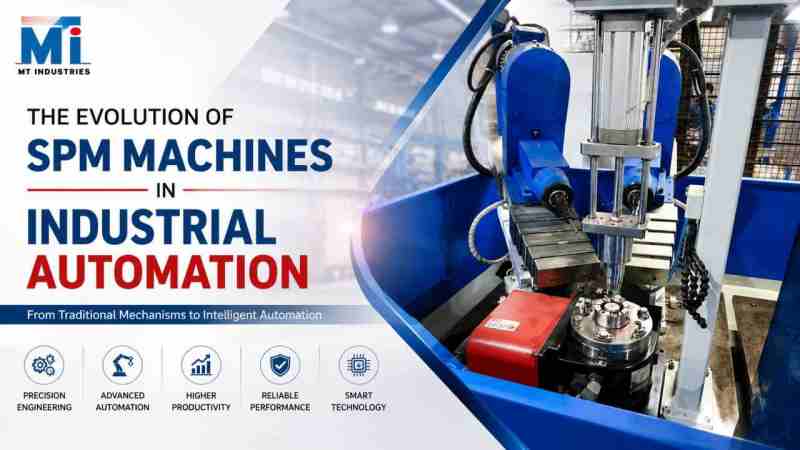
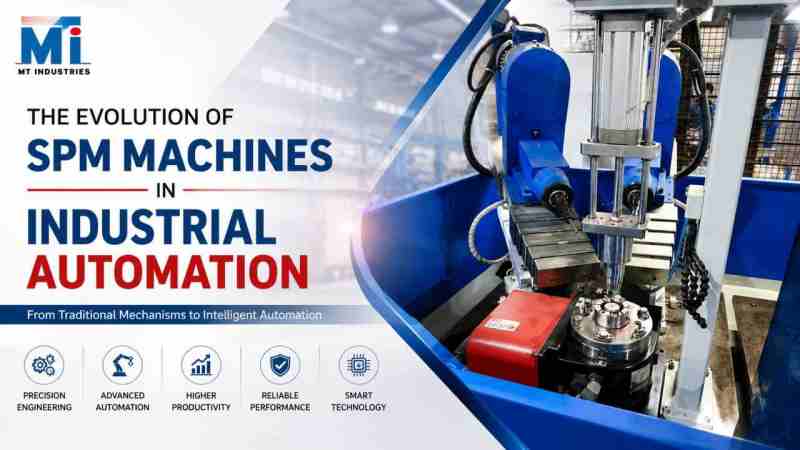
The Evolution of SPM Machines in Industrial Automation
 Mamta Devi
Special Purpose Machines (SPMs) have become an important part of modern manufacturing, particularly where standard equipment cannot deliver the required level of speed, precision, or customization. As industries move toward automated production, SPM machines are evolving from relatively simple dedicated machines into highly integrated systems that combine mechanical engineering, sensors, programmable controls, robotics, and data-driven monitoring.
This transformation has also increased the importance of selecting an experienced SPM Machine Manufacturer capable of understanding specific production requirements rather than simply supplying a standard machine.
For manufacturers, the objective is no longer automation alone. Modern production systems need to deliver consistent quality, shorter cycle times, reduced manual intervention, improved workplace safety, and better control over production data. This is where advanced Industrial Automation Machines are changing the way factories operate.
What Are SPM Machines?
A Special Purpose Machine is a machine designed to perform a specific manufacturing operation or a defined sequence of operations. Unlike general-purpose machines, SPMs are developed around a particular production requirement.
Depending on the application, an SPM can be designed for:
- Assembly and component fitting
- Drilling, tapping, milling, or machining
- Pressing and riveting
- Welding and joining
- Component inspection
- Material handling
- Packaging and other repetitive operations
The major advantage is customization. An SPM can be engineered around the component, production volume, available floor space, required cycle time, and quality standards of a manufacturing process.
How SPM Machines Have Evolved
The early generation of SPMs focused primarily on performing repetitive operations with greater speed and consistency than manual labour. Mechanical fixtures, cams, pneumatic systems, hydraulic systems, and basic control mechanisms were commonly used.
As production requirements became more demanding, manufacturers began incorporating programmable logic controllers (PLCs), servo drives, sensors, and electronic control systems. This made machines more flexible and allowed multiple operations to be coordinated within a single production cycle.
Today, the evolution is moving toward integrated automation.
Modern SPMs may combine:
- PLC-based control systems
- Servo motors and precision drives
- Pneumatic and hydraulic systems
- Vision inspection
- Sensors and monitoring devices
- Robotic loading and unloading
- Human-machine interfaces (HMIs)
- Automated material handling
- Quality-control systems
- Production and machine-status data
The result is a machine that does more than execute a mechanical operation. It can monitor processes, identify abnormalities, communicate with other equipment, and support data-driven production decisions.
Why SPM Machines Matter in Industrial Automation
Manufacturing processes often contain repetitive activities that require high consistency. Performing such operations manually can introduce variations in cycle time and product quality.
Modern Industrial Automation Machines address these challenges by automating repetitive and precision-dependent processes.
The benefits can include:
1. Consistent Production Quality
Automation allows machines to follow predefined operating parameters. When properly designed and maintained, this can reduce process variation and help manufacturers maintain consistent output.
2. Improved Production Speed
An automated machine can perform repetitive tasks at a predictable cycle time. This makes it easier to plan production capacity and identify bottlenecks.
3. Reduced Manual Intervention
SPMs can automate operations such as loading, positioning, assembly, inspection, and unloading. This allows operators to focus more on supervision, quality checks, machine setup, and other higher-value activities.
4. Better Process Control
Sensors, PLCs, and control systems allow manufacturers to monitor important machine conditions. Parameters can be adjusted according to the process requirements, improving repeatability.
5. Improved Workplace Safety
Automation can reduce the need for workers to perform repetitive or potentially hazardous operations directly. However, machine guarding, safety controls, emergency stops, risk assessment, and proper operator training remain essential.
The Role of an SPM Machine Manufacturer
Choosing an SPM Machine Manufacturer is not simply about purchasing equipment. Machine design should begin with an understanding of the manufacturing process.
A competent manufacturer typically evaluates factors such as:
- Component dimensions and tolerances
- Production volume
- Required cycle time
- Number of operations
- Material characteristics
- Loading and unloading requirements
- Available floor space
- Quality inspection requirements
- Existing production-line equipment
- Operator interaction
- Maintenance requirements
- Future production needs
This process is important because an SPM that works well for one application may not be suitable for another.
For example, a high-volume automotive component may require a different combination of fixtures, servo systems, inspection technology, and material handling than a low-volume precision engineering component.
From Standalone Machines to Integrated Automation
One of the most significant changes in SPM technology is the move from standalone equipment toward connected production systems.
Earlier machines were often designed to complete one primary operation. Modern systems can combine several stages into a coordinated production cell.
For example, a production cell may include:
Part feeding → automated positioning → machining/assembly → inspection → rejection of defective parts → unloading
This integration reduces unnecessary material movement between individual processes and can make production flow more efficient.
Companies such as MT Industries work within this broader industrial environment, where machine design increasingly needs to consider how an SPM will interact with the rest of a production line rather than treating it as an isolated piece of equipment.
The Role of Robotics and Vision Systems
Robotics has further expanded what SPMs can accomplish.
A robotic system can handle activities such as component loading, unloading, transfer, orientation, and machine tending. This becomes particularly useful when production volumes are high or when repetitive handling can affect productivity.
Vision systems are another important development. Cameras and image-processing technologies can be integrated into automated systems to check component presence, orientation, dimensions, surface conditions, or assembly results.
When robotics and vision are combined with SPM technology, manufacturers can create more autonomous production cells.
SPM Machines and Industry 4.0
The next stage in the evolution of SPMs is closely connected with Industry 4.0.
Industry 4.0 focuses on connected and data-driven manufacturing. In an advanced automated environment, machines can generate information about:
- Production quantity
- Cycle time
- Machine downtime
- Alarm conditions
- Process parameters
- Maintenance requirements
- Quality results
This information can help production teams identify recurring problems and make more informed maintenance and process-improvement decisions.
For an SPM Machine Manufacturer, this means machine development increasingly involves software, controls, communication systems, and data integration alongside mechanical engineering.
How to Select an SPM for a Modern Production Line
Before investing in an SPM, manufacturers should define the actual production problem they want to solve.
Start With the Process
Map the existing workflow and identify repetitive, slow, inconsistent, or labour-intensive operations.
Define Measurable Requirements
Instead of simply asking for a “high-speed machine,” specify target cycle time, production quantity, accuracy, availability, and quality requirements.
Consider Future Expansion
Production requirements can change. A machine should ideally allow practical upgrades where future automation, additional inspection, or increased capacity may be required.
Evaluate Service and Maintenance
Machine reliability depends not only on design but also on maintenance and technical support. Ask about spare parts, troubleshooting, documentation, preventive maintenance, and response procedures.
Assess Total Cost of Ownership
The purchase price is only one part of the investment. Energy consumption, maintenance, tooling, downtime, operator requirements, spare parts, and expected machine life should also be considered.
What Is the Future of SPM Machines?
The future of SPM technology is likely to focus on greater flexibility, connectivity, precision, and intelligence.
Manufacturers are increasingly looking for systems that can integrate with robotics, sensors, vision inspection, production software, and other Industrial Automation Machines.
Technologies such as predictive maintenance, real-time monitoring, digital production records, and advanced machine diagnostics can further improve equipment management.
At the same time, machine builders must balance automation with practicality. A highly complex system is not automatically a better system. The ideal solution is one that meets the production objective reliably while remaining maintainable, safe, and economically viable.
MT Industries represents the type of industrial machine-building environment where these considerations become important during the development of specialized automation solutions. The focus should remain on matching machine capabilities with actual process requirements.
Conclusion
The evolution of SPM machines reflects the broader transformation of manufacturing. What began primarily as dedicated mechanical equipment has developed into sophisticated automated production systems incorporating PLCs, servo technology, robotics, sensors, vision systems, and production data.
For manufacturers considering automation, the right SPM Machine Manufacturer should be evaluated on more than machine specifications. Engineering capability, process understanding, customization, safety, maintainability, integration, and after-sales support all influence the long-term value of an automation investment.
As factories move toward smarter and more connected production environments, SPMs are likely to remain an important component of customized manufacturing automation.
Frequently Asked Questions
1. What is an SPM machine used for?
An SPM, or Special Purpose Machine, is designed for a specific manufacturing operation or sequence of operations. It can be used for machining, assembly, drilling, tapping, pressing, welding, inspection, material handling, and other repetitive industrial processes.
2. How is an SPM different from a standard machine?
A standard machine is generally designed to perform a broad range of operations, while an SPM is engineered around a particular production requirement. This specialization can provide advantages in cycle time, repeatability, process integration, and automation.
3. What should I consider when selecting an SPM Machine Manufacturer?
Consider the manufacturer's engineering experience, customization capabilities, understanding of your production process, machine quality, automation technology, safety systems, maintenance requirements, integration capabilities, and technical support.
4. Can SPM machines be integrated with robotics?
Yes. SPM machines can be integrated with robotic systems for automated loading, unloading, component transfer, machine tending, and other handling operations. Vision systems and sensors can also be incorporated when automated inspection or positioning is required.
5. Are SPM machines suitable for Industry 4.0 manufacturing?
Yes. Modern SPMs can incorporate PLCs, sensors, HMIs, communication systems, machine monitoring, data collection, and other technologies that support connected manufacturing. The exact level of Industry 4.0 integration depends on the production requirements and machine architecture.
For More Information Click Here:- https://mtindustries.in/
Source:
Click for the: Full Story
You might like







You Might Like this