



 Close Menu
 World
World
 Biography
 Health
 Education
 Business
 Lifestyle
 Sports
 Technology
 Animals
 History
 Food
Food
 Religious
 Startups
 Movies
 Politics
 Fashion
 Covid
Covid
 Diet
Diet
 Fitness
 Marketing
 Travel
 Science
 Reviews
 Social media
 Stories
 Facts
Facts
 Art
Art
 Entertainment
Adotrip Official

Travel
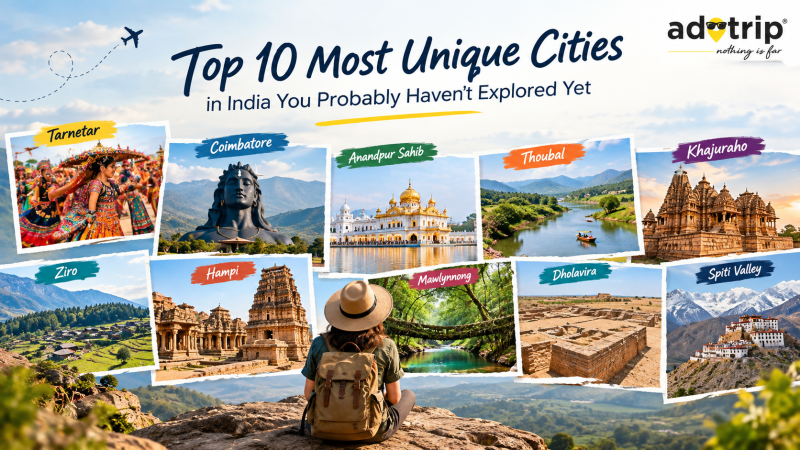
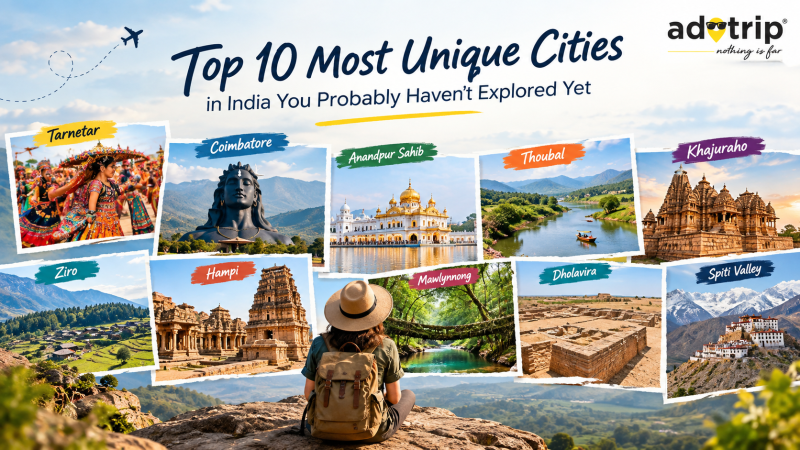
Top 10 Most Unique Cities in India You Probably Haven't Explored Yet
 Adotrip Official
India is a land of extraordinary contrasts. From snow-capped Himalayan passes to sun-drenched coastlines, from ancient cave temples to vibrant textile towns, every corner of this country holds a story waiting to be told. While popular destinations like Jaipur, Goa, and Agra continue to dominate travel itineraries, there exists a quieter, more fascinating India beyond the obvious. These are cities and towns that pulse with culture, history, and a charm so distinctive that no two feel remotely alike. Here are ten of India's most unique cities that deserve a place on every traveller's map.
1. Tarnetar, Gujarat
Nestled in the Surendranagar district of Gujarat, tarnetar is a small town with an outsized cultural identity. It is best known for hosting the legendary Tarnetar Fair, one of the oldest and most colourful tribal fairs in India, traditionally associated with the Swayamvar of Draupadi from the Mahabharata. The fair draws Ahir, Koli, and Rabari tribal communities dressed in dazzling embroidered outfits, peacock feathers, and mirror-work adornments. If you're travelling from the city, the than to tarnetar distance is approximately 40 kilometres, making it a short but immensely rewarding drive through Gujarat's heartland. Tarnetar offers travellers a rare, unfiltered window into tribal Gujarati culture in its most celebratory form.
2. Coimbatore, Tamil Nadu
Often referred to as the "Manchester of South India," coimbatore is far more than an industrial hub. Nestled at the foothills of the Nilgiris and beside the Western Ghats, this city is a fascinating blend of economic energy and natural beauty. Coimbatore tourism has grown significantly in recent years, thanks to its proximity to Ooty, Valparai, and the famous Isha Yoga Centre founded by Sadhguru. The towering Adiyogi statue, at 112 feet the world's largest bust sculpture, has become an iconic landmark drawing visitors from across the globe. The city also boasts a rich textile industry, vibrant street food culture, and a cosmopolitan energy rarely associated with Tier-2 cities. Coimbatore is where spiritual seekers, nature lovers, and urban explorers all find their niche.
3. Anandpur Sahib, Punjab
Few places in India carry the spiritual gravitas of anandpur Sahib. Translating literally to "The Holy City of Bliss," Anandpur Sahib was founded in 1665 by Guru Tegh Bahadur Ji, the ninth Sikh Guru, and later became the birthplace of the Khalsa Panth in 1699 under Guru Gobind Singh Ji. The city is home to several revered Gurdwaras, including Takht Sri Kesgarh Sahib, one of the five Takhts (seats of temporal authority) in Sikhism. Every year during the Hola Mohalla festival, Anandpur Sahib transforms into a stunning arena of Sikh martial arts, music, and devotion, drawing hundreds of thousands of pilgrims and travellers. Even outside festival season, the city exudes a profound serenity that makes every visit deeply meaningful.
4. Thoubal, Manipur
thoubal is a gem hidden in plain sight in northeastern India. The headquarters of the Thoubal district in Thoubal Manipur, this town sits beside the serene Thoubal River and is often described as the commercial backbone of the state. But beyond commerce, Thoubal is a cradle of Meitei culture, known for its handloom weaving traditions, pottery, and the famous Thoubal River wetlands that draw migratory birds during winter. The town also gives access to nearby Loktak Lake and Keibul Lamjao, the world's only floating national park. For travellers seeking authenticity away from tourist crowds, Thoubal offers a deeply immersive northeastern experience that is as culturally rich as it is visually stunning.
5. Khajuraho, Madhya Pradesh
World-famous for its intricately carved medieval temples, Khajuraho is a UNESCO World Heritage Site that continues to astonish historians, art lovers, and travellers alike. The temples, built between 950 and 1050 AD by the Chandela dynasty, feature exquisite sculptures depicting celestial beings, warriors, and scenes of everyday life alongside their celebrated erotic carvings. What makes Khajuraho truly unique is the sheer artistic brilliance packed into a relatively small town that remains largely untouched by mass tourism infrastructure.
6. Ziro, Arunachal Pradesh
Ziro Valley in Lower Subansiri district is a UNESCO-nominated landscape of terraced paddy fields, pine-clad hills, and the ancient Apatani tribal culture. Home to the internationally acclaimed Ziro Music Festival, this town blends organic tribal traditions with a thriving indie music scene, creating one of the most unexpected cultural collisions in all of India. The Apatani women, known for their distinctive facial tattoos and nose plugs, are the living custodians of a civilisation that has resisted modernisation on its own terms.
7. Hampi, Karnataka
Once the magnificent capital of the Vijayanagara Empire, Hampi is an open-air museum spread across 4,100 hectares of surreal boulder-strewn landscape. Ruined palaces, elephant stables, market streets, and towering temple gopurams rise from the rocky terrain like a forgotten dreamworld. A UNESCO World Heritage Site, Hampi draws archaeologists, photographers, spiritual seekers, and backpackers in equal measure. No city in India blurs the line between history and landscape quite like Hampi does.
8. Mawlynnong, Meghalaya
Known as "Asia's Cleanest Village," Mawlynnong in the East Khasi Hills of Meghalaya is a tiny settlement that has earned global recognition for its extraordinary community-led cleanliness and living root bridges. The Khasi community here has cultivated a culture of environmental stewardship for generations, making Mawlynnong not just clean but genuinely sustainable. A visit here feels less like tourism and more like a lesson in how humans and nature can coexist harmoniously.
9. Dholavira, Gujarat
Gujarat's second unique entry on this list, Dholavira is one of the five largest cities of the ancient Indus Valley Civilisation and a UNESCO World Heritage Site since 2021. The archaeological site reveals an astonishingly advanced urban planning system from over 4,500 years ago, complete with water conservation structures, inscribed signboards, and a remarkable dockyard. Visiting Dholavira is nothing short of walking through the world's oldest planned city.
10. Spiti Valley, Himachal Pradesh
Perched at an average altitude of 3,800 metres, Spiti Valley is a cold desert mountain terrain unlike anything else in India. Its ancient Buddhist monasteries, whitewashed villages, and stark lunar landscapes create an atmosphere of profound stillness. The Pin Valley National Park, the mummified monk at Key Monastery, and the star-lit skies above Kaza make Spiti one of the most unique and visually overwhelming destinations in the entire country.
Where Adotrip Fits Into This
India's most unique cities are often the hardest to plan for. They sit off major transit hubs, lack mainstream travel infrastructure, and require local insight to truly experience. That's precisely where Adotrip steps in. As a travel platform built on the belief that every destination deserves to be discovered, Adotrip makes the journey to places like Tarnetar, Thoubal, Anandpur Sahib, and Coimbatore seamless and stress-free. From curated itineraries and accurate travel distances to hotel bookings and local guides, Adotrip connects you to India's most extraordinary places with the care and confidence that only a dedicated travel partner can provide. Whether you're drawn to tribal fairs, Sikh heritage, Himalayan solitude, or ancient civilisations, Adotrip ensures that unique India is always within reach.
Source:
Click for the: Full Story
You might like








You Might Like this