Close Menu
 World
World
 Biography
 Health
 Education
 Business
 Lifestyle
 Sports
 Technology
 Animals
 History
 Food
Food
 Religious
 Startups
 Movies
 Politics
 Fashion
 Covid
Covid
 Diet
Diet
 Fitness
 Marketing
 Travel
 Science
 Reviews
 Social media
 Stories
 Facts
Facts
 Art
Art
 Entertainment
Yatin Samra

Technology
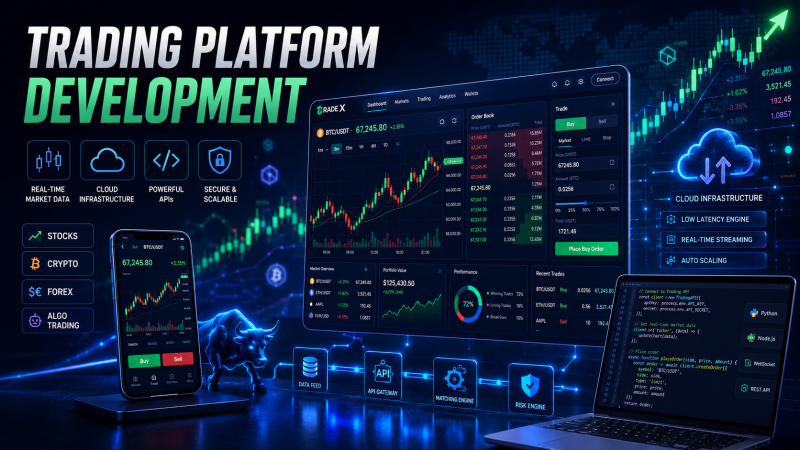
Trading Platform Development in 2026: A Practical Guide to Features, Costs, and Security
 Yatin Samra
Accessing financial markets has become quite different. Now investors and traders want the ability to control their portfolios, watch market dynamics, analyze assets, and perform transactions with easy-to-use digital experience.
It has created a number of business opportunities for fintech startups, brokers, entrepreneurs, and even existing financial institutions to develop trading applications. But creating an effective product is far more complex than simply creating a website with market dynamics.
It involves all aspects, starting from the integration of financial information and real-time data and ending with cybersecurity and compliance issues. If creating a trading website is what you are thinking about, then knowing the whole process may be useful.
What Is a Modern Trading Platform?
A trading platform is a digital environment that enables users to access financial markets and manage trading-related activities.
Depending on its purpose, the platform may provide access to stocks, forex, cryptocurrencies, commodities, derivatives, or other financial instruments.
A modern solution can bring several activities into one interface, including:
- Market research
- Asset discovery
- Price monitoring
- Trading
- Portfolio management
- Transaction tracking
- Account management
- Financial analysis
The exact functionality depends on the target audience and the markets the business intends to support.
Why Businesses Are Investing in Trading Technology
Digital financial services provide businesses with opportunities to create specialized experiences for specific user groups.
Instead of competing solely through a broad range of financial products, a company can differentiate itself through usability, specialized market access, educational features, advanced analytics, or community-driven experiences.
In the USA, for instance, digital investing has become an important part of the financial technology landscape. Businesses entering this market need to consider not only user expectations but also the regulatory and operational environment surrounding financial services.
Essential Components of a Trading Platform
1. Account and User Management
Users need a secure way to register, verify their identity, manage personal information, and access their accounts.
The onboarding process should be straightforward without compromising necessary verification and security procedures.
2. Market Information
Traders depend on accurate and timely information.
Depending on the platform, this can include:
- Asset prices
- Historical market data
- Trading volume
- Market statistics
- Financial news
- Charts and indicators
Data sources should be selected according to the required coverage, speed, licensing terms, and budget.
3. Trading and Order Management
The core trading experience should allow users to select an asset, specify the appropriate order details, review the transaction, and receive confirmation.
Order management can also include features for tracking open, completed, cancelled, or rejected orders.
4. Portfolio Dashboard
A portfolio section allows users to understand their current financial position.
It can display holdings, transaction history, performance information, balances, and other relevant metrics in an easy-to-understand format.
5. Notifications
Real-time notifications can keep users informed about order status, price movements, account activity, and other important events.
Users may also benefit from customizable alerts based on their preferences.
The Technology Behind the Platform
Technology architecture plays a major role in the reliability of a trading application.
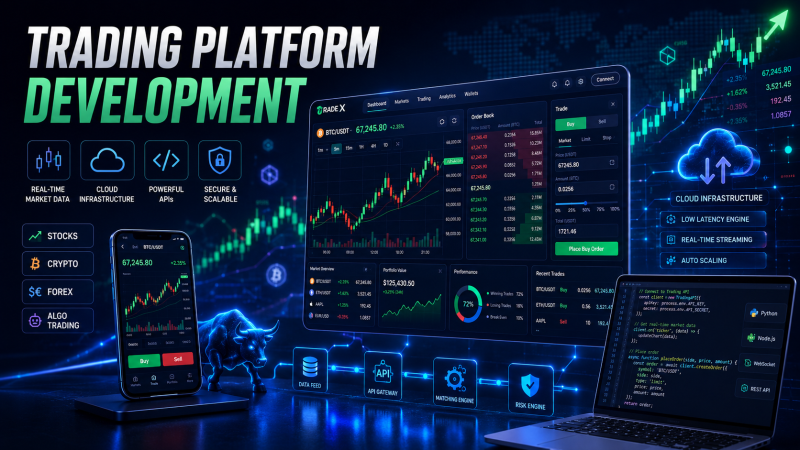
A typical solution can include:
Frontend technology: Used to create the web or mobile interface through which users interact with the platform.
Backend services: Responsible for business logic, user management, transactions, APIs, notifications, and other core operations.
Database systems: Store account information, transaction records, portfolios, settings, and analytical data.
Financial APIs: Connect the platform with market data providers, brokers, exchanges, payment providers, and verification services.
Cloud infrastructure: Supports computing, storage, monitoring, scaling, backups, and disaster recovery.
The architecture should be designed around the expected transaction volume and future growth rather than only the requirements of the initial launch.
Security Cannot Be an Afterthought
Financial platforms are attractive targets for cyberattacks because they handle valuable information and transactions.
A robust security strategy can include:
- Multi-factor authentication
- Encryption
- Secure API design
- Access controls
- Fraud monitoring
- Device and session management
- Transaction monitoring
- Security testing
- Backup and recovery procedures
Security should be considered across the entire application, including the frontend, backend, APIs, databases, infrastructure, and third-party integrations.
Compliance and Regulatory Planning
One of the most important differences between a regular web application and a trading platform is the regulatory environment.
Requirements can vary according to the jurisdiction, financial products, services, customer type, and business structure.
For platforms serving users in the USA, businesses may need to evaluate relevant federal and state requirements before providing financial services. International expansion can introduce additional regulatory obligations.
Because regulations can be complex and change over time, professional legal and compliance guidance should be part of the launch strategy.
How to Approach Development
A practical development process can be divided into several phases.
Phase 1: Market Research
Identify competitors, target customers, supported markets, user problems, and opportunities for differentiation.
Phase 2: Product Planning
Define the core features, user journeys, business model, integrations, and technical requirements.
Phase 3: UX/UI Design
Create a simple trading experience that makes complex financial information easier to understand and navigate.
Phase 4: MVP Development
Develop the core platform with the features required to validate the business concept.
Phase 5: Integration
Connect market data, financial infrastructure, identity verification, payment services, analytics, and other required systems.
Phase 6: Testing
Test security, performance, usability, integrations, transactions, and different market conditions before launch.
Phase 7: Launch and Optimization
Monitor user activity and technical performance, collect feedback, and gradually introduce improvements.
How Much Does It Cost?
The cost of developing a trading platform depends on its complexity rather than a fixed industry price.
Key factors include:
- Number of supported financial markets
- Web and mobile applications
- Trading functionality
- Market data requirements
- Third-party integrations
- Security infrastructure
- KYC/AML services
- Analytics
- Administrative tools
- Cloud infrastructure
- Development and maintenance requirements
A focused MVP can reduce initial costs and help determine whether users respond positively before larger investments are made.
Features That Can Improve Competitive Advantage
Once the core platform is stable, businesses can introduce differentiated features.
These may include:
Advanced Analytics
Provide deeper insights into portfolio performance, market trends, and trading activity.
Social Trading
Allow users to follow selected traders, share insights, or participate in community discussions where appropriate.
Copy Trading
Users may be able to replicate selected trading strategies, subject to the applicable business and regulatory requirements.
Educational Tools
Tutorials, market explainers, simulations, and learning resources can make a platform more accessible to new investors.
AI-Assisted Experiences
AI can potentially support personalized content discovery, data organization, market research workflows, and customer support. Financial AI features should be designed with appropriate transparency, risk controls, and compliance considerations.
Common Mistakes to Avoid
Businesses can reduce development risks by avoiding several common mistakes.
Building too many features too early: A complicated first release can increase costs without proving market demand.
Ignoring infrastructure costs: Market data, cloud services, bandwidth, and third-party APIs can become significant operational expenses.
Treating compliance as a final step: Regulatory requirements can influence the product architecture and user journey from the beginning.
Underestimating security: Financial applications require stronger security planning than many conventional websites.
Neglecting user experience: A technically sophisticated platform can still struggle if users find it confusing or difficult to navigate.
Final Thoughts
Development of trading platforms in 2026 should be based on fintech knowledge, reliable technologies, security, financial integrations, user experience and regulatory compliance.
The best way is to begin with the market niche, develop a good MVP, build a strong technical base and grow according to the users' demand and performance.
In case of building a trading website in 2026, planning these aspects prior to development can become the key to turning the idea into a good fintech product.
Would you like to know more about platform development? Just click on the link below and see the video about the process of developing a trading platform in 2026.
Source:
Click for the: Full Story
You might like