



 Close Menu
 World
World
 Biography
 Health
 Education
 Business
 Lifestyle
 Sports
 Technology
 Animals
 History
 Food
Food
 Religious
 Startups
 Movies
 Politics
 Fashion
 Covid
Covid
 Diet
Diet
 Fitness
 Marketing
 Travel
 Science
 Reviews
 Social media
 Stories
 Facts
Facts
 Art
Art
 Entertainment
sharvan kumar

Marketing
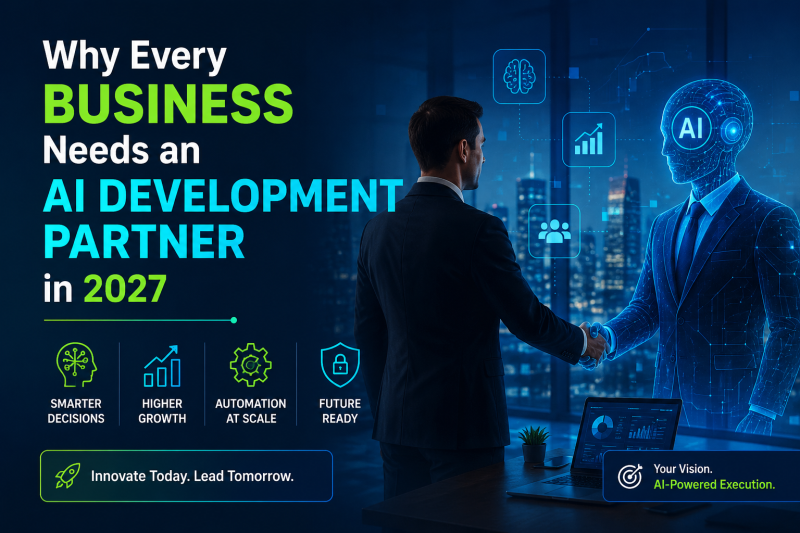
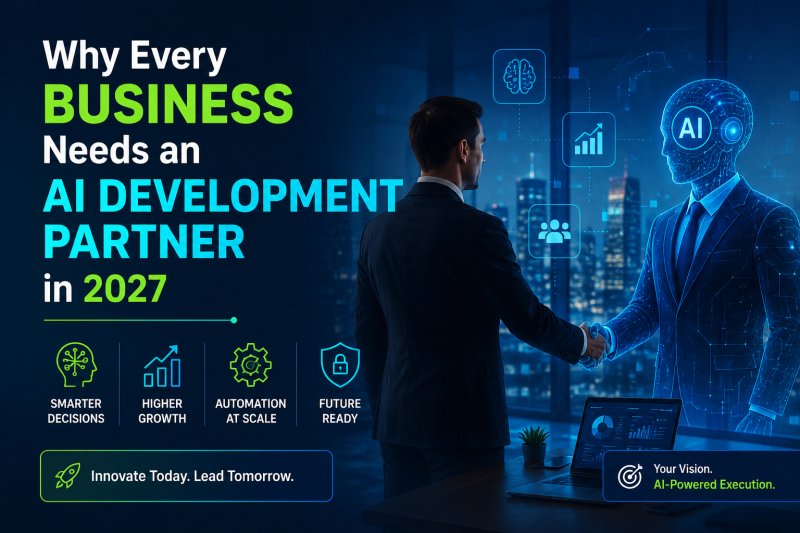
Why Every Business Needs an AI Development Partner in 2027
 sharvan kumar
Artificial intelligence has moved past the hype phase. In 2027, companies are no longer asking "should we use AI?" — they're asking "how do we implement it without wasting time and money?" That shift changes everything about how businesses approach AI adoption.
The Problem With DIY AI
Many companies try to bolt AI onto their existing systems using off-the-shelf tools. It works for a while — until the chatbot gives wrong answers, the automation breaks on edge cases, or the "predictive model" turns out to be a glorified spreadsheet formula. Generic tools solve generic problems. Your business isn't generic.
This is where the difference between using AI and engineering AI systems becomes obvious. A real AI implementation needs:
- Clean, well-structured data pipelines
- Models trained on your actual business context, not generic datasets
- Integration with your existing CRM, ERP, or support tools
- Ongoing monitoring, because models drift over time
- A clear ROI target before a single line of code is written
What Custom AI Actually Looks Like
Instead of forcing your workflows to fit a generic AI tool, a proper implementation starts with your data and your goals, then builds around them. This usually plays out in a few areas:
Intelligent process automation — replacing repetitive, error-prone manual work with AI agents that actually adapt instead of breaking the moment something unexpected happens.
Conversational AI — support agents trained on your knowledge base and brand voice, not a generic script that frustrates customers.
Predictive analytics — using your historical data to forecast demand, catch anomalies early, and reduce churn before it happens, instead of reacting after the damage is done.
Seamless integration — AI that plugs into your existing stack (CRM, ERP, cloud platforms) without a six-month migration project.
Why This Matters More in 2027
The businesses pulling ahead this year aren't the ones with the flashiest AI demo — they're the ones who treated AI as an operations upgrade, not a marketing gimmick. Faster decisions, lower operational costs, and better customer experience compound month over month once the system is actually working with your data instead of against it.
If you're evaluating whether to build this in-house or bring in outside expertise, it's worth working with a company that specializes purely in this space. Teams like Digitechzo, an AI development company focus specifically on building AI systems mapped to measurable business outcomes — automation, predictive models, and integrations — rather than generic AI experiments that never leave the pilot stage.
The Bottom Line
AI isn't a feature you add anymore — it's infrastructure. Whether you build it in-house or partner with specialists, the businesses that treat it that way in 2027 are the ones that will actually see the ROI everyone keeps talking about.
Source:
Click for the: Full Story
You might like






You Might Like this