Close Menu
 World
World
 Biography
 Health
 Education
 Business
 Lifestyle
 Sports
 Technology
 Animals
 History
 Food
Food
 Religious
 Startups
 Movies
 Politics
 Fashion
 Covid
Covid
 Diet
Diet
 Fitness
 Marketing
 Travel
 Science
 Reviews
 Social media
 Stories
 Facts
Facts
 Art
Art
 Entertainment
Raaiha Jannat

Business
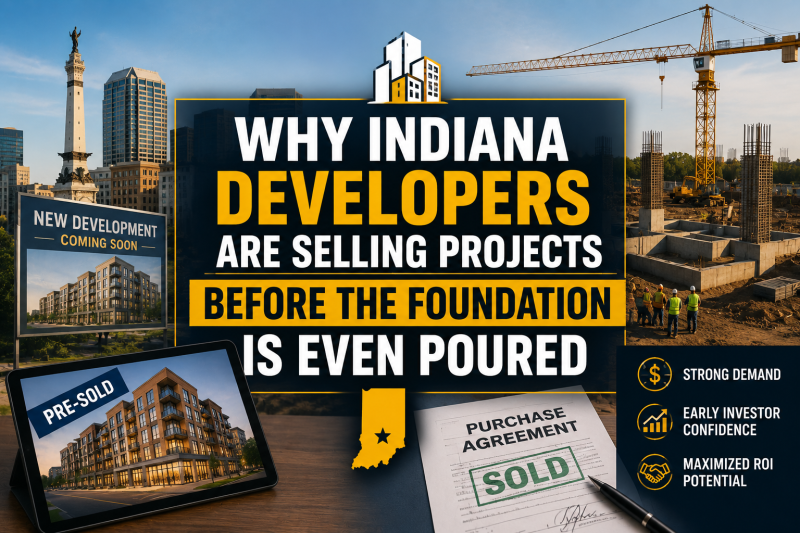
Why Indiana Developers Are Selling Projects Before the Foundation Is Even Poured
 Raaiha Jannat
A few years ago, a real estate developer in the Midwest could get away with a hand-drawn rendering, a vague floor plan, and a lot of enthusiasm to pre-sell units in a new development. That approach doesn't work anymore. Buyers, investors, and even city planning boards expect to see exactly what they're putting their money into, and "trust me, it'll look great" isn't a pitch that closes deals in 2026.
This shift has been especially noticeable across Indiana's growing metro areas. Indianapolis has seen a steady wave of mixed-use development, Fishers and Carmel keep expanding their commercial districts, and smaller cities like Bloomington and Fort Wayne are attracting developers who, a decade ago, would have stuck to the coasts. With more competition for the same buyers and investors, the projects that stand out are the ones that let people see the finished product before it exists.
The Problem With Traditional Sales Materials
Floor plans on paper are functional, but they ask a lot of a buyer's imagination. Most people struggle to translate a two-dimensional line drawing into a mental picture of natural light hitting a kitchen island at 5 p.m., or how a lobby will actually feel walking in from the street. Architectural blueprints are precise, but they're built for contractors and inspectors, not for someone deciding whether to sign a $400,000 purchase agreement.
That gap between technical accuracy and emotional connection is exactly where projects lose momentum. A buyer who can't picture themselves in a space hesitates. A hesitant buyer asks for more time. More time means a longer sales cycle, more carrying costs, and a development that takes longer to reach the return investors were promised.
What Changed the Equation
Photorealistic digital visualization solved this problem in a way paper never could. Instead of asking a buyer to imagine a finished condo, a development team can show them one rendered with accurate lighting, realistic materials, and a level of detail that's genuinely difficult to distinguish from a photograph of a completed building.
This isn't a small stylistic upgrade. It changes the entire sales timeline. Pre-construction sales become viable earlier, marketing materials look finished months before the first wall goes up, and lenders reviewing a project get a far clearer sense of what they're financing.
Where This Makes the Biggest Difference
Marketing to Buyers Who Haven't Seen a Single Physical Wall
Pre-sale marketing lives or dies on how convincingly a project can be shown before it's built. A rendered lobby, a rendered rooftop terrace, a rendered unit interior with the right furniture and lighting these assets do the heavy lifting that a sales brochure full of adjectives simply can't.
Getting Design Approval Without Costly Rework
Architects and developers who present polished visuals to city planning boards or HOA committees tend to move through approval processes faster. It's much easier to approve or request changes to a design that's clearly rendered than one that exists only as a technical drawing full of symbols a layperson has to interpret.
Avoiding Expensive Physical Models
Physical scale models used to be the gold standard for showing off a project, but they're expensive, slow to build, and impossible to update once a design detail changes. A digital rendering can be revised in days, shown from any angle, and updated the moment a design change happens all at a fraction of the cost.
The Indiana Advantage
Developers, architects, and real estate firms working across the state have increasingly turned to specialized visualization partners rather than trying to handle this in-house or relying on generic stock imagery that doesn't match the actual project. A firm offering dedicated 3D rendering services in Indiana brings the software expertise, regional project experience, and turnaround speed that makes pre-construction marketing actually work without the overhead of hiring a full visualization team internally.
Getting It Right From the Start
The projects that sell fastest and run into the fewest approval delays tend to share one thing in common: they were shown to buyers, lenders, and boards as something real, not something theoretical. In a market where competition for buyers keeps tightening, that difference isn't cosmetic it's often the difference between a project that hits its sales targets on schedule and one that spends an extra six months waiting for confidence to catch up.
Final Thoughts
Indiana's development landscape isn't slowing down, and the standards buyers and investors hold projects to keep rising right alongside it. Teams that invest in showing their work clearly, early, and accurately are the ones consistently winning approvals and closing sales faster than their competition. In a business built on first impressions, that clarity is worth every bit of the investment.
Source:
Click for the: Full Story
You might like