Close Menu
 World
 Biography
 Health
 Education
 Business
 Lifestyle
 Sports
 Technology
 Animals
 History
 Food
 Religious
 Startups
 Movies
 Politics
 Fashion
 Covid
 Diet
 Fitness
 Marketing
 Travel
 Science
 Reviews
 Social media
 Stories
 Facts
 Art
 Entertainment
Enterprise Dji

Technology
Year Two of DFR: Measuring, Auditing and Improving a Program
 Enterprise Dji
The first year of a drone as a first responder program is mostly about getting approved and getting airborne. The second year is when the real questions arrive. Are the flights actually helping? Are staff still following the rules, now that the novelty has worn off? What does the council want to see before it funds more?
This guide is for programs past the pilot stage. It covers best practices for police operations, what response-time data does and doesn’t show, how to report results, how fire departments deploy drones and what ongoing oversight looks like. It reflects public information as of late October 2026.
Quick Answer
In year two, tighten the rules, measure what matters and report it honestly. Keep policy narrow, audit flights, review response times in stages, publish summaries that include weak spots and expand only where the data supports it. Police and fire departments use the same infrastructure for different jobs, so coordinate priorities and footage rules in writing.
What Are the Best Practices for a Police Drone Program?
The best programs write their policy before the first flight, keep their uses narrow, train their people, audit regularly and stay open with the public. By year two, these habits are what separate a program that holds together from one that slowly drifts.
Revisit the policy. Say what the program is for, which calls qualify, what’s off limits, how recordings are handled, how long they’re kept and who can see them. If practice has moved beyond what the policy says, fix one or the other. Keep the mission limited, and review the call list on a schedule so use doesn’t quietly expand.
Keep a person in charge of every flight, someone who approves it, watches it and can end it. Keep training, too. New staff need the same standards as the first team, and old hands need refreshers on lost links and competing calls. Log who requested and approved each flight, why it flew and how the footage was stored, then audit a sample regularly. Let the system enforce retention, and keep access logs.
Privacy deserves another look as the program matures. Privacy advocates have raised concerns about license plate readers and similar features being added to drones, so decide in policy what the aircraft may and may not be paired with, and let counsel and the community weigh in.
How Much Do Drone as First Responder Programs Improve Emergency Response Times?
It depends, and anyone who quotes you a flat number is guessing. Distance, coverage, weather and the way you make the comparison all matter. The data you’ve collected in year one is your best guide.
The biggest published record comes from Chula Vista, California. Its program has completed more than 25,000 missions and reports an average response time of 96.98 seconds when the drone arrived before patrol officers. Two caveats apply. That average covers only missions where the drone arrived first, and the city’s geography, call mix and dock placement are its own.
To see where your own time is won or lost, split the response into stages: call to decision, approval to launch, launch to arrival, arrival to useful video, and drone versus the first ground unit. Slow decisions point to a policy or training problem. Slow launches point to equipment or sites. Long flights point to a coverage gap. And arriving faster isn’t the same as a better outcome. The value comes from what responders do with the earlier information.
How Should You Report Results?
Report with clear definitions, local baselines and stated limits. That’s what makes your numbers credible to councils, funders and residents.
Pick a short list of measures and define each in writing: the time stages above, drone versus ground arrival on all missions, calls cleared without an officer and who decides, assisted arrests and safety outcomes, aircraft availability, flights declined and why, user feedback and costs. Compare against the baseline from before launch, match seasons and call types where you can and say plainly where the comparison is imperfect.
Publish summaries that include the weak spots, like weather holds and staffing gaps. An independent review, such as an audit by an oversight body, strengthens trust further. And don’t copy another city’s targets. Geography and call mix differ, so set your own goals.
How Do Fire Departments Deploy Drones for Emergency Response?
Fire departments use drones to get an early look at a fire, a hazmat release or a rescue, then use the video to set tactics and protect crews. Most mix a few deployment models.
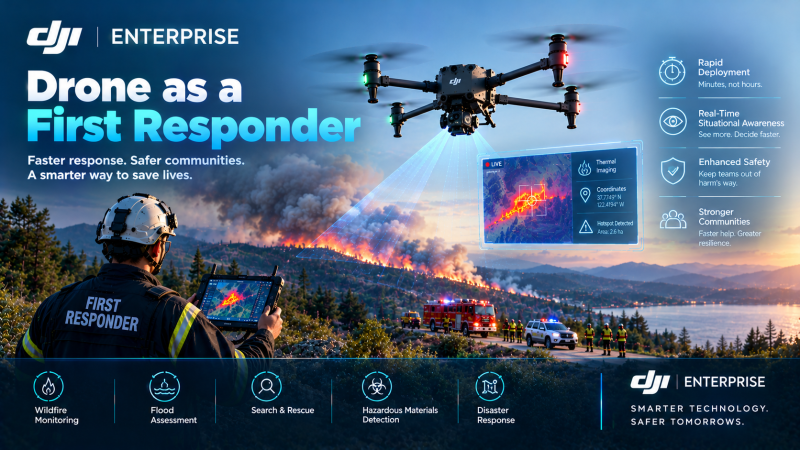
The dock-based version, which DJI Enterprise calls Dock as First Responder, stages an aircraft in a dock at a fire station so it launches with the first alarm and can reach the scene before or alongside the engines. Vehicle-launched aircraft ride with command units and come out for bigger or longer incidents, like wildland fires and major structure fires. Some crews also fly planning missions to map buildings, hazards and access routes before anything goes wrong.
On the fireground, the aerial view shows which sides of a building are involved, where smoke is heading and whether neighbors are exposed. Thermal imaging can help find heat on roofs and in smoke. At hazmat calls, a drone can watch a spill or plume from a safe distance. At brush and wildland fires, it can track movement and open access routes. In rescues, it can scan water or rough terrain for people.
Thermal shows surface heat, not what’s behind a wall, so operators need training to read it. Battery life and weather limit flights, so plan relief aircraft and keep ground fallbacks ready. Fire departments face the same aviation approvals as everyone else.
What Does Ongoing Oversight Look Like?
Oversight in year two is routine, and that’s the point. A supervisor reviews a sample of flights each month, with extra attention to unusual cases or complaints. Access logs get checked. Retention schedules are confirmed to be running. Findings go to leadership and, in summary form, to the public.
Independent review adds credibility. That might be an oversight board, an auditor or a community advisory group. What matters is that findings lead to visible changes, such as updated training or tighter access. An audit that changes nothing isn’t oversight, and residents can tell.
Have a complaint process, too. Residents should know how to ask about a flight, and the agency should answer in a set time. A clear, fair process is one of the cheapest trust-building tools an agency has.
Which Mistakes Show Up in Year Two?
Familiar ones. Staff stop following the approval steps because they’re “obviously fine.” The call list grows without review. Reports stop mentioning weather holds and declined flights, so the numbers look better than reality. Maintenance slips because nothing has gone wrong yet. Training lapses as people rotate out.
The fix is boring and works: scheduled audits, regular training, written decisions when scope changes and honest reporting even when the news isn’t good. If year one built the program, year two proves it can last.
What Should the Year-Two Plan Include?
A short plan beats a long wish list. Confirm policy updates. Schedule audits and training. Decide which measures you’ll report and when. Pick one or two changes to test, such as adding a call type or a second site, and define how you’ll judge them. Review costs against the original budget and plan replacement cycles for aircraft and batteries.
Share the plan with leadership and the public. Programs that explain what they’ll do next, and why, tend to keep the trust they earned in year one.
Frequently Asked Questions
How can agencies keep staff following the rules after the novelty fades?Build the rules into the workflow, so approvals, logs and retention happen by default rather than by memory. Audit regularly, refresh training and review a few flights together each month. When staff see that reviews are routine and fair, compliance becomes a habit instead of a chore.
How can a program show it is improving over time?Track the same measures each quarter, using the same definitions, and compare them against the pre-launch baseline and the previous period. Note what changed, such as a new site or revised policy, so improvements and setbacks have explanations. Publishing the trend, weak spots included, makes the story credible.
How can agencies handle a complaint about a flight?Give residents a clear way to ask, answer within a stated time and check the flight record: who requested it, who approved it, why it flew and what was recorded. Explain the finding in plain language, and if the review shows a policy gap, fix it and say so.
Should every flight be recorded?That’s a policy decision. Some agencies record all flights, some only certain call types and some stream without recording. Whatever the choice, write it down, apply it consistently, set a retention period and explain it to the public. Counsel should confirm what local records and evidence laws require.
Can the same aircraft serve both police and fire?Yes, if the agencies agree on priorities in advance. Shared aircraft need a written priority order, a single approval point and clear rules on who stores and accesses footage. Joint training helps each discipline understand what the other needs from the video, so competing requests don’t slow anyone down.
Source:
Click for the: Full Story
You might like