Close Menu
 World
 Biography
 Health
 Education
 Business
 Lifestyle
 Sports
 Technology
 Animals
 History
 Food
 Religious
 Startups
 Movies
 Politics
 Fashion
 Covid
 Diet
 Fitness
 Marketing
 Travel
 Science
 Reviews
 Social media
 Stories
 Facts
 Art
 Entertainment
Ai agent
Business
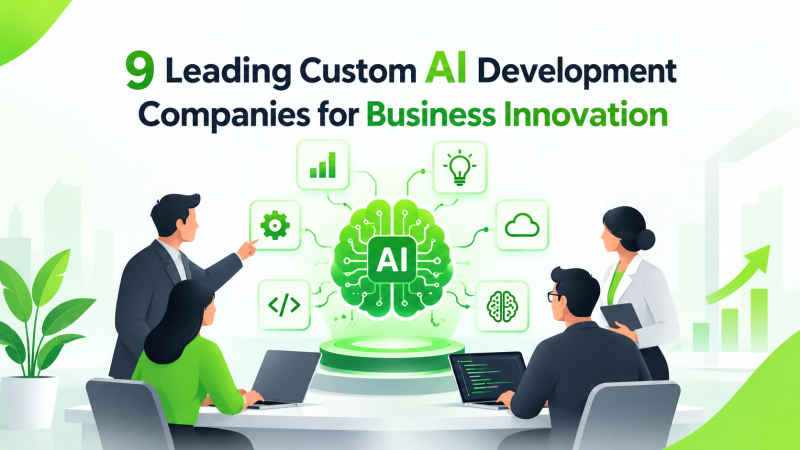
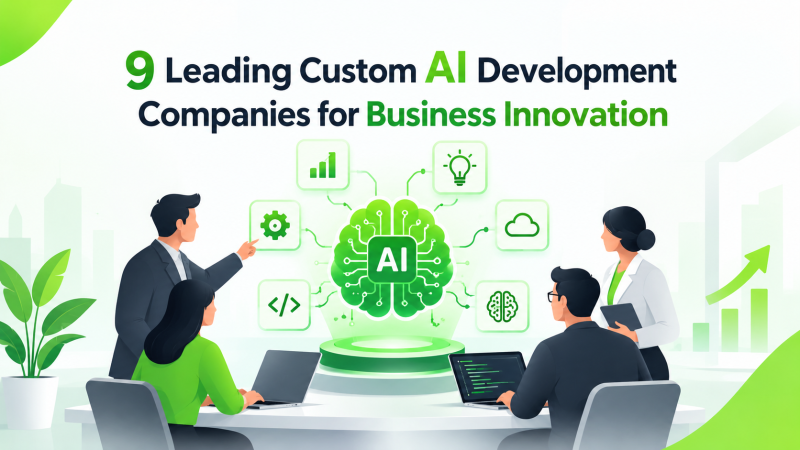
9 Leading Custom AI Development Companies for Business Innovation
 Ai agent
Introduction
Artificial intelligence has moved from experimental labs into everyday business operations. Retailers use it to forecast demand, banks use it to flag fraud in real time, healthcare providers use it to read scans faster, and logistics firms use it to plan smarter routes. Yet for most organizations, the gap between wanting AI and actually deploying it is wide. Off-the-shelf tools rarely fit unique workflows, proprietary data, or industry regulations. That is why more businesses are turning to a specialized Artificial Intelligence Development Company to design, build, and maintain solutions tailored to their needs.
Choosing the right partner is not easy. The market is crowded with agencies that claim AI expertise, from boutique data science studios to large, full-cycle engineering firms. Some focus on machine learning research, others on generative AI, and others on embedding intelligence into mobile and web products. In this guide, we look at nine firms often shortlisted by businesses exploring custom AI work: Blocktech Brew, Code Brew Labs, Dubai App Developers, Royo Apps, Markovate, DataRoot Labs, InData Labs, ValueCoders, and Deviniti.
Before the list, we cover why custom AI is worth the investment and how to evaluate a vendor, so you can match the right company to your own goals.
Why Businesses Are Investing in Custom AI
Generic AI products are useful for general tasks, but competitive advantage usually comes from solutions trained on your own data and shaped around your own processes. A professional AI development company can deliver several benefits that packaged software cannot.
Fit for purpose: A custom model learns from your customers, products, and operations. A recommendation engine built on your purchase history will outperform a generic one every time.
Data ownership and control: Custom builds let you decide where data lives, who can access it, and how models are governed. For regulated industries such as finance and healthcare, this matters enormously.
Integration with existing systems: Real value appears when AI connects to your CRM, ERP, data warehouse, and customer-facing apps. Custom AI development services are designed around those integrations rather than forcing you to work around a tool's limits.
Scalability and differentiation: Proprietary AI becomes an asset. Competitors can buy the same software you do, but they cannot copy a model trained on your data and tuned to your market.
Faster automation of high-value tasks: From document processing to customer support triage, custom automation removes repetitive work and frees teams to focus on judgment-heavy tasks.
How to Evaluate an AI Development Partner
Every company on this list will describe itself in confident terms, so it helps to have a consistent checklist. Consider the following before signing a contract.
1. Relevant domain experience
Ask for case studies in your industry or a closely related one. A team that has already handled healthcare compliance or retail demand forecasting will ramp up much faster than one starting from scratch.
2. Technical depth across the AI stack
Look for capability in machine learning, natural language processing, computer vision, predictive analytics, and generative AI. Also check for data engineering strength, because model quality depends on data quality.
3. Full-cycle delivery
The best partners handle discovery, data preparation, prototyping, model training, deployment, monitoring, and ongoing optimization. A vendor who only delivers a prototype leaves you with a gap between demo and production.
4. Product and mobile capability
Many AI use cases end up inside an app. If your goal is an intelligent customer experience, a firm that doubles as a Mobile app development company can ship the model and the interface together, which reduces handoffs and delays.
5. Security and governance
Ask how the vendor handles data privacy, access control, model explainability, and compliance with regulations relevant to you, such as GDPR or sector-specific rules.
6. Transparent process and communication
Look for clear milestones, regular demos, defined ownership of intellectual property, and honest estimates. Be wary of promises that sound too good, especially around accuracy and timelines.
7. Post-launch support
AI models drift as data changes. A good partner plans monitoring and retraining from the start instead of treating launch as the finish line.
9 Leading Custom AI Development Companies for Business Innovation
The following companies are presented in the requested order. Their suitability depends on the project's technical requirements, budget, industry, geography, and delivery expectations. Businesses should verify current service offerings, relevant case studies, and team capabilities directly with each provider before making a final decision.
1. Blocktech Brew
Blocktech Brew is a technology company to consider when exploring digital solutions involving blockchain, Web3, and related emerging technologies. For businesses interested in combining AI with decentralized systems, a provider with relevant blockchain experience may be worth evaluating.
Potential areas of evaluation
Organizations considering Blocktech Brew for an AI-related project should investigate whether its current capabilities align with their requirements, particularly when a solution involves multiple technologies.
Relevant project areas may include:
- AI integration with blockchain-based applications.
- Intelligent analytics for digital platforms.
- Automated business workflows.
- Data-driven features for Web3 products.
- Custom software and application development, where offered.
Combining AI and blockchain
AI and blockchain can serve different purposes within the same digital ecosystem. AI can analyze data, generate predictions, and automate decisions, while blockchain can provide transaction records and programmable rules. For example, a business platform might use machine learning to identify unusual transaction patterns while using a blockchain network to record selected transactions.
These technologies should not be combined automatically. Blockchain is most useful when shared records, verifiable transactions, or decentralized coordination are genuine requirements. Similarly, AI should be introduced when it provides a clear operational or customer benefit.
Who should evaluate Blocktech Brew?
Businesses developing blockchain-oriented products, digital asset platforms, or applications involving AI and decentralized infrastructure can investigate Blocktech Brew's relevant experience. Before hiring, request examples of completed projects, details about the proposed AI architecture, and evidence of production deployment.
2. Code Brew Labs
Code Brew Labs is a technology and digital product development company to consider for businesses exploring custom software, mobile applications, and AI-enabled products. Organizations evaluating an Artificial Intelligence Development Company should assess its ability to connect business strategy with engineering, deployment, and ongoing product improvement.
For companies seeking custom AI development, the key consideration is whether the provider can translate a business challenge into a secure, scalable system that delivers practical results.
AI development services to evaluate
Businesses can discuss requirements such as:
- Generative AI and large language model integration.
- AI-powered chatbots and virtual assistants.
- Machine learning and predictive analytics.
- Intelligent workflow automation.
- AI-enabled mobile and web applications.
- Recommendation systems and personalized experiences.
- Integration of AI features into existing enterprise software.
The exact availability and depth of each service should be confirmed with the company before engagement.
A production-first approach to AI
AI projects require more than a working demonstration. A business-ready solution may need data preparation, model evaluation, access controls, integration with existing systems, error handling, monitoring, and ongoing maintenance.
For example, a company introducing an AI assistant for internal operations must consider how the assistant accesses company information, how sensitive data is protected, how inaccurate responses are identified, and when human review is required. These decisions influence the solution's reliability and long-term operating costs.
Code Brew Labs can be included in a shortlist for organizations looking to explore custom AI applications and integrated digital products. During the selection process, businesses should request examples of deployed systems and clarify responsibilities for model selection, infrastructure, security, performance monitoring, and post-launch support.
AI-powered mobile application development
Businesses that want to integrate artificial intelligence into consumer-facing products should also evaluate mobile engineering capabilities. A Mobile app development company with relevant AI integration experience can help connect backend intelligence with mobile interfaces, authentication systems, APIs, and user-facing features.
Potential use cases include personalized shopping recommendations, intelligent customer support, voice-enabled features, document scanning, predictive notifications, and AI-assisted productivity tools.
Who should consider Code Brew Labs?
Startups, growing businesses, and enterprises evaluating custom AI software or AI-enabled mobile products can consider Code Brew Labs as part of their vendor assessment. The most important factors are demonstrated delivery experience, technical fit, security practices, and the ability to support the solution beyond its initial launch.
3. Dubai App Developers
Dubai App Developers is a company to evaluate for businesses seeking application development and digital product engineering, particularly when a mobile application is central to the project.
For organizations building AI-enabled applications, the development partner must understand both traditional app engineering and the additional requirements introduced by AI services.
AI application development opportunities
AI features can improve mobile and web products in several ways:
- Conversational assistants for customer support.
- Personalized content and product recommendations.
- Intelligent search and information discovery.
- Image recognition and document processing.
- Predictive insights based on permitted user or business data.
- Workflow automation through backend AI services.
These capabilities may depend on third-party AI APIs, custom models, cloud infrastructure, or a combination of technologies.
Connecting AI with mobile platforms
Building an AI-powered application requires more than placing a chatbot interface inside a mobile app. Developers must consider response times, API reliability, authentication, data privacy, offline behavior where relevant, and the cost of AI inference.
For example, a retail application could use AI to recommend products based on shopping behavior. The implementation would require a suitable recommendation strategy, appropriate data permissions, and testing to ensure that the recommendations remain useful and relevant.
Businesses considering Dubai App Developers should confirm the company's current AI engineering experience, supported mobile platforms, integration capabilities, and post-launch maintenance arrangements.
Who should consider this company?
Organizations whose primary objective is to launch or modernize a mobile application can evaluate Dubai App Developers, particularly if AI functionality is part of the product roadmap. Ask for comparable project examples and a clear explanation of how AI services will be integrated, secured, tested, and maintained.
4. Royo Apps
Royo Apps is another company to consider when assessing application development partners for digital products and business platforms. For an AI initiative, businesses should determine whether the provider has the relevant experience to support the specific combination of mobile engineering, backend development, and artificial intelligence required.
Potential AI-enabled product features
Depending on verified capabilities, businesses may investigate opportunities involving:
- AI-assisted customer engagement.
- Intelligent search and discovery.
- Personalized user experiences.
- Recommendation engines.
- Automation of repetitive application workflows.
- AI integration into existing mobile or web products.
These features can support industries such as retail, healthcare, logistics, education, and on-demand services, provided the implementation meets applicable industry requirements.
Building a useful AI experience
AI features should address a clearly defined user problem. For instance, an on-demand service platform might use predictive analytics to estimate demand, improve resource allocation, or support customer inquiries. A poorly designed AI feature, by contrast, can introduce unnecessary complexity, higher operating costs, and inconsistent results.
Product teams should establish measurable objectives before development begins. These may include reducing customer response times, increasing successful task completion, lowering manual processing requirements, or improving user satisfaction.
What to check before hiring
Ask Royo Apps about its current AI capabilities, available engineering resources, experience with external model providers, and ability to support production deployments. Review the proposed architecture and confirm whether the company provides testing, documentation, monitoring, and ongoing maintenance.
Businesses should select a provider based on proven project fit rather than assuming that general application development experience automatically translates into advanced AI expertise.
5. Markovate
Markovate is a digital product development company that businesses can investigate for custom software and AI-related projects. Its relevance to a particular engagement should be established by reviewing its current service portfolio and experience with comparable solutions.
Areas relevant to custom AI development
When assessing Markovate, businesses can investigate its experience with:
- Generative AI application development.
- AI and machine learning integration.
- Intelligent automation.
- Custom software engineering.
- Enterprise application modernization.
- AI-powered digital product development.
The specific capabilities available for a new engagement should be confirmed directly with the company.
Generative AI for business operations
Generative AI can help organizations summarize documents, draft content, retrieve internal information, support customer interactions, and assist employees with repetitive knowledge work. However, these applications need suitable controls to prevent inappropriate access to confidential information and to reduce inaccurate or unsupported responses.
A business knowledge assistant, for example, may combine a language model with retrieval-augmented generation (RAG). This approach retrieves relevant information from approved sources before generating an answer. The system still requires evaluation, access permissions, and safeguards against incorrect output.
Evaluating delivery quality
Businesses should ask Markovate to explain how it handles data preparation, model evaluation, integration, security, and deployment. A well-defined project proposal should describe the business objective, expected deliverables, testing approach, deployment environment, and criteria for measuring success.
Markovate may be worth evaluating for organizations seeking an experienced digital product partner, provided its verified technical capabilities match the proposed project's complexity.
6. DataRoot Labs
DataRoot Labs is an AI-focused technology provider to investigate when a project requires specialized expertise in artificial intelligence, machine learning, or data-intensive software.
For businesses whose competitive advantage depends on extracting useful insights from data, specialist AI engineering can be an important consideration.
AI and machine learning opportunities
Relevant areas to explore with DataRoot Labs include:
- Machine learning model development.
- Predictive analytics and forecasting.
- Computer vision.
- Natural language processing.
- Data engineering and analytics.
- AI proof-of-concept development and productionization, where available.
The provider's current service offerings and relevant project experience should be verified before selection.
Turning business data into insights
Machine learning systems can help identify patterns that are difficult to detect through manual analysis alone. Retailers may forecast demand, manufacturers may investigate equipment failures, and logistics companies may analyze delivery patterns.
The usefulness of these systems depends on data quality, the suitability of the model, and the business's ability to act on the results. A predictive model that is accurate in a test environment may perform differently when market conditions, customer behavior, or operating processes change.
Why model evaluation matters
An AI development project should include appropriate baseline comparisons, validation using representative data, and ongoing performance assessment. Teams should also establish how the system behaves when data is missing, inputs change, or predictions are uncertain.
Businesses evaluating DataRoot Labs should request examples of comparable deployments and ask how the team approaches model performance, data governance, integration, and production monitoring.
Who should consider this company?
Organizations with data-heavy use cases or a need for specialized machine learning expertise can investigate DataRoot Labs. The strongest fit will depend on the team's verified experience with the relevant data types, deployment environment, and business problem.
7. InData Labs
InData Labs is a technology provider to evaluate for data science, artificial intelligence, and machine learning initiatives. Companies exploring a custom AI solution should examine whether its current capabilities address the project's technical requirements and desired business outcomes.
Potential AI development services
Areas to investigate include:
- Data science and predictive modeling.
- Machine learning development.
- Natural language processing.
- Computer vision.
- Business intelligence and analytics.
- AI integration into business applications.
Confirm the availability of specific services and the team's experience with the intended use case directly with the provider.
Applying data science to business challenges
Data science can help organizations understand historical performance, identify trends, and estimate future outcomes. For example, a subscription business may use predictive models to identify customers who could be at risk of leaving. A logistics company may analyze route data to improve planning, while a financial services provider may investigate unusual patterns in transactions.
These systems should support informed decisions rather than operate without appropriate oversight. Businesses need to understand the limitations of model predictions and identify who is responsible for reviewing or acting on them.
Integrating AI into existing systems
AI models often need to connect with customer relationship management platforms, enterprise resource planning systems, data warehouses, or customer-facing applications. Integration planning helps ensure that insights can be used within real business workflows.
When assessing InData Labs, request information about integration methods, model validation, deployment practices, data security, and the team's approach to maintaining systems as requirements change.
Who should consider InData Labs?
Businesses with analytics-intensive requirements, structured data challenges, or specialized AI use cases can investigate InData Labs as a potential partner. Select the provider only after confirming its suitability for the project's scope and operating environment.
8. ValueCoders
ValueCoders is a software development company that businesses can assess when seeking engineering resources for custom applications, software modernization, and related technology projects.
For AI initiatives, the important question is whether the proposed team has the specific skills needed to implement and maintain the required AI functionality.
Areas to evaluate
Depending on the current service portfolio and assigned team, businesses may investigate experience in:
- Custom software development.
- AI and machine learning integration.
- API and backend engineering.
- Web and mobile application development.
- Cloud-based application architecture.
- Software testing and maintenance.
Confirm the availability of specialized AI resources before committing to a project.
Combining software engineering with AI
An AI solution generally includes multiple components: data pipelines, model or API integration, application logic, user interfaces, security controls, and monitoring. Each component affects the quality of the final product.
For example, a business may introduce an AI-powered document processing system to extract information from invoices. The AI component identifies and structures relevant fields, while the surrounding software manages uploads, permissions, validation, exception handling, and integration with accounting systems.
This illustrates why a dependable software engineering foundation is essential for AI adoption.
What businesses should assess?
When evaluating ValueCoders, review the experience of the proposed developers, project management process, communication arrangements, testing standards, and support model. Ask whether the assigned team has delivered comparable AI projects and how responsibilities will be divided between application engineering and model-related work.
ValueCoders can be included in a broader vendor comparison when the project combines conventional software development with AI functionality. The final decision should reflect technical fit, delivery quality, and long-term maintainability.
9. Deviniti
Deviniti is a technology services company to investigate for software engineering and digital transformation requirements. Businesses interested in using AI should confirm the provider's current AI-specific offerings and experience before treating it as a suitable custom AI development partner.
Relevant areas to investigate
Potential areas for discussion include:
- Business application development.
- Workflow and process automation.
- Enterprise software integration.
- AI-enabled business solutions, where offered.
- Data-driven process improvement.
- Application maintenance and modernization.
The exact fit depends on the available team and verified project experience.
Improving enterprise workflows
Organizations often have workflows spread across multiple systems, creating manual work and inconsistent access to information. AI may help with document classification, knowledge retrieval, task prioritization, and other repetitive activities when suitable data and controls are available.
Before introducing AI, businesses should map the existing workflow and identify the source of delays, errors, or unnecessary effort. Some problems can be solved more economically through conventional automation or system integration. AI is most valuable when its ability to interpret information, recognize patterns, or generate useful outputs adds a clear advantage.
How to evaluate the provider
Businesses considering Deviniti should request a detailed explanation of its relevant capabilities, team composition, integration experience, and deployment approach. For AI-specific projects, ask for evidence of model or API integration, data protection measures, testing practices, and ongoing support arrangements.
A structured evaluation will help determine whether the provider is suited to a particular enterprise software project or AI implementation.
How to Choose the Right Artificial Intelligence Development Company
Comparing companies by name alone is not enough. Businesses should evaluate each provider against a consistent set of technical and commercial criteria.
1. Define the business objective
Identify the problem the solution must address. Examples include reducing manual document processing, improving demand forecasting, personalizing customer experiences, or providing faster access to internal information.
Define measurable success criteria before development starts.
2. Review relevant experience
Request case studies, references, and demonstrations that match the project's complexity. Verify whether the provider has delivered production systems or primarily worked on prototypes.
3. Assess technical capabilities
Determine whether the team can handle data engineering, model selection, application development, API integration, deployment, monitoring, and maintenance. Not every project requires a custom-trained model; an existing model or API may be more appropriate.
4. Prioritize data security and governance
Discuss access controls, encryption, data retention, regulatory obligations, model-provider policies, and handling of confidential information. Requirements will differ across industries and jurisdictions.
5. Understand scalability and operating costs
Ask how the solution will handle increased usage and what expenses are expected for cloud hosting, model inference, data storage, third-party services, and ongoing support.
6. Evaluate integration requirements
AI applications must work with the organization's existing software and workflows. Confirm the availability of suitable APIs, data connectors, authentication mechanisms, and integration testing.
7. Plan for ongoing improvement
Production AI systems need monitoring and periodic evaluation. Data changes, model updates, and new user behavior can affect results over time. Confirm who will manage these responsibilities after launch.
Key AI Development Services Businesses Should Understand
A capable AI development company may provide several types of services, depending on its specialization and the project's needs.
Custom AI development
Custom AI development involves designing a solution around specific business objectives, available data, technical constraints, and operational workflows. It can include model integration, application engineering, data processing, and deployment.
Generative AI and LLM integration
Generative AI solutions can support conversational assistants, document summarization, content generation, and knowledge retrieval. Reliable implementations require testing, access controls, and clear limits on the system's responsibilities.
Machine learning and predictive analytics
Machine learning can support forecasting, classification, anomaly detection, recommendations, and other analytical tasks. Performance should be validated against suitable baselines and real-world requirements.
Intelligent automation
AI-enabled automation combines software workflows with capabilities such as language understanding, document interpretation, or prediction. It can reduce manual work while preserving human review for exceptions and high-impact decisions.
AI-powered mobile applications
A Mobile app development company with AI integration experience can help organizations deliver intelligent features through mobile interfaces. Typical examples include personalized recommendations, virtual assistants, image-based search, and contextual notifications.
AI integration and maintenance
Businesses may not need an entirely new AI platform. Integrating AI into an existing application can be a practical alternative, provided the solution has appropriate security, performance, and monitoring controls.
Industries Benefiting From Custom AI Development
AI can create value across a range of industries, although the appropriate use cases differ by business model and regulatory environment.
- Healthcare: Administrative assistance, medical document processing, operational forecasting, and carefully validated clinical support.
- Finance: Fraud detection, risk analysis, document processing, and customer service automation.
- Retail and e-commerce: Product recommendations, demand forecasting, customer insights, and intelligent search.
- Logistics: Route analysis, demand prediction, resource planning, and exception detection.
- Manufacturing: Predictive maintenance, visual quality inspection, and production optimization.
- Real estate: Property data analysis, lead prioritization, document workflows, and customer engagement.
- Education: Learning support, content discovery, administrative automation, and personalized study assistance.
Organizations working in regulated sectors should ensure that AI applications meet applicable privacy, security, fairness, and human-oversight requirements.
Conclusion
Custom AI is no longer a luxury reserved for technology giants. With the right partner, businesses of almost any size can automate repetitive work, understand customers more deeply, and build products that learn and improve over time. The nine companies covered here, Blocktech Brew, Code Brew Labs, Dubai App Developers, Royo Apps, Markovate, DataRoot Labs, InData Labs, ValueCoders, and Deviniti, represent a range of approaches, from app-centric builders to data science specialists and enterprise engineering teams.
The most successful projects share the same foundations: a clearly defined business goal, good data, a realistic pilot, and a partner who treats AI as an ongoing capability rather than a one-off project. Take the time to compare AI development services carefully, verify each company's current offerings and references, and choose the team that best understands your industry and your ambitions. Done well, the investment pays off not only in efficiency but in lasting competitive advantage.
Source:
Click for the: Full Story
You might like