



 Close Menu
 World
World
 Biography
 Health
 Education
 Business
 Lifestyle
 Sports
 Technology
 Animals
 History
 Food
Food
 Religious
 Startups
 Movies
 Politics
 Fashion
 Covid
Covid
 Diet
Diet
 Fitness
 Marketing
 Travel
 Science
 Reviews
 Social media
 Stories
 Facts
Facts
 Art
Art
 Entertainment
Terra Burst

Technology
Can a Broken Sewer Pipe Be Repaired Without Digging?
 Terra Burst
A broken sewer pipe can cause recurring drain blockages, unpleasant odours, sewage backups, and damage to your property. Traditionally, repairing underground sewer lines involved digging trenches to access the damaged section. However, modern repair technologies now offer alternatives that can reduce the need for extensive excavation.
Yes, a broken sewer pipe can often be repaired without digging, depending on the extent and type of damage. Trenchless sewer repair methods allow contractors to rehabilitate certain damaged pipes from the inside, helping preserve driveways, landscaping, and other surface structures. However, severely collapsed or misaligned pipes may still require excavation.
Understanding how these methods work can help property owners choose an appropriate solution for their sewer problems.
What Is Trenchless Sewer Repair?
Trenchless sewer repair is a method of repairing or rehabilitating underground pipes with minimal excavation. Instead of digging a large trench along the entire pipeline, contractors use existing access points or create small openings to reach the damaged section.
This approach can be suitable for residential and commercial properties where digging would disrupt landscaping, concrete surfaces, parking areas, or other structures.
The process typically begins with an assessment of the sewer line to identify the location and severity of the damage. Based on the findings, a contractor determines whether the pipe can be repaired internally or needs more extensive work.Compared with traditional excavation, trenchless techniques can reduce surface disruption, shorten restoration work, and preserve much of the surrounding property.
How Can a Sewer Pipe Be Repaired Without Digging?
Several technologies can restore damaged sewer pipes without excavating the entire pipeline. The most suitable method depends on the pipe's condition, material, diameter, and accessibility.
1. Cured-in-Place Pipe Lining (CIPP)
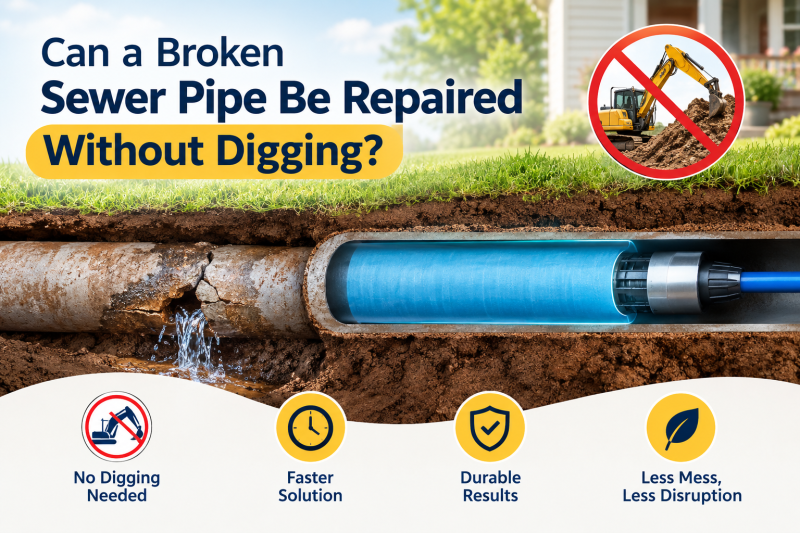
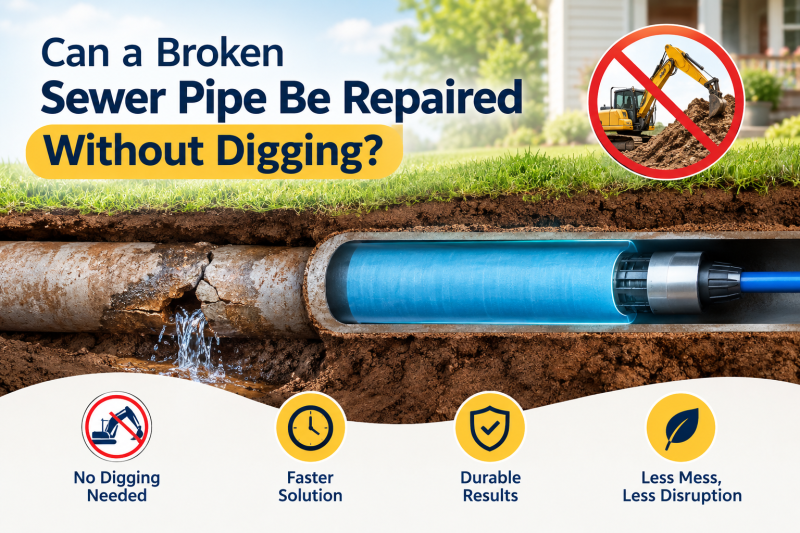
Cured-in-place pipe lining (CIPP) is a trenchless rehabilitation method used to repair certain cracked, corroded, or deteriorating sewer pipes. It creates a new lining inside the existing pipe rather than requiring complete pipe replacement.
During the process, a resin-saturated liner is installed inside the damaged pipe. The liner is then cured using an appropriate method, forming a hardened layer that creates a new pipe wall within the original pipeline.
Benefits of CIPP lining include:
- Minimal excavation compared with conventional replacement.
- Reduced disturbance to landscaping, driveways, and paved surfaces.
- Improved structural integrity in suitable pipes.
- Potentially less restoration work after the repair.
CIPP is not appropriate for every situation. A severely collapsed pipe, significant structural displacement, or an obstruction that prevents liner installation may require additional preparation or excavation.
2. Spray-in-Place Pipe Lining (SIPP)
Spray-in-place pipe lining (SIPP) is another rehabilitation technique that applies a specialized coating to the interior surface of an existing pipe.
After the pipe has been properly cleaned and prepared, equipment sprays the lining material onto its internal walls. Once the coating cures, it forms a protective layer that may help address certain surface deterioration and minor defects.
SIPP may be considered for specific pipe conditions where an internal coating is suitable. Its effectiveness depends on the coating system, pipe condition, and project requirements.Unlike CIPP, which typically uses an inserted liner, SIPP applies the rehabilitation material directly to the pipe's interior. Neither method should be assumed to work for every type of break or structural failure.
When Is Sewer Pipe Repair Without Digging Possible?
Not every damaged sewer line can be repaired using a trenchless method. A professional assessment is necessary to determine whether internal rehabilitation will provide a reliable result.
No-dig repair may be suitable when:
- The pipe has cracks or localized deterioration.
- Corrosion has weakened the internal pipe surface.
- Minor leaks or defects can be addressed with an appropriate lining system.
- The pipe remains sufficiently intact to support the rehabilitation process.
- Existing access points allow the contractor to reach the damaged section.
Excavation may be necessary when the pipe has completely collapsed, sections have shifted significantly, or the line has lost the shape and stability required for internal rehabilitation. Serious root intrusion, persistent obstructions, and substantial grade problems may also require corrective work before a lining solution can be considered.
The goal is not simply to avoid digging. It is to select a repair method that addresses the underlying problem and provides dependable long-term performance.
Why Is Sewer Camera Inspection Important?
A CCTV sewerline inspection helps contractors evaluate the internal condition of an underground sewer line without excavating the entire pipeline.
A specialized camera is guided through the pipe to identify cracks, root intrusion, corrosion, blockages, joint separation, and other visible defects. The inspection helps establish the location and severity of the damage.
This information is important because symptoms such as slow drains or recurring backups do not always indicate a broken pipe. The problem could instead involve accumulated debris, tree roots, or another obstruction.
By identifying the cause, contractors can recommend whether cleaning, localized repairs, pipe lining, or excavation is the most appropriate option.
Is Trenchless Sewer Repair Better Than Traditional Excavation?
The right choice depends on the condition of the sewer line and the work required.
Trenchless repair can be advantageous when the existing pipe is suitable for rehabilitation and property disruption needs to be minimized. It may reduce excavation, surface restoration, and the time required to restore affected areas.
Traditional excavation remains important when a pipe is severely damaged, collapsed, incorrectly aligned, or needs complete replacement. Although excavation can disturb the surrounding property, it may be the most effective way to correct major structural problems.
Property owners should compare the recommended repair methods, expected lifespan, project costs, and any necessary restoration work before making a decision.
Conclusion
A broken sewer pipe does not always require extensive digging. Technologies such as CIPP and SIPP can rehabilitate certain damaged pipes while helping protect driveways, landscaping, and other property features. However, the success of a no-dig solution depends on the pipe's condition and the type of damage involved.
If you are experiencing recurring sewer problems, arrange a professional inspection before deciding on a repair method. TerraBurst provides trenchless sewer rehabilitation solutions to help property owners explore suitable options for damaged underground pipes. Contact the team to discuss your sewer line concerns and determine whether a trenchless approach may be appropriate for your property.
Source:
Click for the: Full Story
You might like









You Might Like this