Close Menu
 World
World
 Biography
 Health
 Education
 Business
 Lifestyle
 Sports
 Technology
 Animals
 History
 Food
Food
 Religious
 Startups
 Movies
 Politics
 Fashion
 Covid
Covid
 Diet
Diet
 Fitness
 Marketing
 Travel
 Science
 Reviews
 Social media
 Stories
 Facts
Facts
 Art
Art
 Entertainment
Kajal yadav

Technology
Custom Marketplace Development: Benefits, Features, and Business Use Cases
 Kajal yadav
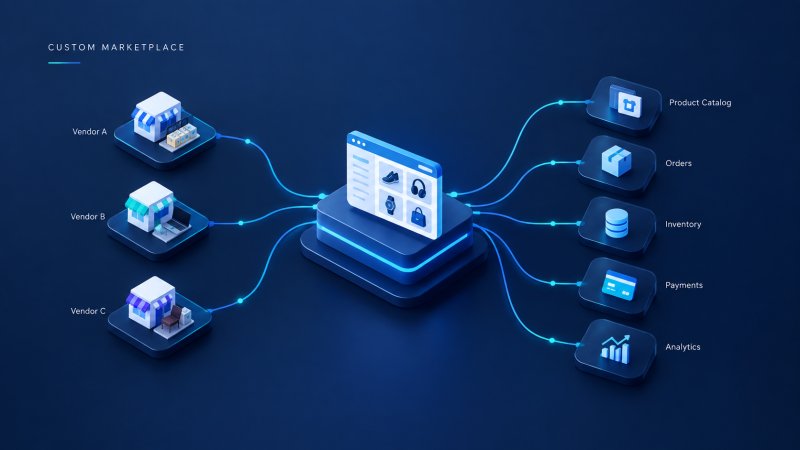
A marketplace is more than a storefront with multiple sellers. It is a commerce system that coordinates buyers, vendors, products, payments, inventory, orders, and fulfillment through a shared platform.
That complexity becomes more visible as a business adds vendors, expands its catalog, introduces new pricing models, or connects enterprise systems. Custom marketplace development gives businesses the flexibility to design these workflows around their operating model instead of forcing them into the limitations of a prebuilt platform.
What Is Custom Marketplace Development?
Custom marketplace development is the process of designing and building a marketplace platform around specific business requirements. It can support B2B, B2C, or hybrid marketplace models.
Unlike a standard ecommerce store, a marketplace has multiple parties operating within the same ecosystem. Vendors may manage their own catalogs and inventory. Buyers need a unified shopping experience. The platform owner needs control over commissions, seller policies, payments, data, and platform governance.
A custom approach allows these rules to become part of the platform architecture. This is especially valuable when businesses have complex pricing, vendor onboarding, fulfillment, or integration requirements that standard marketplace software cannot easily accommodate.
Why Businesses Choose Custom Marketplace Development
1. Business-Specific Workflows
Every marketplace operates differently.
A B2B distributor may need account-specific pricing and approval workflows. A manufacturer marketplace may need supplier verification and inventory synchronization. A service marketplace may require scheduling and location-based availability.
Custom development allows these workflows to be built directly into the platform instead of relying on workarounds.
2. Scalable Architecture
Marketplace growth affects more than website traffic. The platform must handle additional sellers, SKUs, transactions, inventory records, and operational workflows.
A scalable architecture should separate critical components and allow individual services to evolve without requiring a complete platform rewrite. Modular and API-first approaches can make it easier to introduce new integrations and capabilities as requirements change.
3. Flexible Monetization
Marketplace revenue models are rarely limited to a single commission rate.
A platform may charge different commissions by vendor, category, transaction type, or seller tier. It may also use subscription fees, listing fees, transaction charges, or promotional placements.
Custom development can support these rules through configurable commission and settlement logic.
4. Deeper Enterprise Integrations
Enterprise marketplaces rarely operate in isolation.
They may need to exchange data with ERP, CRM, PIM, WMS, accounting, payment, logistics, and analytics systems. An API-first architecture can provide a structured way to connect these systems while keeping business logic manageable.
Essential Features of a Custom Marketplace
A robust custom marketplace should be designed around both buyer and seller operations.
Vendor Management
Vendor management should cover onboarding, verification, approvals, profiles, permissions, catalog access, performance tracking, and account management.
Self-service capabilities are important at scale. Vendors should be able to manage listings, inventory, orders, and other approved operations without creating a manual workload for the marketplace team.
Multi-Vendor Product Catalog
The catalog should support vendor-specific products while maintaining a consistent customer-facing experience.
For enterprise marketplaces, integration with a Product Information Management system can also help maintain structured and consistent product data across channels.
Order Management and Routing
A marketplace may receive one customer order containing products from several vendors. The platform needs to determine how that order is split, routed, fulfilled, tracked, and reconciled.
An integrated Order Management System can coordinate these processes and provide visibility across the order lifecycle.
Payments, Commissions, and Payouts
Marketplace payments introduce additional complexity. A single transaction may involve the customer payment, platform commission, vendor payout, refunds, and settlement rules.
The platform should therefore support configurable payment and commission logic rather than treating marketplace transactions like standard single-merchant ecommerce.
Search and Discovery
Large catalogs require more than basic keyword search.
Businesses can implement advanced filtering, faceted navigation, product attributes, relevance rules, and AI-powered recommendations based on their marketplace model.
Analytics and Reporting
Marketplace operators need visibility into vendor performance, product sales, order volumes, commissions, customer behavior, and operational metrics.
Centralized analytics can help teams identify underperforming products, monitor seller activity, and make informed decisions about marketplace growth.
Business Use Cases for Custom Marketplaces
B2B Marketplaces
B2B marketplaces often involve complex purchasing rules. Buyers may have negotiated pricing, approval hierarchies, credit terms, bulk orders, and account-specific catalogs.
Custom marketplace development can connect these requirements with ERP, CRM, PIM, and OMS systems to create a unified procurement experience.
Manufacturer and Supplier Marketplaces
Manufacturers can use marketplaces to connect buyers with multiple suppliers or distributors.
The platform can support supplier onboarding, product data management, inventory synchronization, order routing, and vendor-specific fulfillment rules.
Retail and Multi-Brand Marketplaces
Retail businesses can expand their assortment by allowing external brands or sellers to operate through the same digital commerce ecosystem.
Custom functionality can help control seller permissions, product approvals, commissions, promotions, and customer experience.
Niche and Vertical Marketplaces
Industry-specific marketplaces often have requirements that general-purpose platforms do not support well.
Examples include industrial equipment, healthcare supplies, automotive parts, construction materials, and professional services. These platforms may require specialized product attributes, certification workflows, account structures, or quote-based purchasing.
Custom vs. Off-the-Shelf Marketplace Platforms
The decision should start with business complexity, not simply the number of features.
An off-the-shelf solution can work when the marketplace has relatively standard workflows and limited customization requirements. Custom development becomes more relevant when the platform needs differentiated business rules, complex integrations, specialized vendor workflows, or greater control over its architecture and data.
The key question is not whether a prebuilt platform has more features. It is whether those features support the way the business actually operates.
Build a Marketplace Around Your Business Model
Custom marketplace development is ultimately about creating an architecture that can support the business as it evolves.
For enterprises, that means thinking beyond the storefront. Vendor management, catalog architecture, payments, order orchestration, integrations, data governance, analytics, and scalability all need to work together.
A well-designed custom marketplace can provide the flexibility to support complex commerce models while creating a foundation for future channels, vendors, products, and customer experiences.
Source:
Click for the: Full Story
You might like