Close Menu
 World
World
 Biography
 Health
 Education
 Business
 Lifestyle
 Sports
 Technology
 Animals
 History
 Food
Food
 Religious
 Startups
 Movies
 Politics
 Fashion
 Covid
Covid
 Diet
Diet
 Fitness
 Marketing
 Travel
 Science
 Reviews
 Social media
 Stories
 Facts
Facts
 Art
Art
 Entertainment
Badal

Health
How a Medico Legal Consultant in Delhi Can Guide Hospitals During Internal Policy Audits
 Badal
Badal
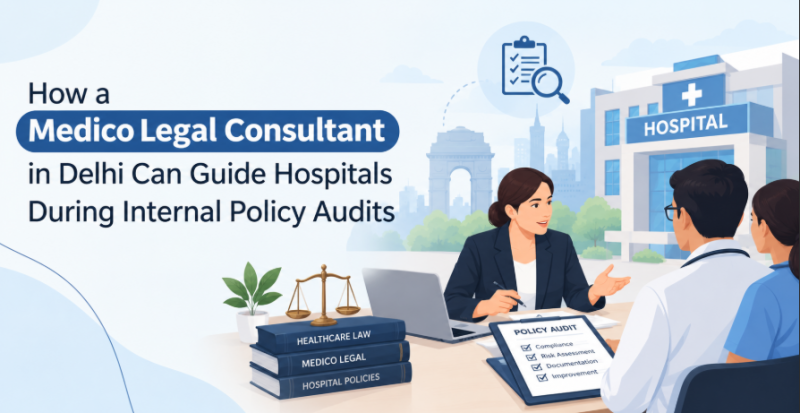
An internal policy audit is meant to find gaps before a patient, regulator or court does. The short answer to how outside guidance helps is this: a medico legal consultant in Delhi can review whether your written policies match actual practice, flag areas of legal exposure, and help you document corrective action. The audit itself, and the clinical and administrative decisions that follow, remain the hospital's responsibility.
Many hospitals have well-written policies that staff rarely follow. When a complaint or legal notice arrives, that gap becomes visible. Medico legal support in Delhi is often most useful at the audit stage, when problems can still be fixed quietly and systematically rather than defended under pressure.
This article is general information, not legal advice. Laws and regulatory guidance change, so confirm the current position with the National Medical Commission (NMC), your state medical council, the relevant regulators and a qualified lawyer.
Why Internal Policy Audits Matter Medico-Legally
Medical negligence is generally assessed by asking whether a duty of care existed, whether care fell below an accepted professional standard, and whether harm resulted. A hospital's policies do not define the legal standard, but they show what the institution itself considered safe practice. If a policy exists and was ignored, or a known gap was never addressed, that can complicate the response to a complaint.
Audits matter to several groups:
- Patients, whose safety depends on consistent processes.
- Treating doctors, who rely on clear protocols and working systems.
- Administrators and clinical governance leads, who are accountable for oversight.
- Nursing, laboratory and support staff, who carry out the policies daily.
How a Medico Legal Consultant in Delhi Can Help
A consultant does not replace your quality team or clinicians. Their value lies in a legal and risk perspective. In practice this may include:
- Reading policies against how work is actually done.
- Identifying where documentation would be weak if challenged.
- Suggesting how to record findings and corrective steps sensibly.
- Advising on how to handle past incidents uncovered during the audit.
- Helping staff understand their responsibilities in complaints and notices.
Be clear on scope at the start. Agree in writing what will be reviewed, what will be delivered and how confidential material will be handled.
Choosing the best medicolegal consultant in Delhi
Hospitals sometimes search for the best medicolegal consultant in Delhi when an audit or dispute is looming. Superlatives are unreliable. Look instead for relevant experience with hospitals and doctors, verifiable credentials, a clear scope of work and cautious, honest advice. Be wary of anyone who promises outcomes or protection from claims.
Policy Areas Worth Auditing
You do not need to audit everything at once. Prioritise areas where disputes commonly arise:
- Informed consent: Is the process defined, and do records show a real discussion of risks and alternatives rather than only a signature?
- Medical records: Are entries dated, timed, legible and signed, with corrections made as dated addenda?
- Patient complaints: Is there a clear route for receiving, logging and answering them?
- Legal notices: Who receives them, who informs insurers and who coordinates replies?
- Incident reporting: Are adverse events and near-misses reported and reviewed?
- Online consultations: If offered, do records show identity checks, consent, history, advice and follow-up, and does prescribing follow the Telemedicine Practice Guidelines of 2020?
- Data protection: Is patient information handled securely, with reference to the Digital Personal Data Protection Act, 2023?
- Doctor credentials: Are registrations current and scope of practice defined?
Check the current text of any regulation directly rather than relying on summaries.
A Practical Process for the Audit
- Define scope and purpose. Decide which policies and departments are covered.
- Collect the policies and note version dates and owners.
- Compare policy with practice. Sample records, interview staff and observe workflows.
- Record findings factually. Avoid speculation and blame in written reports.
- Rank risks by likelihood and potential harm to patients.
- Assign corrective actions with owners and deadlines.
- Follow up to confirm changes took effect.
- Report to leadership and keep a clear audit trail.
A realistic example: A hospital audit finds that its consent policy requires the operating surgeon to explain risks, but a sample of files shows forms signed at admission by relatives, with no clinician's note. Management revises the process so the surgeon records the discussion, trains staff, and re-checks a sample of files after two months. The records now show the gap was identified and corrected in an orderly way.
Documentation and Confidentiality During Audits
Audit documents can be sensitive, so decide early how they will be created and stored. Aim to keep:
- The audit plan, scope and dates.
- Findings, with reference to the records or processes reviewed.
- Corrective actions, owners and completion dates.
- Training provided and attendance.
- Communications with management about unresolved risks.
Never alter or back-date existing clinical records to make them appear compliant. If a gap is found, correct the process going forward and add dated addenda where appropriate. Whether audit material is protected from disclosure in a dispute depends on the law and the facts, so take advice before assuming it is confidential.
Mistakes to avoid
- Treating the audit as a paperwork exercise.
- Writing policies that staff cannot realistically follow.
- Editing past records after problems are found.
- Recording opinions or blame in audit reports.
- Ignoring findings without a documented decision.
- Leaving staff untrained on revised policies.
- Seeking guidance only after a notice arrives.
Quick checklist
- Scope and objectives defined in writing
- Policies compared with real practice
- Findings recorded factually
- Risks ranked and actions assigned
- Staff trained on changes
- Follow-up audit scheduled
- Records left unaltered
When to Seek Professional Medico-Legal Guidance
Consider advice when an audit reveals serious consent or documentation gaps, when unresolved adverse events are found, when you are unsure how to handle a disclosed incident, or when a complaint or legal notice is already pending. If a notice arrives, do not ignore it, do not alter records, preserve all documents, inform your insurer and seek guidance before replying. Dr. Vimal Kant Goyal is a practical medico-legal guide for doctors who explains how such matters are commonly approached, and it can serve as a helpful reference alongside advice on your own situation.
Conclusion
An internal policy audit is most valuable when it compares what the hospital says with what it actually does, and records how gaps are closed. Define the scope, sample real practice, document findings factually and follow up on corrective action. Engaging a medico legal consultant in Delhi can add a useful legal perspective, but consistent practice, honest reporting and unaltered records remain the strongest foundation for patient safety and institutional confidence.
Frequently Asked Questions
1. Do hospitals need a medico legal consultant for an internal audit?Not necessarily. Many audits are run by internal quality teams. A consultant adds a legal and risk view, which can be useful where past disputes, complex consent processes or unclear compliance duties exist.
2. Can audit findings be used against the hospital?It depends on the law and the circumstances, so take advice before assuming either way. Recording findings factually and showing prompt corrective action is generally a sensible approach.
3. How do I choose the best medicolegal consultant in Delhi for a hospital audit?Focus on relevant experience, verifiable credentials, a defined scope and honest guidance. Avoid anyone who guarantees protection from complaints or claims.
4. How often should hospitals review clinical and legal policies?There is no single answer. Review them regularly, after significant incidents and when regulations change, and record the date and owner of each review.
5. What should we do if an audit uncovers a past adverse event?Do not alter records. Preserve documents, report it through your incident process, inform insurers where appropriate and seek guidance on disclosure and communication.
Source:
Click for the: Full Story
You might like