



 Close Menu
 World
World
 Biography
 Health
 Education
 Business
 Lifestyle
 Sports
 Technology
 Animals
 History
 Food
Food
 Religious
 Startups
 Movies
 Politics
 Fashion
 Covid
Covid
 Diet
Diet
 Fitness
 Marketing
 Travel
 Science
 Reviews
 Social media
 Stories
 Facts
Facts
 Art
Art
 Entertainment
Codezeros

Technology
How AMM Models Impact Decentralized Exchange Development Solutions
 Codezeros
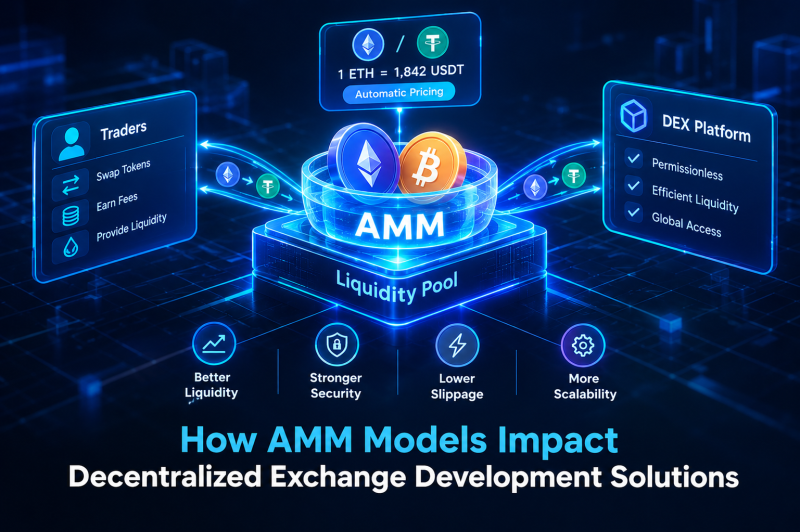
Automated market makers (AMMs) play a central role in decentralized exchange development by allowing users to trade digital assets through smart contracts instead of relying on traditional order books. Their pricing mechanisms, liquidity pool structures, and fee models influence trading efficiency, capital requirements, security, and the overall user experience of a decentralized exchange (DEX).
As decentralized finance continues to mature in 2026, businesses building DEX platforms need to select AMM models based on their assets, liquidity requirements, risk tolerance, and long-term growth plans. Artificial intelligence, automated liquidity management, and enterprise adoption are also influencing how modern decentralized exchanges are designed.
What Is an AMM in Decentralized Exchange Development?
An automated market maker is a smart contract-based mechanism that enables users to trade tokens against liquidity pools. Liquidity providers deposit assets into these pools and may earn a share of trading fees in return. Prices are calculated using predefined mathematical rules rather than matching individual buy and sell orders.
For example, a constant-product AMM uses the formula (x \times y = k), where the quantities of two pooled assets determine their relationship. When a trader buys one asset, the pool balance changes, and the price adjusts accordingly.
This model allows DEX platforms to facilitate trading without requiring a conventional order book or a centralized intermediary.
How AMM Models Influence DEX Architecture
1. Liquidity Pool Design and Capital Efficiency
The AMM model determines how liquidity is supplied, distributed, and used. Basic constant-product pools are relatively straightforward to implement, but they may require substantial liquidity to support large trades with limited price impact.
Concentrated liquidity models allow liquidity providers to allocate capital within specific price ranges. This can improve capital efficiency when liquidity is placed around active trading prices, although providers may face more complex management decisions and greater exposure to impermanent loss.
Actionable insight: Choose a pool design based on expected trading volume, token volatility, liquidity provider behavior, and the depth required for large transactions.
2. Pricing Accuracy and Slippage
AMM pricing mechanisms affect how much traders receive when executing swaps. Slippage can increase when pools have limited liquidity, trades are large relative to pool size, or market prices move quickly.
Different AMMs address this challenge in different ways. Constant-product models support broad token-pair use cases, while stable-swap models are often designed for assets expected to trade at similar values. Concentrated liquidity can improve execution around active price ranges when liquidity is managed effectively.
DEX developers should model expected trade sizes, price impact, pool depth, and volatility before selecting a pricing mechanism.
3. Trading Fees and Liquidity Provider Incentives
Trading fees affect both platform revenue and the returns available to liquidity providers. Fees that are too high may discourage trading, while fees that are too low may not adequately compensate providers for risks and operating costs.
Some AMM designs support different fee tiers based on asset volatility or pool characteristics. A well-planned fee structure should account for network costs, liquidity competition, expected volume, and the risk of impermanent loss.
There is no universally best AMM. The appropriate choice depends on the target market, supported assets, liquidity availability, and the level of complexity the platform can support.
The Role of Smart Contracts and Security
AMMs rely on smart contracts to execute swaps, update pool balances, calculate fees, and manage liquidity positions. Errors in these contracts can expose users and liquidity providers to financial losses.
A secure decentralized exchange development solution should account for:
- Contract correctness: Validate pricing formulas, token transfers, fee calculations, and pool accounting.
- Economic attack scenarios: Test flash-loan attacks, sandwich attacks, oracle manipulation, and abnormal liquidity movements where relevant.
- Token compatibility: Consider fee-on-transfer tokens, rebasing tokens, and other non-standard token behavior.
- Independent audits: Combine code reviews, automated testing, fuzz testing, and independent security assessments.
- Monitoring and incident response: Establish alerts and procedures for unusual trading activity or contract vulnerabilities.
Developers should also assess the limitations of upgradeable contracts, admin permissions, and emergency controls. Security decisions should be documented before deployment rather than added after problems emerge.
How AI and Automation Are Shaping AMMs in 2026
AI and automation are increasingly relevant to the operation and monitoring of decentralized exchanges. Their value depends on how they are integrated with transparent, verifiable smart contract systems.
AI-Assisted Liquidity Analytics
Machine learning systems can analyze historical volume, volatility, liquidity depth, and trading patterns to help operators understand pool performance. These insights can inform liquidity incentives and fee-model reviews, but predictions remain uncertain and should not be treated as guaranteed outcomes.
Automated Risk Monitoring
Automated systems can flag abnormal swaps, sudden liquidity withdrawals, suspicious transaction patterns, and potential oracle issues. On-chain monitoring can help teams respond more quickly, provided alert thresholds and response procedures are carefully designed.
Agentic AI and Controlled Workflows
Agentic AI systems may coordinate defined operational tasks, such as preparing liquidity reports, reviewing pool metrics, or recommending parameter changes. High-impact actions should use explicit permission boundaries, transaction simulation, human approval where appropriate, and auditable execution rules.
For enterprise adoption, AI features must also account for data privacy, governance, regulatory obligations, and operational accountability.
Choosing a Decentralized Exchange Development Partner
Selecting an AMM model is only one part of building a reliable DEX. Businesses should evaluate the wider engineering capabilities behind the platform.
A qualified Decentralized Exchange Development Company should be able to explain its approach to AMM architecture, liquidity mechanisms, smart contract security, blockchain selection, wallet integration, and transaction performance.
Before making a decision, ask prospective development teams:
- Which AMM model best fits the platform's assets and expected trading activity?
- How will liquidity depth, slippage, and fee settings be tested?
- What security audits and economic attack simulations are included?
- Can the architecture support additional trading pairs and future protocol upgrades?
- How will analytics, automated monitoring, and AI-assisted operations be governed?
A strong decentralized exchange development service should connect these technical decisions to measurable business requirements, including user demand, liquidity acquisition, maintenance costs, and risk management.
Conclusion
AMM models shape how decentralized exchanges price assets, distribute liquidity, manage trading fees, and handle market risks. Selecting the right model requires a clear understanding of the target users, supported assets, liquidity strategy, and security requirements. In 2026, AI-assisted analytics and automation can provide additional operational insight when combined with strong governance and tested smart contracts.
Businesses planning a DEX should evaluate these elements together rather than treating the AMM as an isolated technical component. For guidance on architecture, liquidity design, and implementation options, contact us today to discuss your project requirements with Codezeros.
FAQ’s
1. How do AMMs improve decentralized exchange functionality?
AMMs enable token swaps through smart contract-managed liquidity pools. They remove the need for a traditional order book and allow users to trade whenever suitable pool liquidity is available.
2. Which AMM model is best for a DEX platform?
The best model depends on the assets and trading strategy. Constant-product AMMs support general swaps, stable-swap models suit assets with similar values, and concentrated liquidity models can improve capital efficiency when liquidity is actively managed.
3. Are AMMs safer than centralized exchange order books?
Not automatically. AMMs reduce dependence on centralized trade matching, but users can still face smart contract vulnerabilities, price manipulation, slippage, impermanent loss, and other protocol risks.
4. What should businesses consider before building an AMM-based DEX?
Businesses should evaluate liquidity requirements, pricing logic, fee structures, supported blockchains, security audits, user experience, scalability, and regulatory obligations.
Source:
Click for the: Full Story
You might like







You Might Like this