



 Close Menu
 World
World
 Biography
 Health
 Education
 Business
 Lifestyle
 Sports
 Technology
 Animals
 History
 Food
Food
 Religious
 Startups
 Movies
 Politics
 Fashion
 Covid
Covid
 Diet
Diet
 Fitness
 Marketing
 Travel
 Science
 Reviews
 Social media
 Stories
 Facts
Facts
 Art
Art
 Entertainment
Sakshi Padiyar

Education
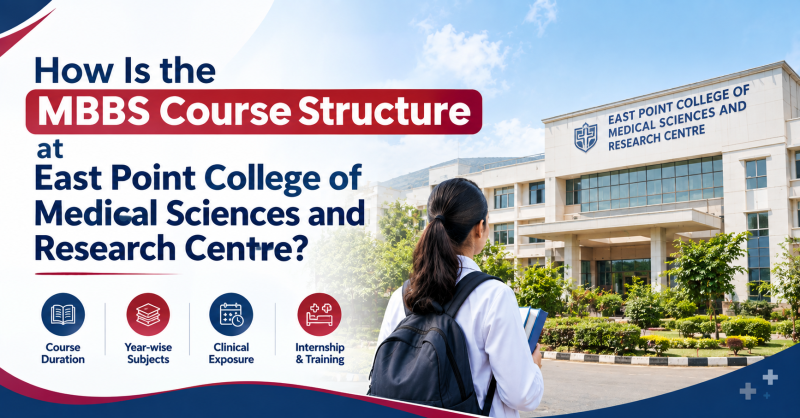
How Is the MBBS Course Structure at East Point College of Medical Sciences and Research Centre?
 Sakshi Padiyar
Students researching medical colleges in Bengaluru often come across East Point College of Medical Sciences and Research Centre while comparing course structure, fees, and admission pathways. Understanding how the MBBS programme is organised — from academic phases to clinical training — helps applicants and parents make an informed decision before starting the admission process.
Overview of East Point College of Medical Sciences and Research Centre
East Point College of Medical Sciences and Research Centre is located in Bengaluru, Karnataka, and offers an MBBS programme structured in line with the curriculum guidelines set by the National Medical Commission (NMC). The institution is affiliated with Rajiv Gandhi University of Health Sciences (RGUHS), which governs academic standards and examination patterns for medical colleges across the state.
Location and Institutional Background
Situated on the outskirts of Bengaluru, the college campus houses academic blocks, laboratories, and a teaching hospital intended to support hands-on learning. Its location within Karnataka's medical education ecosystem is a factor many families consider when comparing accessibility, connectivity, and overall campus environment.
Recognition and Approval Status
Before applying to any medical college, verifying its recognition and approval status is essential. Approval from the National Medical Commission and affiliation with RGUHS should always be reconfirmed through official sources, since accreditation details and seat matrices can be updated periodically by regulatory authorities.
MBBS Course Structure and Duration
The MBBS course at East Point College of Medical Sciences and Research Centre follows the standard national curriculum, spanning four and a half years of academic training followed by a one-year mandatory internship. The programme is divided into pre-clinical, para-clinical, and clinical phases, each building progressively on foundational medical knowledge.
Pre-Clinical and Para-Clinical Phases
The initial phase covers subjects such as Anatomy, Physiology, and Biochemistry, forming the theoretical foundation of medical education. This is followed by para-clinical subjects like Pathology, Microbiology, and Pharmacology, which introduce students to disease mechanisms and treatment principles before they move into direct clinical exposure.
Clinical Training and Internship
In the later years, students rotate through clinical departments including Medicine, Surgery, Obstetrics and Gynaecology, and Paediatrics, gaining supervised exposure to patient care. The final internship year emphasises practical application, allowing students to work under faculty guidance across various hospital departments before graduating.
MBBS Admission in India – Process and Requirements
MBBS Admission in India for institutions like East Point College is primarily governed by NEET eligibility and counselling conducted through the appropriate state or central authorities. Understanding this process early helps students and parents plan applications without last-minute confusion.
Eligibility Criteria for Admission
Candidates typically need to have completed Class 12 with Physics, Chemistry, and Biology, along with a qualifying NEET score as prescribed for the respective academic year. Age criteria and minimum percentage requirements may also apply, and since these norms are reviewed periodically, applicants should confirm current eligibility through official NMC or state counselling notifications.
Counselling and Seat Allotment Process
Admission to MBBS seats generally follows a structured counselling process involving choice filling, seat allotment based on rank and category, and document verification. Since counselling schedules and cut-off ranks vary each year depending on demand and seat availability, students are advised to track official counselling authority websites rather than relying on previous years' data.
Quota Admission in India and Seat Categories
Quota Admission in India plays an important role in how MBBS seats are distributed across government, management, and NRI categories at colleges like East Point. Each category may carry different eligibility conditions, fee structures, and application procedures.
Types of Quota Seats
Seats may be broadly classified under government quota, management quota, and NRI quota, with allocation depending on state-level policies and institutional guidelines. Applicants should identify which category they fall under and understand the specific documentation required for that quota before applying.
Fee Variation Across Quota Categories
Fee structures often differ significantly between government and management quota seats, with NRI quota typically carrying separate cost implications. Since fee revisions occur periodically, students should verify the current fee schedule directly from the college's official admission office rather than assuming figures remain unchanged year to year.
Infrastructure, Faculty and Clinical Exposure
Academic performance during MBBS training is closely linked to the quality of infrastructure, faculty experience, and access to real clinical cases through an attached teaching hospital.
Hospital Facilities and Clinical Exposure
A well-equipped teaching hospital with adequate patient inflow allows students to gain practical exposure across various specialities. Prospective students should look into the hospital's bed capacity, department diversity, and patient load, as these factors directly influence the depth of clinical learning during the course.
Faculty Qualifications and Academic Support
Experienced faculty members contribute significantly to how effectively theoretical concepts translate into clinical understanding. Parents and students evaluating the college should consider faculty-to-student ratios and the availability of academic mentoring alongside standard classroom teaching.
Frequently Asked Questions
Common Questions on Course and EligibilityWhat is the duration of the MBBS course at this college?
The programme spans four and a half years of academic study followed by a one-year compulsory internship, in line with NMC guidelines.
Is NEET mandatory for admission?
Yes, NEET eligibility is a mandatory requirement for MBBS Admission in India, including at East Point College of Medical Sciences and Research Centre.
Does the college offer quota-based admission options?
Quota Admission in India, including government, management, and NRI categories, may be available depending on current seat matrices and state guidelines.
Common Questions on Fees and FacilitiesAre fees the same across all quota categories?
No, fees generally vary between government, management, and NRI quota seats, and should be confirmed through the official fee notification.
Does the college provide hostel facilities?
Hostel facilities are typically available for students, though specifics like capacity and charges should be verified directly with the college administration.
Understanding the MBBS course structure at East Point College of Medical Sciences and Research Centre — from academic phases to clinical training and admission pathways — helps students and parents plan their application more confidently. Since cut-offs, fees, counselling dates, and seat availability are subject to change each year, all details should be verified through official sources before making a final decision.
For personalised guidance on eligibility, quota options, and the admission process, College Storia offers dedicated counselling support for students exploring MBBS opportunities. Reach out to College Storia at +91 9310937372 for further assistance.
Source:
Click for the: Full Story
You might like







You Might Like this