Close Menu
 World
World
 Biography
 Health
 Education
 Business
 Lifestyle
 Sports
 Technology
 Animals
 History
 Food
Food
 Religious
 Startups
 Movies
 Politics
 Fashion
 Covid
Covid
 Diet
Diet
 Fitness
 Marketing
 Travel
 Science
 Reviews
 Social media
 Stories
 Facts
Facts
 Art
Art
 Entertainment
Codezeros

Technology
How Perpetual Exchange Development Supports Modern DeFi Trading Ecosystems
 Codezeros
Decentralized finance has expanded from basic token swaps and lending protocols into a broader financial infrastructure that includes derivatives, structured products, perpetual contracts, and automated trading systems. Among these developments, perpetual markets have become an important component of modern DeFi because they allow traders to gain leveraged exposure to assets without managing contracts with fixed expiration dates.
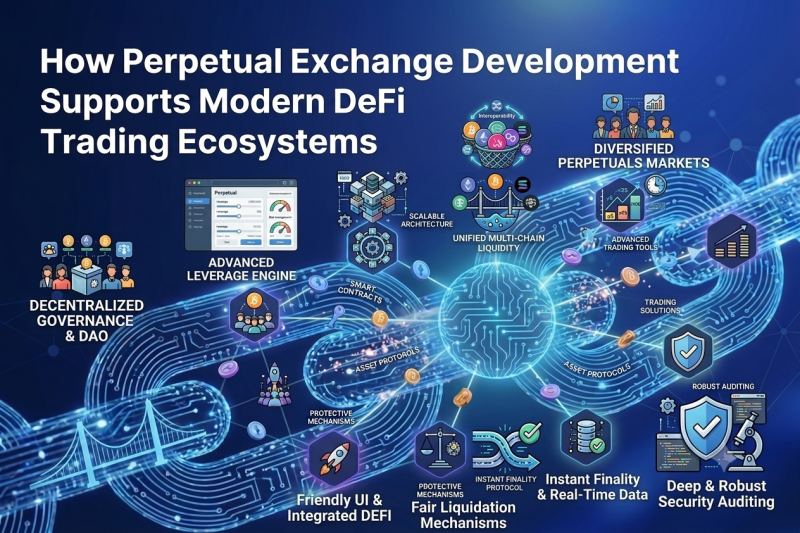
A well-designed perpetual exchange can provide continuous trading, transparent settlement, and programmable risk management. However, building one requires more than deploying smart contracts. Liquidity, pricing, margin management, oracle infrastructure, liquidation mechanisms, security, and scalability all need to work together.
In 2026, Perpetual DEX Development is also being shaped by Layer 2 networks, cross-chain liquidity, AI-assisted monitoring, automation, and growing institutional interest in decentralized markets.
What Is a Perpetual Exchange?
A perpetual exchange enables users to trade perpetual contracts that do not have a predefined expiry date. Traders can generally open long or short positions and use leverage based on the platform's risk parameters.
Unlike conventional spot exchanges, a perpetual trading platform must continuously manage the relationship between contract prices and underlying market prices.
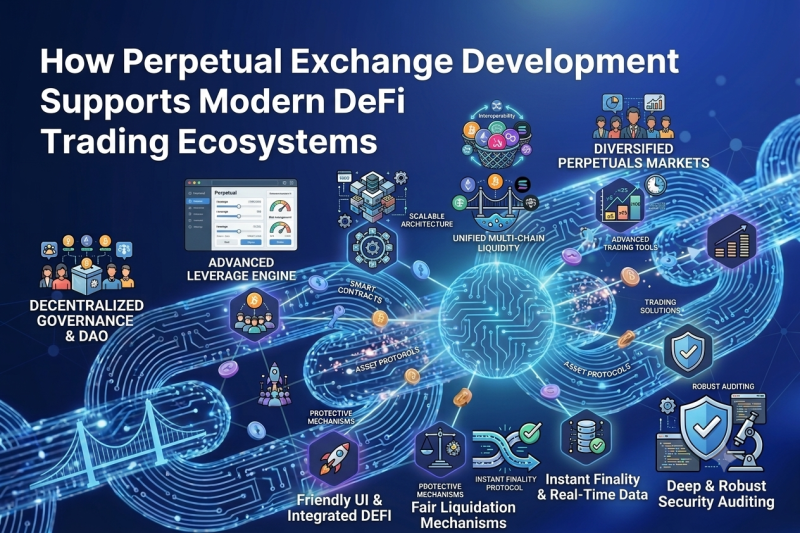
Core components can include:
- Perpetual smart contracts
- Margin and collateral management
- Funding-rate mechanisms
- Price oracles
- Liquidity infrastructure
- Liquidation engine
- Insurance fund
- Wallet connectivity
- Trading interface
- Risk monitoring systems
The architecture chosen for each component can directly affect the platform's reliability and trading experience.
How Perpetual Exchange Development Supports DeFi
1. Enables Decentralized Derivatives Trading
Perpetual markets give DeFi users access to derivatives without requiring a traditional centralized intermediary.
Smart contracts can automate position management, collateral handling, funding payments, and settlement according to predefined rules. This creates transparent market infrastructure where important trading processes can be verified on-chain.
For DeFi ecosystems, perpetual contracts can complement spot trading, lending, liquidity provision, and other financial applications.
2. Expands Trading Strategies
A perpetual trading platform can support both long and short positions, allowing traders to respond to rising and falling markets.
Leverage can also increase capital efficiency, although it introduces substantially greater liquidation risk. Platforms therefore need clearly defined margin requirements and risk parameters.
For developers, the challenge is balancing flexible trading functionality with mechanisms that limit excessive systemic exposure.
3. Creates Additional Liquidity Opportunities
Perpetual markets can create new opportunities for liquidity providers and market makers.
Depending on the architecture, liquidity may come from order books, liquidity pools, virtual AMMs, professional market makers, or hybrid models.
Each approach creates different requirements for capital efficiency, pricing, inventory management, and risk exposure. A DEX Development Company should select a liquidity model based on expected trading volume and target market rather than simply following the most popular design.
Essential Components of Perpetual Futures Exchange Development
Funding Rate Mechanism
Funding payments help maintain alignment between perpetual contract prices and the underlying asset.
The mechanism needs to be designed carefully because extreme funding rates can influence trader behavior and liquidity.
Oracle Infrastructure
Reliable price feeds are essential. Incorrect or delayed prices can trigger inappropriate liquidations or allow market manipulation.
A robust oracle architecture may incorporate multiple sources, deviation checks, update requirements, and emergency controls.
Margin and Liquidation Management
Traders need sufficient collateral to maintain leveraged positions. When collateral falls below required levels, the platform may initiate liquidation.
Liquidation mechanisms should be designed to reduce unnecessary market impact while managing potential bad debt.
Insurance Fund
Insurance funds can help cover certain losses when liquidated positions do not provide sufficient collateral.
The size, funding method, and withdrawal rules for an insurance fund should be defined as part of the platform's broader risk framework.
Layer 2 and Cross-Chain Infrastructure
High transaction costs and network congestion can affect leveraged trading platforms. Layer 2 networks can help address these issues by supporting higher transaction throughput and lower costs for suitable applications.
Cross-chain infrastructure can also expand access to assets and users across different ecosystems. However, multi-chain support increases complexity because each network may have different transaction models, wallet requirements, liquidity conditions, and security assumptions.
A scalable architecture should therefore introduce additional chains only when there is a measurable user or business benefit.
AI, Automation, and Agentic Trading in 2026
AI is becoming increasingly relevant to DeFi infrastructure. Perpetual platforms can use AI-assisted systems for anomaly detection, liquidity monitoring, market analysis, operational alerts, and risk assessment.
Automation can continuously monitor variables such as open interest, funding rates, collateral ratios, liquidity depth, and oracle deviations.
Agentic AI creates another emerging possibility. AI agents may be able to execute predefined trading or portfolio-management actions according to user permissions and specific conditions.
However, agentic systems should not operate without safeguards. Position limits, transaction permissions, spending controls, audit trails, and human intervention mechanisms can help prevent unintended actions.
AI should support the risk framework rather than replace deterministic controls such as margin thresholds and liquidation rules.
Enterprise Adoption of Decentralized Derivatives
Institutional and enterprise interest is increasing the expectations placed on DeFi trading infrastructure. Professional users typically require transparent execution, predictable risk parameters, detailed analytics, strong security, and reliable infrastructure.
Enterprise-oriented perpetual platforms may also need:
- Role-based administration
- Compliance workflows
- Detailed reporting
- Advanced analytics
- API integrations
- Monitoring dashboards
- Institutional wallet support
- Robust security controls
For businesses evaluating development capabilities, Codezeros can be considered when comparing blockchain and decentralized exchange development providers.
How to Plan Perpetual Exchange Development
Before beginning development, decision-makers should define:
- Target traders and markets
- Supported assets
- Blockchain and Layer 2 infrastructure
- Liquidity model
- Maximum leverage
- Funding-rate methodology
- Oracle architecture
- Liquidation mechanism
- Insurance and bad-debt strategy
- Security and monitoring requirements
Starting with these decisions makes it easier to estimate development complexity and identify the infrastructure required for launch.
FAQ'S
1. What is Perpetual Exchange Development?
Perpetual Exchange Development involves creating blockchain-based infrastructure that allows users to trade perpetual contracts with features such as leverage, margin management, funding rates, price oracles, and automated liquidation.
2. How does a perpetual exchange support DeFi?
A perpetual exchange adds decentralized derivatives to the DeFi ecosystem, allowing users to access long and short positions while connecting derivatives activity with other blockchain-based financial services.
3. Why are liquidity and risk controls important?
Liquidity affects execution quality and slippage, while risk controls manage leverage, collateral, liquidations, oracle risks, and potential bad debt. Both are essential to a sustainable perpetual market.
4. Can AI be used in perpetual trading platforms?
Yes. AI can support monitoring, anomaly detection, analytics, and automated workflows. Agentic AI can potentially execute predefined actions, provided strong permission and risk controls are implemented.
5. What should businesses consider when choosing a DEX Development Company?
Businesses should evaluate blockchain expertise, liquidity architecture, smart contract security, oracle design, liquidation systems, scalability, Layer 2 capabilities, AI integration, and ongoing technical support.
Conclusion
Perpetual exchanges are becoming an important part of modern DeFi because they introduce decentralized derivatives, leveraged trading, and additional liquidity opportunities into blockchain ecosystems. Their success depends on much more than trading functionality.
Liquidity design, oracle reliability, funding mechanisms, margin requirements, liquidation processes, security, and scalable infrastructure must be planned together. In 2026, AI-assisted monitoring, automation, Layer 2 networks, cross-chain infrastructure, and enterprise adoption are adding further considerations for development teams.
Businesses evaluating Perpetual Futures Exchange Development should therefore begin with a clear market model and risk framework before selecting technology or development partners.
If you are planning a perpetual trading platform and want to evaluate its architecture, liquidity requirements, or risk framework, contact us today to discuss your project requirements.
Source:
Click for the: Full Story
You might like