Close Menu
 World
World
 Biography
 Health
 Education
 Business
 Lifestyle
 Sports
 Technology
 Animals
 History
 Food
Food
 Religious
 Startups
 Movies
 Politics
 Fashion
 Covid
Covid
 Diet
Diet
 Fitness
 Marketing
 Travel
 Science
 Reviews
 Social media
 Stories
 Facts
Facts
 Art
Art
 Entertainment
Yatin Samra

Technology
How to Build a Successful Home Service App Business: From Idea to Revenue
 Yatin Samra
A digital revolution is happening in the home services industry. Consumers who depended on word-of-mouth, directories, and telephone calls can now find professionals, evaluate the service offered, make appointments, and pay online via mobile apps.
For businesses, this means the chance to develop a home services marketplace that not only brings together consumers and service professionals but also makes money through bookings, subscriptions, leads, or any other source of income.
But developing a good platform takes more than simply creating a mobile app. Businesses will need to solve a consumer problem, attract credible service providers, develop trust, and sustain their economics as the platform grows.
This is what entrepreneurs need to know about the market.
Understanding the Home Service App Business
A home service app works as a digital marketplace between people who need services and professionals who provide them.
A typical customer journey looks like this:
Discover a service → Compare providers → Select a professional → Schedule a booking → Pay → Receive the service → Leave a review
At the same time, providers use the platform to manage their profiles, availability, bookings, customers, and earnings.
The platform owner manages the ecosystem and earns revenue by facilitating these transactions.
This marketplace approach can be applied to many categories, including cleaning, plumbing, electrical work, appliance repair, painting, landscaping, pest control, and home maintenance.
Why the Business Model Matters
A strong app cannot compensate for an unclear business model.
Before starting development, determine exactly how the platform will create value for customers and service providers.
For customers, the value may come from convenience, transparent pricing, verified professionals, easy scheduling, or faster service.
For providers, the platform may provide access to new customers, digital booking tools, payment management, and business visibility.
When both sides receive meaningful value, the marketplace has a stronger foundation for sustainable growth.
Selecting Your Initial Market
Trying to serve every customer and every service category immediately can make the business difficult to manage.
A better approach is to identify a specific market.
For example, you could launch with:
- One city
- One type of customer
- A small number of service categories
- A specific price segment
- A specialized service
Once demand and provider availability are established, the platform can expand.
This approach can be particularly useful when entering the USA, where customer expectations, service prices, regulations, and professional requirements can differ between locations.
Features Your Platform May Need
A successful home service marketplace typically requires three connected systems.
Customer Experience
The customer application should make finding and booking a service simple.
Key functionality can include:
- User registration
- Location-based search
- Service categories
- Provider profiles
- Pricing information
- Ratings and reviews
- Appointment scheduling
- Online payments
- Notifications
- Booking history
- Customer support
Provider Experience
Professionals need a separate set of tools to manage their work.
These may include:
- Profile management
- Service listings
- Availability settings
- Booking requests
- Job status updates
- Customer communication
- Earnings tracking
- Payout management
- Navigation
- Reviews
Administration
The business owner needs visibility across the entire marketplace.
An administrative dashboard can manage customers, providers, bookings, payments, commissions, disputes, promotions, content, and analytics.
This three-sided structure is one of the most important considerations in home service app development.
Trust Is a Core Product Feature
Home services are different from many other online purchases.
A customer isn't simply receiving a package at their doorstep. They may be allowing a professional to enter their home.
As a result, trust can have a major influence on booking decisions.
A platform can strengthen trust through:
- Verified profiles
- Professional credentials where applicable
- Ratings and reviews
- Transparent service descriptions
- Clear pricing
- Secure payments
- Booking confirmations
- Customer support
- Cancellation policies
Verification requirements should be adapted to the service category and local regulations.
Location Technology Can Improve the Marketplace
Home services are inherently location-sensitive.
Customers generally want professionals who operate within their area and can reach them at a convenient time.
Location-based functionality can help the platform:
- Find nearby providers
- Display service areas
- Estimate travel distance
- Calculate arrival times
- Improve provider matching
- Support navigation
As the platform becomes more sophisticated, matching algorithms can consider availability, location, service type, ratings, and other factors.
Choosing the Right Revenue Model
There are several ways to monetize a home service marketplace.
Commission
The platform takes a percentage of each completed booking.
This model directly connects platform revenue with transaction volume.
Subscription
Professionals pay a recurring fee to access platform services.
Different plans can offer different levels of visibility or functionality.
Lead Generation
Providers pay for qualified customer leads rather than paying a commission on the final transaction.
Featured Listings
Professionals pay for increased visibility in search results or promotional areas.
Hybrid Revenue
The platform combines multiple approaches.
A hybrid model can diversify income, but fees should remain reasonable and transparent to avoid discouraging providers or customers.
How Much Does It Cost?
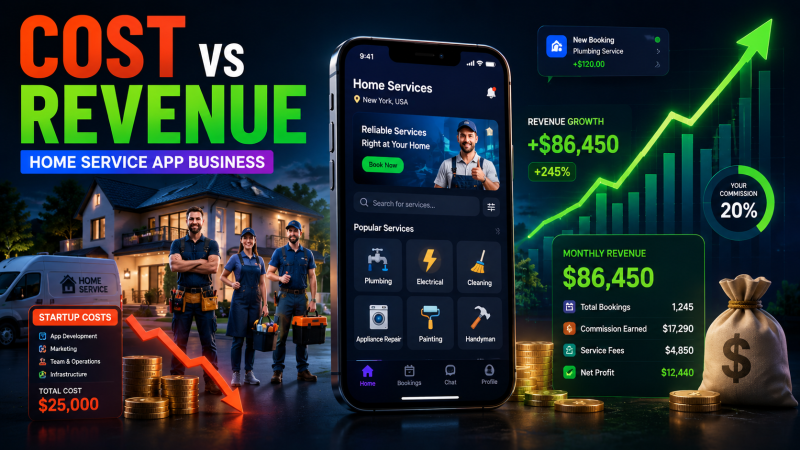
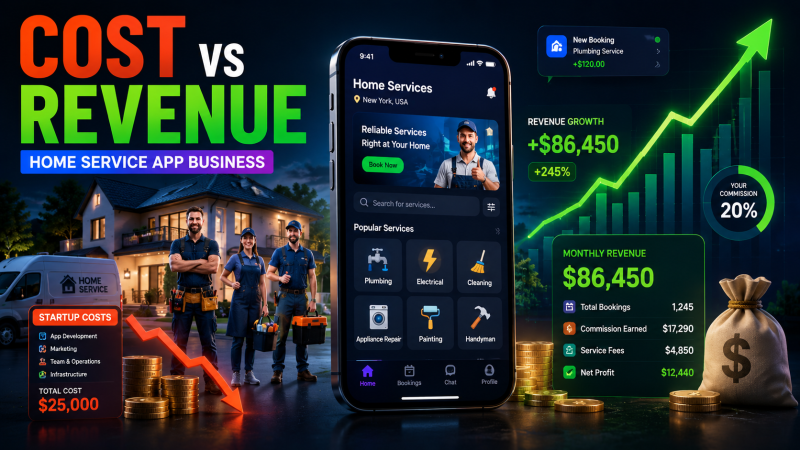
The cost of launching a home service platform depends on its scope.
A simple MVP with basic booking and payment functionality will require a different budget from a sophisticated marketplace with automated matching, real-time tracking, advanced analytics, multiple applications, and extensive integrations.
Major cost factors include:
Design: Research, user journeys, interfaces, prototypes, and usability testing.
Mobile Development: Customer and provider applications.
Backend Development: APIs, databases, authentication, business logic, and marketplace operations.
Admin Panel: Tools for managing the platform.
Integrations: Payments, maps, messaging, notifications, analytics, and verification services.
Security: Data protection, access controls, secure authentication, and monitoring.
Testing: Device compatibility, performance, security, and functional testing.
Maintenance: Updates, bug fixes, infrastructure management, and future enhancements.
The final budget should therefore be based on a detailed feature and technology assessment rather than a generic app development estimate.
Why an MVP Can Be a Smart Starting Point
An MVP allows entrepreneurs to test their assumptions before making a larger investment.
The first version might focus on:
Customers: Search, provider profiles, booking, payment, and reviews.
Providers: Profile setup, availability, job requests, and earnings.
Admin: User management, booking management, provider approval, and basic reporting.
Once the platform has real customers and providers, the business can identify which features deserve further investment.
Advanced functionality such as automated matching, dynamic pricing, loyalty programs, AI-powered recommendations, or real-time tracking can then be introduced when there is a clear business case.
Understanding the Economics
Revenue alone doesn't determine whether a home service marketplace is profitable.
You also need to understand the cost of generating each transaction.
Important metrics include:
- Customer acquisition cost
- Average booking value
- Platform commission
- Provider acquisition cost
- Repeat booking rate
- Customer lifetime value
- Cancellation rate
- Provider retention
- Cost of customer support
For example, acquiring a customer for $40 may not make sense if that customer generates only $20 in platform revenue.
On the other hand, repeat bookings can significantly improve customer lifetime value and make acquisition spending more sustainable.
Scaling the Business
Once the marketplace gains traction, expansion can happen in several directions.
You could add:
- New cities
- Additional service categories
- More providers
- New payment methods
- Subscription plans
- Corporate customers
- Premium services
- Advanced scheduling
- Loyalty programs
However, expansion should be based on measurable demand.
Rapid geographic expansion without sufficient provider availability can result in poor customer experiences. Similarly, adding many service categories without adequate quality control can make the marketplace difficult to manage.
Common Mistakes to Avoid
Several mistakes can make a home service marketplace harder to scale.
Building Too Many Features
An oversized first release increases development costs and delays market validation.
Ignoring Provider Supply
Customer demand means little if there aren't enough qualified professionals available.
Treating Trust as an Afterthought
Weak verification and unclear provider information can reduce customer confidence.
Using an Unsustainable Pricing Model
Excessive commissions or fees can cause providers to leave the platform.
Focusing Only on Downloads
App downloads don't necessarily translate into bookings or revenue. Marketplace activity and repeat usage matter more.
Underestimating Operations
Customer support, disputes, refunds, provider management, and quality control become increasingly important as the platform grows.
A Practical Path to Launch
A structured approach can reduce unnecessary risk.
Step 1: Research the target market.
Step 2: Select a focused service niche.
Step 3: Validate customer demand.
Step 4: Develop the provider acquisition strategy.
Step 5: Select the revenue model.
Step 6: Define the MVP features.
Step 7: Design the platform experience.
Step 8: Build and test the application.
Step 9: Launch in a focused market.
Step 10: Measure performance and expand based on results.
This process keeps technology aligned with business objectives.
Final Thoughts
Home service app can create a cohesive digital marketplace out of the chaotic local services. However, the technology itself is just one piece of the puzzle that makes up the business.
Making sure everything works together involves striking a balance between demand, supply, trust, convenience, technology, and profitability.
That is why entrepreneurs who plan to develop such an application should start with market research and business model validation first.
Start with a minimal viable product, build a solid network of providers, track your unit economics, and listen to the customers' feedback for future changes.
If you want to learn more about this platform development, follow the link below and watch the video to find out more about the development process, key features, technologies used, costs, and earnings opportunities behind home service app development.
Source:
Click for the: Full Story
You might like