Close Menu
 World
 Biography
 Health
 Education
 Business
 Lifestyle
 Sports
 Technology
 Animals
 History
 Food
 Religious
 Startups
 Movies
 Politics
 Fashion
 Covid
 Diet
 Fitness
 Marketing
 Travel
 Science
 Reviews
 Social media
 Stories
 Facts
 Art
 Entertainment
Rajan

Health
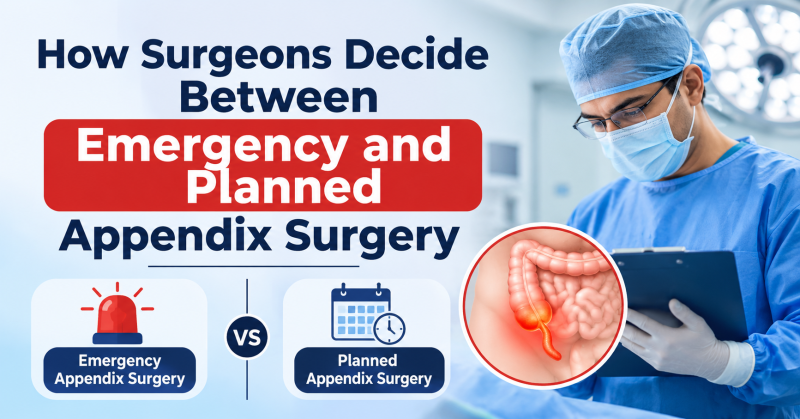
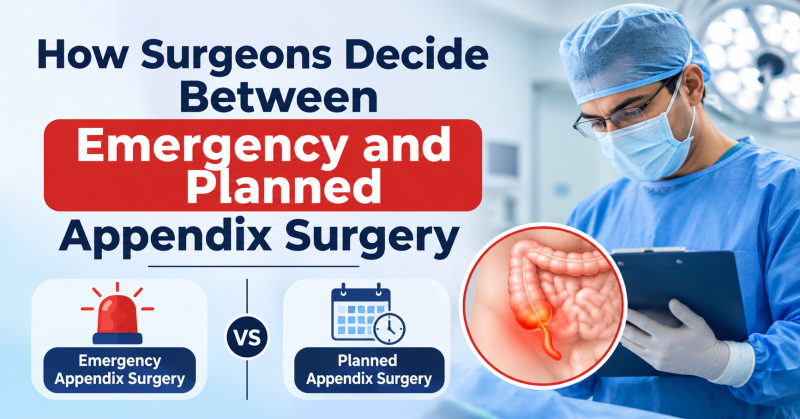
How Surgeons Decide Between Emergency and Planned Appendix Surgery
 Rajan
Sudden pain near the belly button that travels to the lower right abdomen sends many people straight to the emergency room. Others have milder, on-and-off discomfort for days and wonder if it can wait. Both can be appendicitis, and the right treatment depends on how the condition is behaving. This guide explains how surgeons choose between emergency and planned appendix surgery, and what to look for when searching for the best appendix surgeon in Delhi.
What Is the Appendix, and Why Does It Cause Trouble?
The appendix is a small, finger-shaped pouch attached to the large intestine. When its opening is blocked by hardened stool, swollen lymph tissue, or infection, bacteria multiply inside. The appendix swells, blood supply drops, and in severe cases it can rupture.
Appendicitis can affect any age group, but it is most common between 10 and 30 years. Because a rupture spreads infection through the abdomen, timing matters a great deal.
When Is Appendix Surgery an Emergency?
An emergency appendectomy is done within hours of diagnosis. Surgeons usually go this route when:
- Pain is severe and progressive, especially when it settles in the lower right abdomen.
- Fever, vomiting, and loss of appetite accompany the pain.
- The abdomen is rigid or very tender, with pain on coughing, walking, or release of pressure (rebound tenderness).
- Blood tests show a high white cell count or raised inflammatory markers.
- Imaging suggests inflammation, an enlarged appendix, or a perforation.
- The patient is a child, an older adult, pregnant, or has diabetes, where complications can develop faster.
In these cases, waiting increases the risk of rupture, abscess formation, and widespread infection (peritonitis). Most surgeons consider acute, uncomplicated appendicitis a reason to operate promptly, often within 24 hours.
When Can Appendix Surgery Be Planned?
A planned (elective or interval) appendectomy is scheduled once the person is stable. It usually applies to these situations:
- Appendiceal abscess or mass. If the infection has been walled off by the body, operating immediately can be risky. Surgeons may first treat with antibiotics and drain the abscess, then remove the appendix a few weeks later (interval appendectomy).
- Recurrent or chronic appendicitis. Some people have repeated bouts of right-sided pain that settle on their own. After other causes are ruled out, surgery can be scheduled.
- Mild, uncomplicated appendicitis managed with antibiotics first. Selected patients with early disease may be treated with antibiotics. Studies show many recover, but a notable share have a recurrence within a few years, so some later choose a planned operation.
- Incidental findings. Occasionally the appendix is flagged during imaging or another surgery for a different problem.
How Surgeons Reach the Decision
Surgeons rarely rely on one factor. A typical assessment includes:
1. Clinical Examination
The location of tenderness, guarding, and fever pattern offer the first clues. Experienced surgeons can often tell how advanced the problem is from examination alone.
2. Scoring Systems
Tools like the Alvarado score combine symptoms, signs, and lab values into a number that estimates the likelihood of appendicitis. A high score pushes toward urgent surgery.
3. Blood and Urine Tests
These help confirm infection and rule out urinary stones or infections that mimic appendicitis.
4. Imaging
- Ultrasound is the first choice for children, young women, and pregnant patients.
- CT scan gives a detailed view in adults and shows whether there is a perforation, abscess, or mass.
- MRI is sometimes used in pregnancy when ultrasound is inconclusive.
5. Patient-Specific Factors
Age, other illnesses, blood thinners, pregnancy, and how long symptoms have lasted all influence the plan.
Laparoscopic vs. Open Surgery
Most appendectomies today are done laparoscopically, through a few small incisions. Benefits typically include less pain, smaller scars, a lower chance of wound infection, and faster return to routine activity. Open surgery is still used when the infection is extensive, the anatomy is unclear, or laparoscopy is not safe for the individual patient. A good surgeon chooses the approach based on safety, not preference.
Signs You Should Not Wait
Go to a hospital immediately if you or your child has:
- Worsening pain in the lower right abdomen
- Pain that begins near the navel and shifts
- Fever with vomiting
- A swollen, hard abdomen
- Sudden relief from pain followed by fever and weakness (this can signal a rupture)
Avoid taking painkillers repeatedly to “see if it settles,” as they can mask symptoms and delay diagnosis.
Choosing the Best Appendix Surgeon in Delhi
When people search for the best appendix surgeon in Delhi, they are usually looking for sound judgment as much as technical skill. Useful things to look for include:
- Postgraduate training in general surgery with experience in laparoscopic techniques
- Affiliation with a hospital that has 24-hour emergency, imaging, and ICU support
- Willingness to explain why surgery is urgent or can be scheduled
- Transparency about risks, recovery, and alternatives such as antibiotic therapy
- Clear follow-up instructions
Location also matters in emergencies. Many families prefer the best appendix surgeon in Central Delhi because well-connected hospitals there are reachable quickly from different parts of the city. Surgeons such as Dr. Tarun Mittal, a senior laparoscopic and general surgeon at Sir Ganga Ram Hospital, handle appendix cases alongside hernia, gallbladder, and other minimally invasive procedures. The hospital is located at Sir Ganga Ram Hospital Marg, Old Rajinder Nagar, New Delhi, Delhi 110060. Whichever surgeon you consult, confirm credentials and ask how emergency cases are handled after hours.
What to Expect After Surgery
Recovery is usually quick after an uncomplicated laparoscopic appendectomy:
- Many patients go home within 24 to 48 hours.
- Light walking is encouraged early.
- Desk work can often resume within a week, while strenuous exercise may need two to four weeks.
- Complicated or ruptured cases may require longer hospital stays and antibiotics.
Call your surgeon if you notice persistent fever, spreading redness, wound discharge, worsening pain, or repeated vomiting.
Conclusion
The decision between emergency and planned appendix surgery comes down to how inflamed or complicated the appendix is, how stable the patient is, and what examination and imaging reveal. Emergency surgery protects against rupture, while planned surgery suits abscesses, recurrent episodes, or carefully selected cases treated with antibiotics first. If you have persistent right-sided abdominal pain, get evaluated early rather than waiting. A careful assessment, followed by a clear explanation from an experienced surgeon, is what separates good care from guesswork, and it is the most reliable way to identify the best appendix surgeon in Delhi for your situation.
FAQs
1. Can appendicitis go away without surgery?
Mild cases sometimes settle with antibiotics, but this needs a surgeon’s supervision. Recurrence is possible, and untreated appendicitis can rupture.
2. How long can I wait before surgery for appendicitis?
Once diagnosed with acute appendicitis, surgery is generally advised within about 24 hours. Delay increases the risk of perforation.
3. Is planned appendix surgery safer than emergency surgery?
Planned surgery in a stable patient carries lower risk than operating on a ruptured appendix, but it is only suitable when the situation allows waiting.
4. How do I find the best appendix surgery in Central Delhi?
Look for a hospital with round-the-clock emergency care, experienced laparoscopic surgeons, good infection-control practices, and clear communication about the treatment plan.
5. Will I have a scar after appendectomy?
Laparoscopic surgery leaves a few small marks that fade with time. Open surgery leaves a single larger scar in the lower right abdomen.
Source:
Click for the: Full Story
You might like