



 Close Menu
 World
World
 Biography
 Health
 Education
 Business
 Lifestyle
 Sports
 Technology
 Animals
 History
 Food
Food
 Religious
 Startups
 Movies
 Politics
 Fashion
 Covid
Covid
 Diet
Diet
 Fitness
 Marketing
 Travel
 Science
 Reviews
 Social media
 Stories
 Facts
Facts
 Art
Art
 Entertainment
Sakshi Padiyar

Education
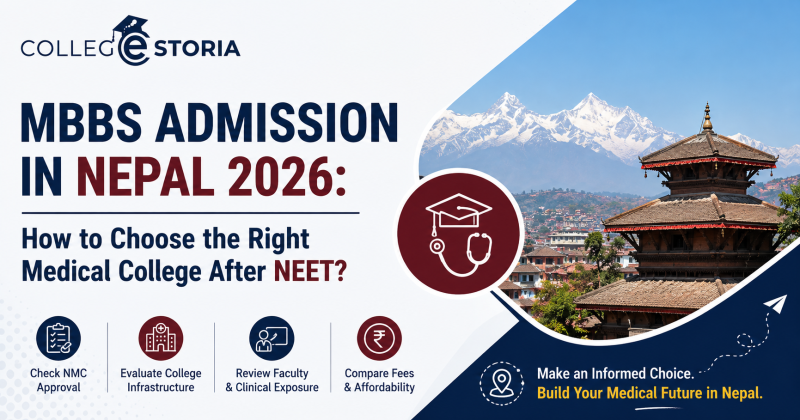
MBBS Admission in Nepal 2026: How to Choose the Right Medical College After NEET?
 Sakshi Padiyar
Scoring well in NEET is only the first step toward becoming a doctor. If you are considering MBBS Admission in Nepal after NEET 2026, the next and more important decision is choosing a medical college that fits your academic goals, budget and long-term career plans.
Nepal attracts Indian medical aspirants because of its geographical proximity, familiar cultural environment and established medical education system. However, choosing a college simply because it has a lower fee or is popular online can create problems later.
So, how should you choose the right college for MBBS in Nepal after NEET?
The answer is to compare colleges across recognition, admission route, clinical exposure, fees, internship, location and future registration requirements—not just rankings.
Why Are Indian Students Considering MBBS in Nepal?
MBBS in Nepal can be an alternative for students who want to study medicine outside India. Nepal's medical education system includes universities and medical institutions offering MBBS programmes, with foreign-student admission conducted under the applicable rules of the Medical Education Commission (MEC).
The MEC's published foreign-student admission lists demonstrate that international candidates can be matched to MBBS institutions such as Maharajgunj Medical Campus, B.P. Koirala Institute of Health Sciences and Kathmandu University School of Medical Sciences.
For Indian students, proximity is another practical advantage. Nepal is geographically close to India, making travel comparatively convenient for students and families.
But convenience alone should not determine your college choice.
How to Choose the Right Medical College in Nepal After NEET 2026
1. Check Recognition and Regulatory Status First
Before comparing fees or facilities, verify the college's current recognition and regulatory status.
This is particularly important for Indian students because completing an MBBS abroad does not automatically mean that a graduate can practise medicine in India.
Check:
- The college's current status in Nepal
- The university or academy awarding the degree
- Applicable NMC requirements for foreign medical graduates
- Course duration and internship structure
- Current admission rules for Indian students
Do not rely on a consultant's statement such as “NMC-approved college” without checking the current regulatory information yourself.
2. Understand the Admission Route
One of the biggest mistakes students make is assuming that every Nepal medical college follows the same admission process.
The Medical Education Commission conducts the Medical Education Common Entrance Examination (MECEE-BL) for medical admissions, while the exact route for foreign candidates can depend on the prevailing rules and category.
For example, Nepal-based medical institutions describe foreign applicants as being subject to the applicable MEC entrance process and documentation requirements.
Therefore, before applying, ask:
Is admission through MEC counselling, an entrance examination, or another officially permitted route for my category?
Getting this answer first can prevent confusion later.
3. Compare Clinical Exposure, Not Just Campus Infrastructure
A beautiful campus does not necessarily mean better medical training.
For MBBS students, clinical exposure is one of the most important factors because medicine requires practical experience with real patients.
When comparing colleges, find out:
- Which teaching hospital is attached to the college?
- How many patients does the hospital handle?
- Which major departments are available?
- When does clinical training begin?
- How are clinical postings organised?
- Is there adequate exposure to medicine, surgery, pediatrics, obstetrics and gynecology?
- Where is the compulsory internship conducted?
A college with strong hospital exposure can provide a more useful learning environment than a college that simply promotes modern buildings and laboratories.
4. Don't Select a College Only on the Basis of Fees
Fees naturally matter, especially for families planning several years of medical education.
However, the cheapest MBBS college in Nepal is not automatically the best choice.
5. Check the College's Location
Location can influence your day-to-day student experience.
Popular medical education locations in Nepal include Kathmandu, Dharan, Pokhara, Bharatpur, Biratnagar and other regional centres.
Ask yourself:
- Do I prefer a large city or a quieter location?
- How far is the college from the nearest airport?
- Is accommodation available nearby?
- How convenient is transportation?
- How easy is it to travel home to India?
- Does the city provide adequate student facilities?
For some students, Kathmandu may be attractive because of its urban facilities. Others may prefer a quieter environment where they can focus on academics.
6. Investigate Internship and India-Return Requirements
This is an area students should never ignore.
If your plan is to return to India after MBBS in Nepal, you need to understand the current regulatory requirements applicable to foreign medical graduates.
Before admission, verify whether the proposed programme's:
- Academic duration
- Clinical training
- Internship
- Registration pathway
- Degree structure
align with the rules applicable to your graduating batch.
Do not wait until the final year to investigate these requirements.
7. Compare Colleges Based on Your NEET Profile
Your NEET score should influence your strategy, but it should not be the only factor.
A student with a stronger score may have access to more competitive options, while another student may need to consider a broader range of colleges and admission routes.
Instead of asking:
“Which is the cheapest college I can get?”ask:
“Which recognised college gives me the best combination of academics, clinical exposure, affordability and career suitability?”This change in approach can make your college-selection process much more effective.
8. Check the Student-to-Hospital Learning Environment
Hospital exposure is valuable only when students actually receive meaningful clinical learning opportunities.
Before choosing a college, research:
- Number and variety of departments
- Patient load
- Clinical posting schedule
- Availability of teaching faculty
- Laboratory facilities
- Emergency services
- Internship opportunities
A medical student should ideally have sufficient opportunities to observe, learn and gradually develop clinical skills under supervision.
9. Speak to Current Students—But Verify Their Claims
Student reviews can provide useful practical information about:
- Hostel life
- Food
- Faculty availability
- Attendance
- Clinical postings
- Campus environment
- Daily expenses
However, don't make a final decision based on one student's experience.
A review from 2024 may not accurately describe the situation in 2026. Use student feedback as one input, then verify important information through official sources.
10. Avoid “Guaranteed Seat” Claims
Indian students searching for MBBS Admission in Nepal may encounter advertisements promising guaranteed admission, extremely low fees or immediate seat confirmation.
Treat such claims carefully.
The Embassy of India in Kathmandu has also advised applicants in certain educational schemes to be cautious of unauthorised education consultants and intermediaries.
Before paying a large amount:
- Ask for the official admission letter.
- Verify the college and programme.
- Confirm the applicable admission route.
- Request the official fee structure.
- Check the payment recipient.
- Keep receipts and written communication.
- Avoid making decisions solely on verbal promises.
A Simple College-Selection Checklist
Before finalising your MBBS in Nepal college, ask these questions:
- Is the college currently recognised by the relevant Nepalese authority?
- Does the programme satisfy applicable NMC requirements?
- What is the official admission route for Indian students?
- What is the complete tuition fee?
- What are the hostel and living costs?
- Which hospital provides clinical training?
- How strong is the clinical exposure?
- What is the internship structure?
- What university or academy awards the degree?
- What are the requirements for returning to India after graduation?
If you cannot get clear answers to these questions, don't rush into admission.
MBBS Admission in Nepal 2026: What Should Be Your Priority?
A useful way to shortlist colleges is to rank your priorities:
Recognition → Admission Route → Clinical Exposure → Total Cost → Internship → Location → Student Facilities
This order is more practical than choosing a college based only on social-media popularity or advertisements.
Remember that MBBS Admission in Nepal is a long-term educational investment. A difference in tuition fees today may be less important than the quality of clinical training and regulatory compatibility over the next five or six years.
Final Takeaway
Choosing a medical college after NEET is more important than simply finding a seat. If you are planning MBBS Admission in Nepal 2026, compare colleges systematically instead of making a decision based on advertisements, rankings or fee figures alone.
The right college should offer a suitable combination of recognition, academic quality, clinical exposure, transparent fees, proper internship and a clear pathway for your future career.
If you are confused about which medical college to choose for MBBS in Nepal, CollegeStoria can help you compare available options based on your NEET score, budget, academic preferences and long-term goals.
FAQs
1. Is MBBS in Nepal a good option after NEET 2026?
It can be an option for eligible Indian students who want to pursue medicine outside India. However, students should compare recognition, clinical exposure, fees, admission route and future registration requirements before choosing a college.
2. How should I select a medical college in Nepal after NEET?
Start by checking recognition and regulatory requirements, then compare the admission route, clinical exposure, hospital facilities, total cost, internship and location.
3. Is NEET required for MBBS Admission in Nepal?
Indian students should verify the current requirements applicable to foreign medical education and their future registration in India. NEET eligibility is an important consideration for Indian applicants.
4. Should I choose the cheapest MBBS college in Nepal?
Not necessarily. Total cost matters, but students should also evaluate clinical exposure, hospital facilities, recognition, internship and future career requirements.
5. What is the biggest mistake students make while choosing MBBS in Nepal?
One common mistake is selecting a college based only on fees or claims made by admission agents. Students should independently verify the college's current status, admission process, fee structure and applicable regulations.
Source:
Click for the: Full Story
You might like



You Might Like this