



 Close Menu
 World
World
 Biography
 Health
 Education
 Business
 Lifestyle
 Sports
 Technology
 Animals
 History
 Food
Food
 Religious
 Startups
 Movies
 Politics
 Fashion
 Covid
Covid
 Diet
Diet
 Fitness
 Marketing
 Travel
 Science
 Reviews
 Social media
 Stories
 Facts
Facts
 Art
Art
 Entertainment
Sakshi Padiyar

Education
MBBS Admission in Nepal After NEET 2026: What Happens After You Qualify?
 Sakshi Padiyar
Qualifying NEET 2026 is an important milestone, but it does not automatically mean that you have secured an MBBS seat. If you are considering MBBS Admission in Nepal after NEET, the next steps involve understanding eligibility, entrance requirements, registration, counselling, college selection and documentation.
For Indian students, the process can be different from MBBS Admission in India, so it is important to understand what happens after qualifying NEET before making any financial commitment.
This guide explains the practical steps an Indian student should consider after qualifying NEET 2026 and deciding to pursue MBBS in Nepal.
What Happens After Qualifying NEET 2026?
After receiving your NEET 2026 result, don't immediately pay an admission agent or college. First, determine whether studying medicine in Nepal is suitable for you.
The process can broadly be understood as:
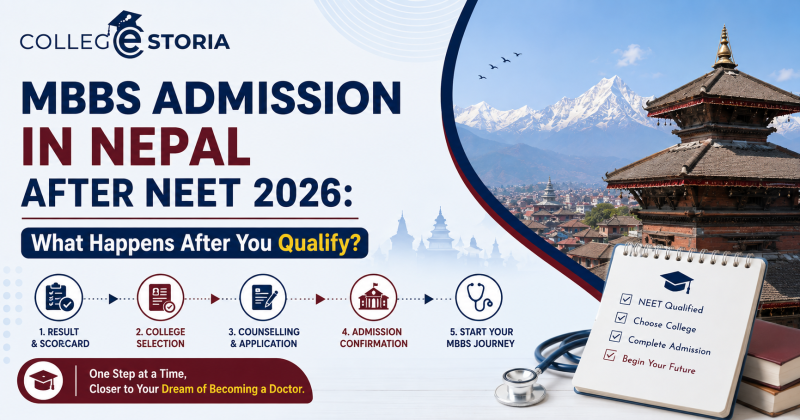
NEET Qualification → Check Eligibility → Understand Nepal's Admission Route → Register for Applicable Process → Participate in Selection/Counselling → Verify College → Complete Documents → Pay Official Fees → Join the MBBS Programme
The exact procedure can differ according to your student category and the rules applicable to the 2026 admission cycle.
Step 1: Check Your NEET 2026 Result and Eligibility
Your first step should be to download and preserve your NEET 2026 scorecard.
Check your:
- NEET score
- All India Rank
- Qualification status
- Category
- Personal details
- Application information
For an Indian student planning medical education abroad, NEET qualification is an important requirement under the applicable Indian rules. However, qualifying NEET does not itself guarantee admission to a Nepalese medical college.
You must also satisfy the academic and admission requirements applicable in Nepal.
Step 2: Understand the Difference Between MBBS in Nepal and MBBS Admission in India
Students sometimes assume that qualifying NEET means they can follow the same counselling process everywhere.
That is not necessarily the case.
MBBS Admission in India generally involves counselling conducted through authorities such as MCC and respective state counselling bodies, depending on the seat category.
For MBBS Admission in Nepal, students need to understand the admission framework applicable under Nepal's Medical Education Commission (MEC), as well as the rules for international students.
Therefore, don't assume that registering for Indian counselling automatically registers you for a Nepalese medical college.
Step 3: Check Whether You Meet the Academic Requirements
Before applying, check the eligibility criteria applicable to your category.
Students should generally review requirements related to:
- Class 12 or equivalent qualification
- Physics
- Chemistry
- Biology/Biotechnology
- Minimum required marks
- NEET qualification
- Medical entrance requirements applicable in Nepal
- Passport and other identity documents
- Equivalence requirements for foreign-board students, where applicable
The exact requirements should be verified from the current admission notification rather than relying on an old blog or social-media post.
Step 4: Understand Nepal's Medical Entrance and Selection System
One of the most important things to understand after NEET is that Nepal has its own medical education admission framework.
The Medical Education Commission (MEC) manages medical education entrance and admission processes in Nepal. The Medical Education Common Entrance Examination, commonly known as MECEE-BL, is an important part of Nepal's medical admission system.
However, the process applicable to foreign students can differ from that applicable to Nepalese candidates.
Therefore, Indian applicants should first identify their category and then check the current 2026 instructions regarding:
- Entrance examination
- Registration
- Foreign-seat allocation
- Merit
- Counselling or matching
- Document verification
- Admission deadlines
This is particularly important because admission rules can be updated from one academic session to another.
Step 5: Register for the Applicable Admission Process
Once you understand the requirements, complete the relevant registration within the prescribed deadline.
During registration, you may need to provide information such as:
- Personal details
- NEET information
- Academic qualifications
- Passport details
- Photograph
- Citizenship/nationality information
- Category information
- Entrance-related details
- Supporting certificates
Always enter information exactly as it appears on your official documents.
A small mistake in your name, date of birth or document number can create unnecessary problems during verification.
Step 6: Shortlist Medical Colleges in Nepal
This is where you should slow down and compare your options.
Don't choose a college simply because someone says it is the “best” or “cheapest” option.
When comparing colleges for MBBS in Nepal, consider:
Recognition and regulatory status
Verify the college's current status with the relevant authorities.
Teaching hospital
Find out which hospital provides clinical training and whether students receive meaningful patient exposure.
Total cost
Consider tuition, hostel, food, travel, books, examination charges and other expenses.
Course structure
Check the duration of academic education and internship.
Location
Consider accessibility, accommodation, transportation and distance from your home.
Future career plans
If you intend to return to India, understand the current NMC requirements applicable to foreign medical graduates.
Step 7: Participate in Counselling or Seat Allocation
After completing the relevant registration and entrance requirements, eligible students proceed through the applicable selection or seat-allocation process.
Depending on the admission category, students may have to provide preferences for eligible medical colleges.
This is an important stage because your college preference should be based on more than reputation.
A sensible preference strategy considers:
College suitability + clinical exposure + total cost + location + future career requirements
rather than simply choosing colleges based on their popularity.
Step 8: Verify the Seat Before Paying
Suppose you receive a seat at a medical college.
Do not immediately transfer a large amount of money to an individual account.
First verify:
- Official admission letter
- College name
- Course
- Student category
- Fee amount
- Payment deadline
- Official bank/payment details
- Refund conditions
- Required documents
Whenever possible, make payments through the official channel specified by the institution.
Keep every receipt, email and admission document safely.
Step 9: Complete Document Verification
Foreign students may need additional documentation compared with domestic applicants.
Depending on the applicable admission rules, students may be asked for academic certificates, NEET documents, passport, photographs, entrance-related documents, equivalence certificates and other supporting records.
Keep multiple copies of your important documents.
It is also useful to maintain a digital folder containing scanned copies so that you can access them when required.
Step 10: Complete Admission and Prepare for MBBS
After successful document verification and payment of the prescribed fees, you can complete the admission formalities.
Before travelling or joining the college, confirm:
- Reporting date
- Hostel availability
- Orientation schedule
- Required medical documents
- Original certificates needed
- Fee payment schedule
- University registration requirements
- Local accommodation and transportation
Planning these details early makes the transition much easier.
What About NMC Requirements for Indian Students?
This is one of the most important considerations when planning MBBS Admission in Nepal.
An Indian student studying medicine abroad should understand the NMC requirements applicable to foreign medical graduates before joining the course, rather than waiting until graduation.
Check whether the programme you are considering satisfies the rules applicable to your graduating batch regarding:
- Medical education duration
- Clinical training
- Internship
- Qualification recognition
- Registration in the country of study
- Licensing requirements in India
- Eligibility for registration in India
Regulations can change, so students should rely on the latest official information applicable to their admission year.
MBBS in Nepal vs MBBS in India: What Should You Consider?
Students often compare MBBS Admission in India with studying medicine in Nepal.
Neither option is automatically better for everyone.
MBBS in India may be preferable for students who secure a suitable seat and want to remain within India's medical education and registration system.
Nepal may be considered by students who are exploring medical education abroad and meet the applicable admission and regulatory requirements.
Before deciding, compare:
- Total education cost
- College recognition
- Clinical exposure
- Admission competitiveness
- Location
- Internship structure
- Future registration requirements
- Long-term career plans
The decision should be based on your individual circumstances rather than what another student has chosen.
Common Mistakes After NEET Qualification
Choosing a college before checking recognition
Never assume that a college is suitable simply because an agent recommends it.
Looking only at tuition fees
A lower tuition fee may not mean a lower overall cost.
Ignoring clinical exposure
Hospital training is one of the most important parts of medical education.
Assuming NEET qualification guarantees a Nepal seat
NEET and Nepal's admission requirements should be understood separately.
Delaying NMC research
If you intend to return to India, understand the applicable foreign medical graduate regulations before admission.
Paying without verifying documents
Always confirm the official admission offer and payment details.
Final Takeaway
Qualifying NEET 2026 is not the end of the admission journey—it is the point where you need to make an informed decision.
If you are considering MBBS Admission in Nepal, first understand your eligibility, identify the correct admission route, compare medical colleges and verify the regulatory requirements applicable to Indian students.
Most importantly, don't rush because an agent tells you that a seat is “limited.” Take time to verify the college, fees, documents, clinical training and future career pathway.
If you are also considering MBBS Admission in India, compare both options carefully before making your final decision.
For personalised guidance on MBBS in Nepal, college selection, eligibility, fees and admission planning, CollegeStoria can help you evaluate your options according to your NEET profile and career goals.
Frequently Asked Questions
1. Can I apply for MBBS in Nepal after qualifying NEET 2026?
Indian students who qualify NEET can explore medical education in Nepal, subject to the eligibility and admission requirements applicable to Indian/foreign candidates. NEET qualification alone does not guarantee a seat.
2. Do I need to follow the same counselling process as MBBS Admission in India?
No. The admission framework for MBBS in Nepal can differ from the counselling process used for MBBS Admission in India. Students should check the current Nepalese admission instructions applicable to foreign candidates.
3. Is NEET qualification enough for MBBS Admission in Nepal?
No. Students must also satisfy the academic, entrance, documentation and other requirements applicable to their admission category.
4. What should I check before selecting a medical college in Nepal?
Verify recognition, university affiliation, teaching hospital, clinical exposure, complete fees, internship structure, admission route and the applicable requirements for returning to India.
5. Can I return to India after completing MBBS in Nepal?
Students can plan to return to India, but they must meet the applicable NMC and registration requirements for foreign medical graduates. These requirements should be checked before admission.
Source:
Click for the: Full Story
You might like



You Might Like this