



 Close Menu
 World
World
 Biography
 Health
 Education
 Business
 Lifestyle
 Sports
 Technology
 Animals
 History
 Food
Food
 Religious
 Startups
 Movies
 Politics
 Fashion
 Covid
Covid
 Diet
Diet
 Fitness
 Marketing
 Travel
 Science
 Reviews
 Social media
 Stories
 Facts
Facts
 Art
Art
 Entertainment
Sakshi Padiyar

Education
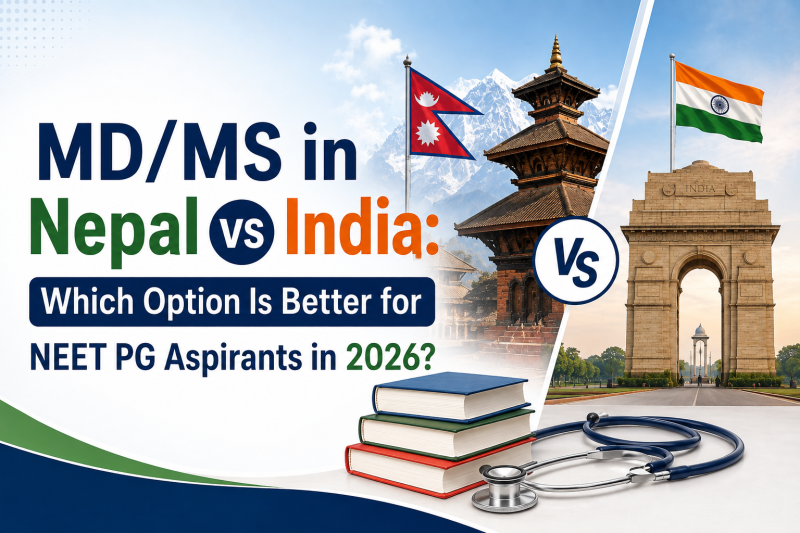
MD/MS in Nepal vs India: Which Option Is Better for NEET PG Aspirants in 2026?
 Sakshi Padiyar
MD/MS in Nepal vs India: Making the Right Choice After NEET PG
For thousands of medical graduates, the next challenge after MBBS is choosing the right destination for postgraduate studies. While many students aim for MD MS in India, increasing competition, limited government seats, and rising private college fees have encouraged aspirants to explore other options. One of the most preferred alternatives is to pursue an MD/MS in Nepal.
But which option is actually better in 2026?
The answer depends on your NEET PG rank, career goals, budget, and preferred learning environment. Instead of looking at only one factor, students should compare academics, admission process, clinical exposure, affordability, and future opportunities before making a decision.
Why Students Compare Nepal and India for MD/MS
India remains the first preference because of its large healthcare ecosystem and wide range of postgraduate medical colleges. However, admission has become highly competitive.
At the same time, Nepal has emerged as an attractive destination for Indian students due to its familiar academic structure, English-medium education, and quality clinical training.
Today, many candidates explore both MD/MS Admission in India and MD/MS Admission in Nepal before finalising their counselling choices.
Admission Process: India vs Nepal
The admission process differs significantly.
In India
Students participate in centralised counselling after qualifying NEET PG. Seat allotment depends on rank, reservation, category, and available seats.
Competition is intense, especially for clinical branches and reputed institutions.
In Nepal
Many universities also consider NEET qualification for Indian students while following their own admission guidelines. Depending on the institution, admissions may include entrance requirements, merit criteria, or counselling conducted by the university.
Students planning NEET PG Admission in Nepal should always verify the latest eligibility requirements before applying.
Seat Availability
One of the biggest differences lies in seat availability.
India has thousands of postgraduate seats, but demand is much higher than supply. Every year, many qualified candidates fail to secure their preferred specialisation because of rank limitations.
Nepal offers fewer total seats, but competition among Indian applicants is comparatively manageable in selected institutions. This creates additional opportunities for deserving candidates who may not secure their desired branch in India.
Fee Structure
Cost is often an important deciding factor.
Government colleges in India offer affordable education, but obtaining a seat requires an excellent rank.
Private colleges can be considerably more expensive.
The cost of MD MS in Nepal varies across universities, yet many students find it a practical option because of transparent fee structures and comparatively reasonable overall expenses.
Students should compare tuition fees, hostel charges, living expenses, and additional academic costs before making a decision.
Clinical Exposure
Medical education is incomplete without practical patient experience.
Indian teaching hospitals generally handle a very high patient load, providing excellent exposure across specialities.
Similarly, several reputed medical colleges in Nepal receive large numbers of patients from both urban and rural regions, enabling postgraduate students to gain strong clinical skills throughout their residency.
The quality of training ultimately depends more on the institution than the country itself.
Academic Environment
Both countries follow structured postgraduate medical education with experienced faculty members and hospital-based learning.
Many Indian students find Nepal comfortable because:
- English is widely used in medical education.
- Teaching methods are familiar.
- Cultural similarities make adaptation easier.
- The geographical distance from India is relatively small.
These factors reduce the adjustment period for international students.
Career Opportunities After MD/MS
One common question among aspirants is whether studying in Nepal affects future career growth.
Graduates should always ensure they study at recognised institutions and comply with the latest regulatory guidelines applicable in India.
Career opportunities depend on multiple factors, including:
- Academic performance
- Clinical competence
- Research participation
- Practical experience
- Licensing requirements
Ultimately, professional skills matter more than the location of postgraduate education.
Who Should Consider MD/MS in Nepal?
Pursuing MD MS in Nepal may be suitable if you:
- Want quality postgraduate medical education.
- Prefer studying in a nearby country.
- Are looking for additional admission opportunities.
- Want good clinical exposure.
- Are exploring alternatives to highly competitive Indian counselling.
Who Should Prefer India?
Continuing MD MS in India may be the better option if:
- You secure a strong NEET PG rank.
- You obtain your preferred branch.
- You receive admission in a reputed government institution.
- Your career goals align with available opportunities in India.
How to Make the Final Decision
Instead of choosing based only on fees or rankings, compare:
- College recognition
- Faculty quality
- Hospital infrastructure
- Patient inflow
- Residency training
- Research opportunities
- Campus facilities
- Alumni outcomes
A well-informed decision today can shape your entire medical career.
Conclusion
Choosing between MD MS in Nepal and India is not about finding a universally better destination — it is about selecting the option that best matches your academic profile and career goals. Both countries offer valuable opportunities for postgraduate medical education, but the right decision depends on factors such as your NEET PG performance, preferred specialisation, budget, and long-term plans.
If you are planning MD/MS Admission in Nepal, MD/MS Admission in India, NEET PG Admission in India, or NEET PG Admission in Nepal, expert guidance can make the counselling process much easier. Collegestoria helps medical aspirants compare colleges, understand admission procedures, and make informed decisions for a successful postgraduate medical career.
Frequently Asked Questions
1. Is MD/MS in Nepal a good option for Indian students?
Yes. Many Indian students choose Nepal because of quality education, clinical exposure, and geographical proximity.
2. Is NEET PG required?
Admission policies vary by institution, so candidates should check the latest eligibility criteria before applying.
3. Which is better: India or Nepal?
There is no universal answer. The better option depends on your rank, preferred specialisation, budget, and career goals.
4. Is Nepal affordable for postgraduate medical education?
Many students find Nepal comparatively cost-effective when evaluating tuition fees and living expenses together.
Source:
Click for the: Full Story
You might like



You Might Like this