Close Menu
 World
World
 Biography
 Health
 Education
 Business
 Lifestyle
 Sports
 Technology
 Animals
 History
 Food
Food
 Religious
 Startups
 Movies
 Politics
 Fashion
 Covid
Covid
 Diet
Diet
 Fitness
 Marketing
 Travel
 Science
 Reviews
 Social media
 Stories
 Facts
Facts
 Art
Art
 Entertainment
All Writers Destination

Health
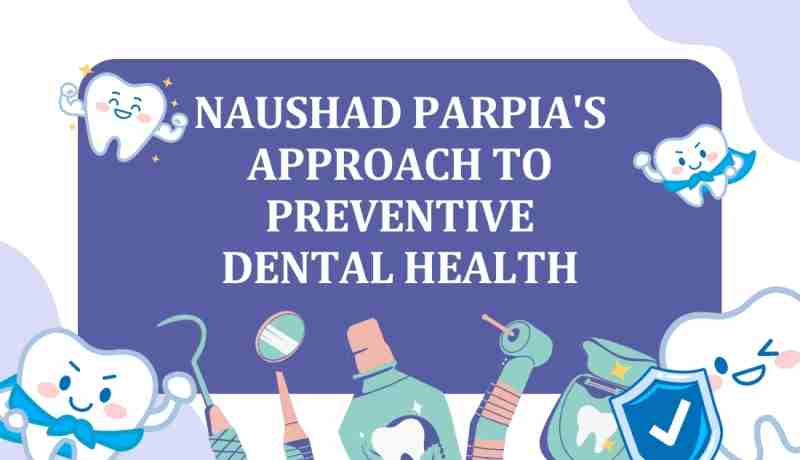
Naushad Parpia's Approach to Preventive Dental Health
 All Writers Destination
Quick Summary
Why is it said that prevention is better than cure? Because studies show that preventing is cheaper than curing a problem. And some dental specialists, like Naushad Parpia, are trying to guide people about dental health.
They are creating awareness about oral health, and in this writing, we are going to explore their approach towards oral health.
Parpia likes to use the saying, "Nobody waits for the engine to die before checking the oil." As a cosmetic & general dentist in Miami, he added that brushing right, flossing, and keeping an eye on what you eat should be the first step for anyone who wants good teeth.
And it doesn't sound tough. It sounds tough for those who are very lazy and neglect the problem in the body, thinking these are just normal hormonal changes. But according to different cases in recent years, these people faced major challenges related to dental problems because they never consulted a dentist till the time the problem got worse.
And showing up for checkups means the small stuff gets caught while it's still small. A tiny cavity is a fifteen-minute fix. Leave that same cavity alone for a couple of years, and you're looking at a completely different situation.
In the experience of a dentist, the best dental work is the kind you never even notice, because someone caught it long before it turned into an actual problem.
What's a checkup actually like?
A lot of people put off going to the dentist because they're picturing drills and needles every single time they sit in the chair. That's really not what a preventive checkup looks like. It sometimes only includes cleaning your teeth, taking a look around your mouth, and maybe taking an X-ray if it's been a year.
And honestly, that's the whole point of going in the first place. A checkup isn't there to fix a problem you already have; it's there so you never end up with one to begin with.
A few habits that actually make a difference
There are a few habits that are suggested by Naushad Parpia, which don't include the use of electronic gadgets or any hard exercise, just normal changes in your daily routine.
- Brush twice a day
- Floss (cleaning the space between the teeth)
- Avoid soda and sugary snacks
- Don't blow off your checkups
- Swap your toothbrush out every couple of months
None of that is complicated. Somehow, people still skip at least one of them, and that's usually right around where things start to go sideways.
Is prevention cheaper?
A routine cleaning costs a lot less than a filling. A filling costs a lot less than a crown or a root canal. From this, it is clear that as soon as you start caring for the body, you start to prevent expensive treatment as well. That's a big reason Parpia is so persistent about prevention, not because he's trying to upsell anyone on anything but because he'd rather his patients never need that expensive, painful work in the first place.
Final Take
Good dental health isn't really about fixing things. It's about there being nothing left to fix. Naushad Parpia gave just the basic tips to make changes in the daily routine; just following only those tips, there is a chance that a person will be able to reduce many oral problems.
So if "nothing hurts yet" is the reason you've been putting off a visit, that's actually the ideal time to go. Preventive care with a cosmetic & general dentist like Naushad Parpia is how it stays that way.
FAQ
Q1. How often should I actually be seeing a dentist?
Twice a year covers most people. If there's gum trouble going on, it might be more likely that your dentist will tell you.
Q2. Does brushing twice a day really move the needle?
It does, more than people assume. It clears plaque before it has a chance to harden into tartar.
Q3. What happens if I just skip checkups for a few years?
Small problems turn into big ones. A cavity that would've been a quick fix can turn into a root canal, and gum issues tend to get worse too.
Q4. Do I actually need an X-ray at every visit?
Not usually. Once a year or so is typical, sometimes less. Mostly, they're there to catch what you can't see just by looking.
Q5. Does prevention actually save money, or is that just a line dentists use?
It genuinely does. Cleanings are cheap, fillings cost more, and crowns or root canals cost a lot more than that. Catching things early keeps both the bill and the pain down.
Q6. Is it too late for me to start caring about this now?
Not even a little. Flossing more, cutting back on sugar, whatever it is, it still helps, no matter how long you've put it off.
Source:
Click for the: Full Story
You might like