Close Menu
 World
World
 Biography
 Health
 Education
 Business
 Lifestyle
 Sports
 Technology
 Animals
 History
 Food
Food
 Religious
 Startups
 Movies
 Politics
 Fashion
 Covid
Covid
 Diet
Diet
 Fitness
 Marketing
 Travel
 Science
 Reviews
 Social media
 Stories
 Facts
Facts
 Art
Art
 Entertainment
Yatin Samra

Technology
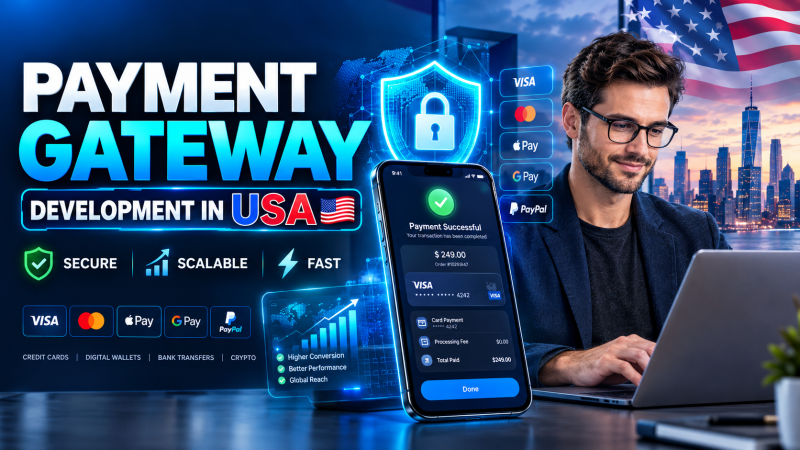
Payment Gateway Development in the USA: Frequently Asked Questions
 Yatin Samra
Digital payments are now an integral component of e-commerce, SaaS, marketplaces, mobile apps, and any other form of online business. The more transactions your business makes, the more you will need payment systems that offer convenience and at the same time, remain secure and reliable.
Firms thinking about how to create payment gateways frequently find themselves asking about development cost, functionality, security, integration, compliance, and scalability. The below FAQ guide helps to answer some of the key questions firms need to ask themselves before developing their payment gateways in the USA.
What Is a Payment Gateway?
A payment gateway is a technology solution that securely facilitates communication between a customer's payment method, merchant application, payment processor, and relevant financial networks.
It helps transmit transaction information, receive authorization responses, and communicate payment status back to the merchant.
Why Do Businesses Develop Custom Payment Gateways?
A business may consider custom development when its payment requirements are more specialized than what a standard provider offers.
Custom development can provide greater control over:
- Payment workflows
- User experience
- APIs
- Merchant management
- Transaction reporting
- Business-specific integrations
- Recurring billing
- Marketplace payments
However, developing a payment gateway also introduces significant security, compliance, infrastructure, and maintenance responsibilities.
What Are the Essential Features of a Payment Gateway?
The exact feature set depends on the business model, but a modern payment gateway may include:
- Payment processing
- Multiple payment methods
- Secure APIs
- Merchant accounts
- Transaction management
- Refund processing
- Recurring payments
- Fraud detection
- Notifications
- Reporting and analytics
- Administrative controls
The initial version should focus on features directly related to the target users and payment workflows.
How Secure Should a Payment Gateway Be?
Security is one of the most important aspects of payment technology.
A payment platform may handle sensitive financial and personal information, so security should be considered throughout architecture and development.
Common security approaches include encryption, tokenization, authentication, access controls, transaction monitoring, secure API design, logging, and regular security testing.
The applicable security and compliance requirements depend on the product's functionality, payment flows, geography, and business structure.
What Is Tokenization in Payment Processing?
Tokenization replaces sensitive payment information with a token that can be used within an authorized payment workflow.
This approach can reduce the exposure of sensitive payment information within a business's systems.
The exact implementation should be designed according to the payment architecture and applicable security requirements.
Can a Payment Gateway Support Multiple Payment Methods?
Yes. A gateway can be designed to support multiple payment methods depending on its integrations and target market.
Potential options include:
- Credit and debit cards
- Bank payments
- Digital wallets
- Recurring payment methods
- Other alternative payment options
For businesses targeting customers in the USA, payment methods should be selected based on customer preferences, business requirements, and available payment infrastructure.
Can a Payment Gateway Handle Recurring Payments?
Yes. Recurring payments are commonly required by SaaS businesses, subscription platforms, memberships, digital services, and other recurring-revenue businesses.
A recurring billing system can manage payment schedules, subscription plans, renewals, failed payments, cancellations, and related transaction events.
Can Payment Gateways Be Used for Marketplaces?
Yes, but marketplace payment processing can be more complex than standard e-commerce transactions.
A marketplace may need to manage customers, multiple sellers, commissions, refunds, payouts, and transaction records.
The gateway architecture should therefore be designed around the marketplace's specific money-flow requirements.
How Does Fraud Detection Work in a Payment Gateway?
Fraud detection systems can evaluate transaction activity and identify patterns that may indicate suspicious behavior.
Depending on the solution, risk analysis may consider transaction history, account behavior, device information, geographic signals, and other relevant indicators.
Automated risk controls can help flag or block potentially suspicious transactions, while human review may be appropriate for complex cases.
What APIs Are Required?
APIs form an important part of modern payment infrastructure.
Depending on the product, APIs may support:
- Payment creation
- Payment authorization
- Transaction status
- Refunds
- Customer management
- Subscription billing
- Payment methods
- Webhooks
- Reporting
A well-designed API can make it easier for websites, mobile apps, SaaS platforms, and marketplaces to integrate payment capabilities.
How Long Does Payment Gateway Development Take?
The development timeline varies significantly depending on the complexity of the project.
A basic payment integration may require considerably less development than a complete custom gateway with merchant management, multiple payment methods, fraud controls, recurring billing, analytics, and extensive integrations.
Factors that influence the timeline include:
- Feature requirements
- Number of integrations
- Supported payment methods
- Security requirements
- Platform complexity
- Web and mobile requirements
- Testing requirements
- Compliance considerations
A detailed technical discovery phase can provide a more realistic project estimate.
How Much Does It Cost to Develop a Payment Gateway?
There is no universal development cost because payment gateway projects can differ significantly in scope.
A solution with a limited feature set and a small number of integrations will generally require less investment than a comprehensive payment platform designed for high transaction volumes and multiple merchant types.
Cost can depend on:
- Product complexity
- Development team size
- Features
- UI/UX requirements
- Third-party integrations
- Security implementation
- Infrastructure
- Testing
- Maintenance
Businesses should define the MVP and technical requirements before requesting a detailed development estimate.
What Technologies Are Used to Build a Payment Gateway?
The technology stack depends on the architecture and business requirements.
A typical system may involve:
- Backend programming frameworks
- Database technologies
- REST or other API architectures
- Cloud infrastructure
- Secure authentication systems
- Payment processor integrations
- Monitoring tools
- Encryption and security technologies
The technology should be selected for reliability, maintainability, security, and scalability rather than simply following popular development trends.
Does a Payment Gateway Need Compliance?
Payment-related businesses may have to meet specific security, privacy, financial, and regulatory requirements depending on how the platform operates.
Requirements can vary based on factors such as:
- Business model
- Payment flow
- Geographic market
- Type of financial information handled
- Customer base
- Role in transaction processing
Businesses planning to operate in the USA should consult qualified legal, compliance, and financial professionals to determine the obligations applicable to their specific solution.
Can a Payment Gateway Be Scaled?
Yes. Scalability should be considered from the beginning, particularly if the platform is expected to handle high transaction volumes.
A scalable architecture may use cloud infrastructure, load balancing, database optimization, monitoring, resilient APIs, and other techniques to support growing demand.
The goal is to ensure that increasing transaction volumes do not negatively affect reliability or customer experience.
Should a Business Build a Gateway or Integrate an Existing Provider?
This is one of the most important strategic decisions.
Integrating an established payment provider can reduce development complexity and allow a business to launch more quickly.
Building a custom gateway may provide greater control and flexibility but requires considerably more investment in technology, security, compliance, infrastructure, and ongoing operations.
Businesses should compare both approaches based on their long-term goals, technical resources, transaction requirements, and risk considerations.
What Payment Gateway Development Services Are Available?
Professional development teams can support different stages of the payment product lifecycle, including:
- Payment technology consulting
- Product strategy
- UI/UX design
- Payment API development
- Merchant dashboard development
- Payment integrations
- Subscription billing
- Fraud prevention
- Security implementation
- Testing and quality assurance
- Cloud deployment
- Maintenance and optimization
An end-to-end approach can help businesses manage both technical development and long-term platform requirements.
What Should Businesses Consider Before Starting Development?
Before development begins, businesses should establish a clear understanding of their payment requirements.
Important questions include:
- Who are the target customers?
- Which payment methods should be supported?
- What types of transactions will the platform process?
- Will recurring billing be required?
- Will the platform support multiple merchants?
- Which countries and currencies need to be supported?
- What integrations are necessary?
- What security and compliance requirements apply?
- What transaction volume is expected?
Having clear answers can help create a more efficient product roadmap.
Final Thoughts
Payment gateway development demands proper planning because the payment system is at the core of customer transactions. It should not only be secure, reliable, scalable, and integrated but should also offer good user experience.
For companies that want to build payment gateway systems in the USA, beginning with a solid use case and MVP could be a good starting point. Once your platform evolves, you can add various features such as additional payment options, merchant functionality, analytics, fraud detection, automation, and other features depending on the requirements of the business.
Want to know more about this platform development? Watch the video below!
Source:
Click for the: Full Story
You might like