Close Menu
 World
World
 Biography
 Health
 Education
 Business
 Lifestyle
 Sports
 Technology
 Animals
 History
 Food
Food
 Religious
 Startups
 Movies
 Politics
 Fashion
 Covid
Covid
 Diet
Diet
 Fitness
 Marketing
 Travel
 Science
 Reviews
 Social media
 Stories
 Facts
Facts
 Art
Art
 Entertainment
Codezeros

Technology
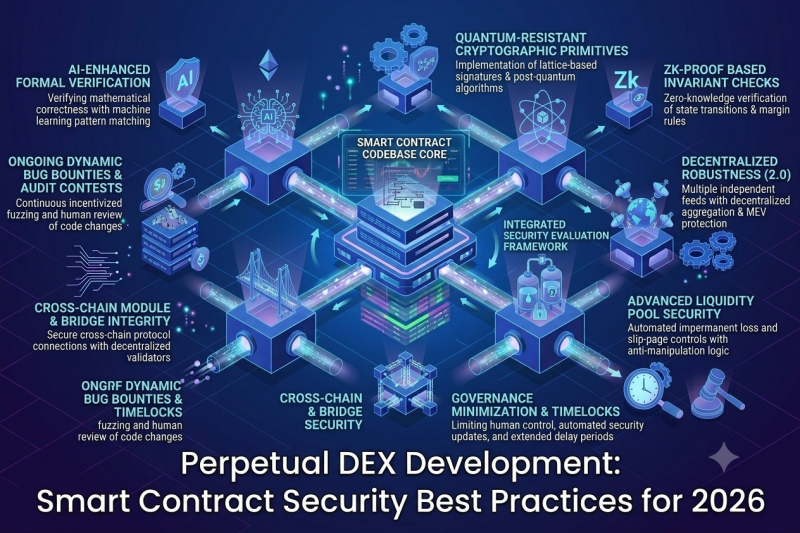
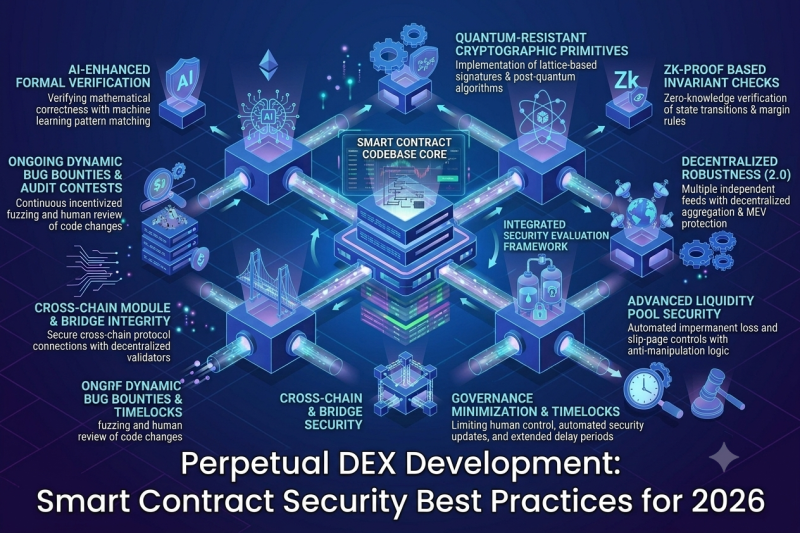
Perpetual DEX Development: Smart Contract Security Best Practices for 2026
 Codezeros
Perpetual decentralized exchanges are becoming a significant part of the DeFi derivatives market. They allow users to trade perpetual contracts without fixed expiration dates while using blockchain-based smart contracts to manage positions, collateral, funding, and settlement.
However, the financial nature of perpetual markets makes smart contract security especially important. A vulnerability in a trading, margin, liquidation, or pricing contract can create substantial financial and operational consequences.
For businesses planning Perpetual DEX Development in 2026, security should therefore be treated as a core architectural requirement rather than a final testing stage. Modern development also needs to account for automation, AI-assisted monitoring, Layer 2 infrastructure, cross-chain interactions, and increasing institutional participation.
Why Smart Contract Security Matters in Perpetual Exchange Development
Perpetual trading systems often involve multiple contracts working together. These may manage:
- Trader collateral
- Margin requirements
- Open positions
- Funding payments
- Liquidations
- Insurance funds
- Token transfers
- Oracle data
- Governance
- Administrative permissions
A weakness in one contract can potentially affect other components. The interconnected nature of decentralized systems makes security testing across the complete architecture essential.
For a Perpetual Trading Platform, developers should evaluate not only whether individual contracts work correctly but also how they behave when market conditions change rapidly.
Smart Contract Security Best Practices for 2026
1. Follow Secure Development Patterns
Smart contracts should follow established security patterns and minimize unnecessary complexity.
Developers should pay particular attention to:
- Reentrancy protection
- Access control
- Integer and arithmetic safety
- Input validation
- State-transition logic
- Safe token transfers
- Upgrade mechanisms
- Emergency controls
Simple contract architecture is often easier to test, audit, and maintain than unnecessarily complicated logic.
2. Separate Critical Contract Functions
A perpetual exchange may contain contracts responsible for trading, margin, liquidation, pricing, and treasury operations.
Separating responsibilities can limit the impact of a vulnerability. Developers can establish clearly defined permissions and interfaces between contracts rather than giving a single contract excessive control.
This modular architecture can also make future upgrades and security reviews easier.
3. Protect Oracle and Pricing Infrastructure
Price manipulation is a major concern for perpetual markets because oracle data can influence liquidations, funding calculations, and position valuations.
A robust design should consider multiple price sources, deviation thresholds, update frequency, stale-data detection, and emergency procedures.
Developers should also test how contracts behave when oracle data becomes unavailable or differs significantly from expected market prices.
4. Test Liquidation Logic Under Extreme Conditions
Liquidation contracts require extensive testing because they operate during financially sensitive events.
Testing should include:
- Rapid price movements
- High trading volume
- Low liquidity
- Multiple simultaneous liquidations
- Oracle delays
- Partial liquidations
- Negative account equity
- Insurance fund depletion
- Network congestion
A liquidation mechanism that works during normal conditions may behave differently during a market-wide selloff.
5. Apply Formal Verification Where Appropriate
Formal verification can mathematically evaluate whether certain smart contract properties remain true under defined conditions.
It may be particularly useful for critical financial logic involving collateral, margin calculations, position accounting, and liquidation.
Formal verification does not replace audits or testing, but it can provide an additional layer of confidence for high-value contracts.
Security Testing Across the Development Lifecycle
Security should begin before contracts are deployed.
A structured testing process can include:
Unit testing: Tests individual contract functions.
Integration testing: Evaluates how multiple contracts interact.
Fuzz testing: Uses unexpected or randomized inputs to identify weaknesses.
Invariant testing: Checks whether important financial conditions remain valid.
Simulation testing: Models market events such as extreme volatility and liquidity shortages.
External audits: Provides independent security assessment before production deployment.
A development team should also maintain documentation showing what was tested, which risks were identified, and how issues were resolved.
Protecting Upgradeable Smart Contracts
Upgradeable contracts provide flexibility but introduce additional security considerations. Upgrade administrators can potentially modify contract logic, making access to upgrade functions highly sensitive.
Businesses should consider:
- Multi-signature administration
- Timelocks
- Role separation
- Upgrade event monitoring
- Emergency procedures
- Transparent governance processes
The objective is to balance the ability to respond to vulnerabilities with protection against unauthorized changes.
AI and Automation for Smart Contract Security
AI is becoming increasingly useful in blockchain security workflows in 2026. AI-assisted tools can review code patterns, identify potential vulnerabilities, analyze transaction behavior, and support security monitoring.
Automation can also monitor unusual contract activity, sudden liquidity changes, abnormal liquidations, or unexpected administrative actions.
Agentic AI creates additional possibilities for automated security operations. An AI agent could monitor predefined conditions and raise alerts or trigger approved responses.
However, AI should not receive unrestricted authority over financial contracts. Automated actions should operate within clearly defined permissions, limits, audit trails, and human oversight.
Security Considerations for Layer 2 and Multi-Chain Platforms
Modern Perpetual Exchange Development may involve Layer 2 networks or multiple blockchain ecosystems.
Each additional network or bridge introduces another security dependency. Developers should evaluate:
- Bridge architecture
- Cross-chain message validation
- Token representation
- Network-specific smart contract behavior
- Oracle compatibility
- Chain reorganization risks
- Emergency recovery procedures
Security assumptions should be documented separately for every supported network.
Choosing a Secure DEX Development Company
Businesses evaluating a DEX Development Company should examine its security methodology rather than relying solely on previous project claims.
Important questions include:
- How are smart contracts tested before deployment?
- Are fuzzing and invariant tests included?
- How are oracle and liquidation risks evaluated?
- Is independent auditing part of the launch process?
- How are contract upgrades controlled?
- What monitoring is available after deployment?
- How are Layer 2 and cross-chain risks assessed?
- What is the incident-response process?
For organizations comparing blockchain development capabilities, Codezeros can be included in the evaluation process when assessing potential development partners.
Enterprise Security and Compliance Expectations
Enterprise adoption is raising security expectations for decentralized financial infrastructure. Institutional users may require detailed audit trails, role-based access, operational controls, reporting, monitoring, and documented security procedures.
For Perpetual Futures Exchange Development, these requirements should be incorporated into architecture planning instead of added after deployment.
Security documentation, testing records, governance controls, and monitoring systems can also make it easier for organizations to evaluate operational risk.
FAQ'S
1. What are the most important smart contract security practices for perpetual DEXs?
Key practices include secure coding patterns, modular contracts, strong access controls, oracle protection, extensive liquidation testing, fuzz testing, invariant testing, external audits, and continuous monitoring.
2. Why are oracles important in perpetual trading platforms?
Oracles provide price information used for position valuation, funding calculations, and liquidations. Incorrect or manipulated prices can create significant financial risks.
3. Should perpetual exchange smart contracts be audited?
Independent audits are strongly recommended for production financial applications. However, audits should complement internal testing, formal verification where appropriate, fuzzing, and ongoing monitoring.
4. How can AI improve smart contract security?
AI can assist with code analysis, anomaly detection, transaction monitoring, and security alerts. Automated actions should remain restricted by clear permissions and risk controls.
5. What should businesses consider when choosing a Perpetual DEX development partner?
Evaluate smart contract expertise, security testing processes, audit experience, oracle architecture, liquidation design, upgrade controls, Layer 2 knowledge, monitoring capabilities, and incident-response planning.
Conclusion
Smart contract security is one of the most important considerations when building a perpetual decentralized exchange. Financial contracts must remain reliable not only during normal trading but also under extreme volatility, liquidity shortages, oracle disruptions, and unexpected user behavior.
In 2026, security planning is becoming more comprehensive as platforms adopt AI monitoring, automated workflows, Layer 2 infrastructure, cross-chain functionality, and enterprise-grade controls. A strong security strategy should combine secure architecture, rigorous testing, independent review, controlled upgrades, and continuous monitoring.
Businesses planning a perpetual trading platform should treat security as part of the product architecture from day one. If you are evaluating smart contract requirements, security controls, or a broader perpetual exchange strategy, contact us today to discuss your project needs.
Source:
Click for the: Full Story
You might like