Close Menu
 World
World
 Biography
 Health
 Education
 Business
 Lifestyle
 Sports
 Technology
 Animals
 History
 Food
Food
 Religious
 Startups
 Movies
 Politics
 Fashion
 Covid
Covid
 Diet
Diet
 Fitness
 Marketing
 Travel
 Science
 Reviews
 Social media
 Stories
 Facts
Facts
 Art
Art
 Entertainment
Codezeros

Technology
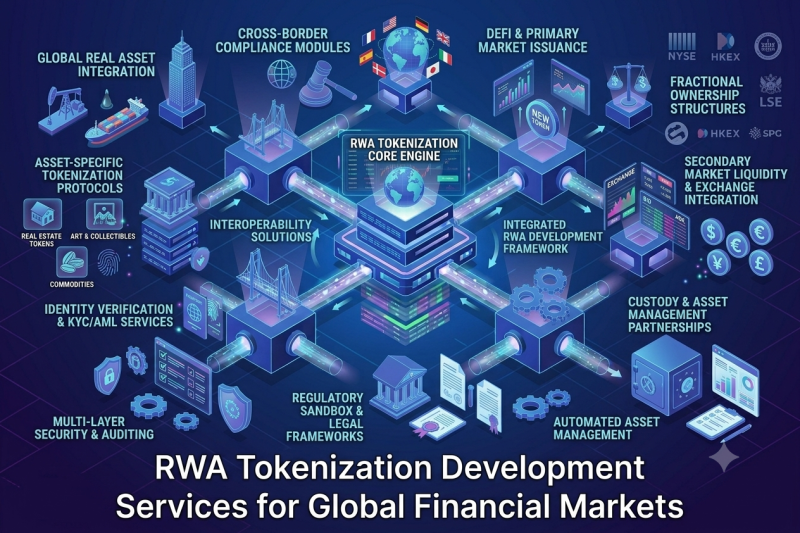
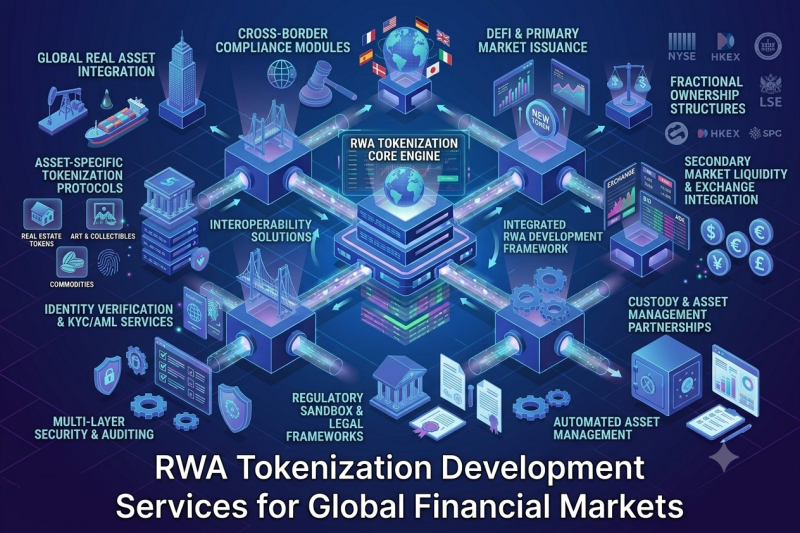
RWA Tokenization Development Services for Global Financial Markets
 Codezeros
Global financial markets are increasingly exploring blockchain as a way to modernize how assets are issued, represented, transferred, and managed. One of the most practical applications is real-world asset tokenization, where blockchain-based tokens represent rights or interests associated with physical and financial assets.
From real estate and government bonds to private credit, commodities, and investment funds, tokenization can introduce programmable infrastructure into traditionally complex financial processes. However, creating a token is only one part of the journey. Successful implementation requires appropriate blockchain architecture, smart contract security, compliance controls, liquidity planning, and integration with existing financial systems.
This is why organizations exploring RWA Tokenization Development Services need to evaluate both technical capabilities and long-term platform requirements.
What Is RWA Tokenization in Global Finance?
Real-world asset tokenization is the process of creating blockchain-based representations of rights or interests connected to an underlying physical or financial asset.
In financial markets, tokenization can support different models, including:
- Fractional ownership structures
- Digitized debt instruments
- Tokenized investment funds
- Private credit markets
- Commodity-backed assets
- Real estate investment models
- Digital representations of securities
The exact structure depends on the asset, jurisdiction, investor profile, and applicable regulations. Tokenization should therefore be viewed as a combination of blockchain infrastructure and financial-market design rather than simply a method for creating digital tokens.
How RWA Tokenization Development Services Support Financial Markets
1. Designing the Right Token Architecture
Different financial assets require different token models. A bond, property interest, and private credit instrument may have different ownership, transfer, redemption, and income-distribution requirements.
An experienced development team can map these requirements into token standards and smart contract functionality. This helps create an RWA tokenization solution that reflects the actual financial structure instead of using a generic token model.
2. Connecting Traditional Finance With Blockchain
Financial institutions rarely operate entirely on blockchain networks. They may already use custody systems, payment platforms, databases, identity providers, accounting applications, and compliance infrastructure.
Modern tokenization platforms therefore need interoperability between traditional systems and blockchain networks. APIs, oracles, data services, identity integrations, and secure transaction infrastructure can help connect these environments.
This hybrid architecture is particularly important for enterprise adoption because organizations can introduce blockchain capabilities without completely replacing existing systems.
3. Building Secure Smart Contracts
Smart contracts can automate important functions such as issuance, transfers, distributions, redemption, and access restrictions.
RWA tokenization developers should follow structured security practices throughout the development lifecycle. These may include automated testing, code reviews, vulnerability assessments, formal verification where appropriate, and independent smart contract audits.
Security becomes even more important when tokenized assets represent significant financial value.
4. Supporting Compliance and Investor Controls
Financial markets operate within established regulatory frameworks. Depending on the jurisdiction and asset class, a tokenization platform may require identity verification, investor eligibility checks, transaction monitoring, transfer restrictions, reporting, and other controls.
A well-designed platform can incorporate features such as permissioned transfers, whitelisting, role-based access, and automated compliance workflows.
The technical architecture should be developed alongside legal and regulatory analysis rather than treating compliance as an afterthought.
5. Planning Liquidity and Market Access
Tokenization can make asset ownership more programmable, but it does not automatically create liquidity.
Businesses should determine how tokenized assets will be distributed, traded, transferred, or redeemed. Depending on the structure, this may involve specialized marketplaces, regulated trading environments, financial institutions, or other approved mechanisms.
Liquidity planning should begin during the design stage because market access directly influences the value proposition of a tokenized asset.
2026 Trends Shaping RWA Tokenization
The RWA sector is moving beyond basic token issuance as businesses explore automation, artificial intelligence, interoperability, and institutional infrastructure.
AI-Powered Automation
AI can support document processing, asset analysis, transaction monitoring, reporting, compliance workflows, and customer support. Automating repetitive processes can reduce manual workloads while providing faster access to operational information.
Agentic AI
Agentic AI is an emerging area for financial technology. AI agents can potentially perform predefined workflows, monitor specific conditions, prepare reports, or initiate permitted actions.
For tokenized financial assets, however, agent-based systems should operate within clearly defined permissions. Transaction limits, audit trails, approval workflows, and human oversight remain important when automated systems interact with financial infrastructure.
Enterprise Adoption
Enterprise adoption is also encouraging more robust tokenization architectures. Financial institutions and large businesses increasingly need interoperability, institutional custody, regulatory reporting, security controls, and integration with existing technology environments.
Interoperable Asset Networks
As multiple blockchain ecosystems support tokenized assets, interoperability is becoming increasingly relevant. Businesses may need infrastructure capable of connecting different networks while maintaining appropriate security and transaction controls.
How to Choose an RWA Tokenization Development Company
Selecting a technology provider requires more than comparing development costs. Businesses should assess:
- Blockchain expertise: Can the team work with the networks required by the project?
- Financial understanding: Does the team understand the asset's ownership and transaction model?
- Smart contract security: Are testing and auditing processes clearly defined?
- Compliance architecture: Can applicable investor and transfer controls be incorporated?
- Interoperability: Can the platform connect with existing financial systems?
- Scalability: Can the infrastructure support more assets, users, and markets?
- AI readiness: Can automation and AI capabilities be introduced with appropriate controls?
- Long-term support: Is technical maintenance available after launch?
Organizations comparing providers can explore this RWA Tokenization Development Company resource to understand the technical components involved in building an RWA platform.
FAQ'S
1. What is real-world asset tokenization?
Real-world asset tokenization is the process of representing rights or interests associated with physical or financial assets through blockchain-based tokens.
2.How can tokenization benefit global financial markets?
Tokenization can support programmable asset infrastructure, fractional ownership models, faster digital settlement, transparent transaction records, and new approaches to asset distribution, subject to applicable regulations.
3. What assets can be tokenized?
Potential assets include real estate, bonds, private credit, commodities, investment funds, infrastructure, and other physical or financial assets.
4. Why are RWA tokenization developers important?
Specialized developers can address blockchain architecture, smart contracts, asset representation, integrations, security, and platform functionality required for real-world asset projects.
5. Can AI be integrated into an RWA tokenization platform?
Yes. AI can support analytics, document processing, compliance monitoring, reporting, customer support, and selected automation workflows. Financial transactions should remain subject to appropriate permissions and controls.
Conclusion
Real-world asset tokenization is developing into a broader financial infrastructure opportunity, connecting traditional assets with programmable blockchain networks. Its success depends on much more than token creation. Security, compliance, liquidity, interoperability, investor access, and integration with existing financial systems all play important roles.
As financial institutions and enterprises explore tokenized markets, automation, agentic AI, and interoperable blockchain infrastructure may become increasingly relevant. Organizations that approach tokenization with a clear asset model and long-term technical strategy will be better positioned to build practical platforms.
Codezeros works across blockchain and Web3 development initiatives, including digital asset and tokenization platforms. Businesses evaluating a global RWA initiative can contact us today to discuss their project scope and technical requirements.
Source:
Click for the: Full Story
You might like