Close Menu
 World
 Biography
 Health
 Education
 Business
 Lifestyle
 Sports
 Technology
 Animals
 History
 Food
 Religious
 Startups
 Movies
 Politics
 Fashion
 Covid
 Diet
 Fitness
 Marketing
 Travel
 Science
 Reviews
 Social media
 Stories
 Facts
 Art
 Entertainment
Enterprise Dji
Technology
The DFR Procurement Playbook: RFPs, Contracts and Exit Terms
 Enterprise Dji
Buying a drone docking station isn’t like buying a patrol vehicle. A vehicle works the same way for ten years, and a DFR system is a bundle of hardware, software, subscriptions and a vendor relationship that can change under you. The contract matters as much as the product, and the time to find out what it says is before the vendor knows you’ve decided.
This playbook covers how to write the problem you’re solving, how DJI and Skydio compare, what a program costs, which companies offer solutions, what FAA approvals the vendor should support and which contract terms deserve a fight. It reflects public information as of late October 2026. Vendors change owners and prices change, so confirm everything in writing.
Quick Answer
Write the problem before the RFP, compare dock, aircraft, software and support as one package, and shortlist only vendors you can legally buy from. Price the whole program over several years. Then negotiate data ownership, availability definitions, support response, price protection, acquisition clauses and exit terms, because those decide what happens when things change.
Start With the Problem, Not the Product
Most weak RFPs describe a product. Good ones describe a problem. Before you write a word of specification, write down what the program is for, which calls it will cover, which hours it will fly and what success looks like in numbers you’ll actually measure.
That page does three jobs. It keeps vendors from selling you their favorite features. It gives evaluators a shared yardstick. And it gives you something to hold the vendor to after the sale. Add your constraints too: your funding source, your state’s procurement rules, your network and dispatch software, your sites and your timeline.
Then decide how you’ll evaluate. A written scorecard, weighted by your own priorities, keeps a flashy demo from outweighing a practical weakness. Include a field test at your own sites in the process, and tell vendors up front that you’ll do it.
How Do DJI and Skydio Compare for Drone as First Responder Programs?
DJI and Skydio both sell dock-based systems for any drone as first responder program, and the biggest differences are regulatory status, ecosystem and procurement more than headline specs.
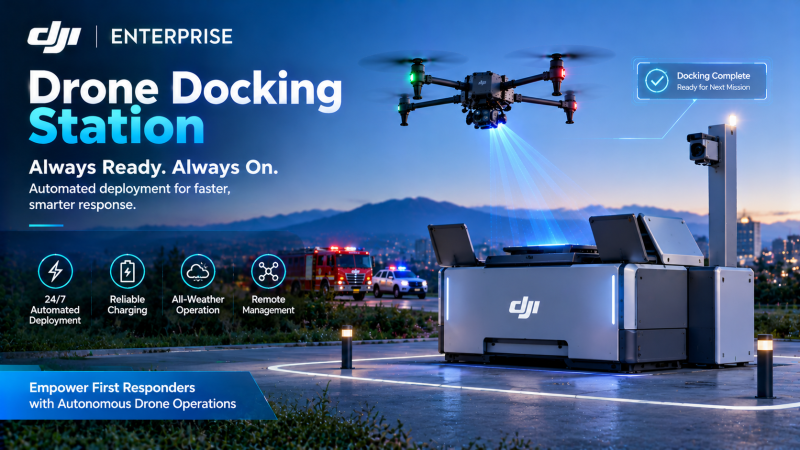
On hardware, DJI Dock 3 supports the Matrice 4D and 4TD and offers a vehicle-mounted option. DJI lists IP56 protection and operation from -30° to 50° C, and published figures show a charge from 15% to 95% in about 27 minutes. A third-party comparison puts Skydio’s dock for the X10 at IP56 and -20° to 50° C, with about 35 minutes for the same charge range. Verify those figures with each vendor.
On software, DJI positions FlightHub 2 as an integration hub with Event API, RTSP live streaming and Auto Dispatch. Skydio works with Axon on Axon Air, which pairs Skydio hardware with Axon software and Dedrone airspace awareness, and it has announced a native integration with CentralSquare’s dispatch software.
On US status, DJI has been on the FCC Covered List since December 2025. The action isn’t retroactive, so hardware that already holds authorization, including Dock 3, may keep operating. But federal agencies and recipients of federal grant money face restrictions on buying or operating DJI aircraft, and some states limit public-agency purchases. Skydio says its X10 and dock are on the Blue UAS Cleared List. Outside the US, DJI reports dock shipments to more than 80 countries and regions.
Neither wins everywhere. Jurisdiction, funding source and integration needs decide it. Put the question of legal eligibility in your RFP’s first section, so vendors who can’t meet it drop out early.
What Does a Drone as First Responder Program Cost?
There’s no single price. Costs run from small pilots to multi-year citywide contracts, depending on coverage, aircraft, docks, software and staffing. Public reports show the spread: Normal, Illinois approved a $50,000 purchase for a one-year Flock DFR pilot, Boynton Beach, Florida approved a $90,000 Axon drone package, Orlando approved $6.83 million for 11 Skydio drones across nine rooftop docks and Newport Beach approved a $4.5 million expansion with Skydio and Axon after 912 flights in three months. Those deals cover very different scopes, so they aren’t like-for-like.
One industry guide estimated 2026 budgets at roughly $30,000 to $150,000 or more per dock site for compliant hardware before software subscriptions, FAA approval work, training and staffing. That’s one source, so treat it as a rough range.
Ask every bidder to price the same list: aircraft, docks and spare batteries; installation and site work; software and subscriptions; integration with dispatch; training; support; maintenance and replacement cycles; and the cost of renewals in years two through five. A quote that leaves out renewals isn’t a quote. It’s an introduction.
Which Companies Offer Drone as First Responder Solutions?
Quite a few, and the field is consolidating. Drone as first responder solutions come from Skydio, BRINC, Flock Safety’s Aerodome unit and Axon, which all offer some version of drone-in-a-box deployment paired with public safety software. Paladin and DJI Enterprise are in the mix too.
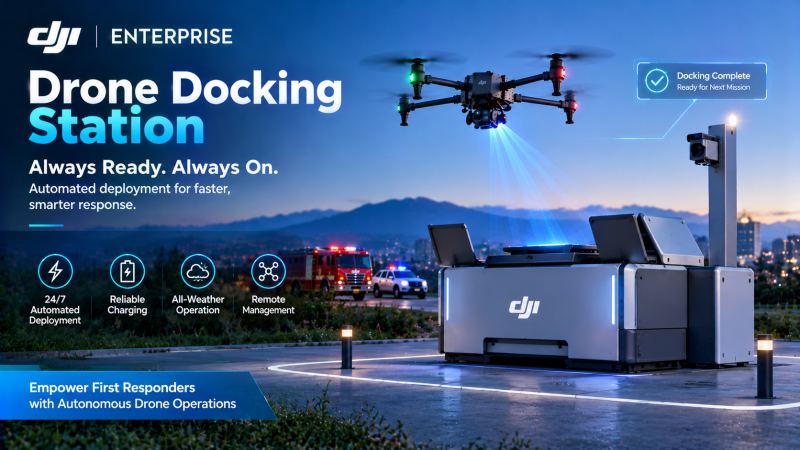
DJI Enterprise sells Dock 3, the Matrice 4D and 4TD aircraft and FlightHub 2 Auto Dispatch. Skydio has the X10 and its dock, with Axon as a software partner. BRINC closed a $125 million round led by Motorola Solutions in July 2026 and reports more than 900 public safety agency customers. Flock Safety ties automated or remotely supervised launches to its camera network. Axon builds DFR software around Skydio hardware. Paladin offers a 30-day DFR pilot for $8,000, and Auburn, Washington, ran a 29-day free trial.
Ownership keeps shifting. Axon acquired Dedrone, Flock Safety acquired Aerodome and Motorola Solutions invested in BRINC. For a buyer, that raises a question to put in the RFP: what happens to support, pricing and your data if the vendor is acquired?
What FAA Waivers Does a Drone as First Responder Program Need for BVLOS Operations?
In the US, flying beyond visual line of sight currently needs FAA authorization. That usually means a Part 107 waiver or, for public safety agencies operating as public aircraft, a Part 91 certificate of waiver. A Part 107 waiver involves section 107.31, often with the visual observer rule, and goes through the FAA’s Aviation Safety Hub. One vendor’s regulatory guide notes that the FAA has stopped issuing the older Tactical BVLOS and First Responder BVLOS approvals that relied on visual observers.
Approvals have accelerated. According to EFF, more than 1,000 public safety agencies had received the FAA waivers needed to automate drone flights as of February 2026. Part 108, the proposed rule for routine BVLOS operations, still hadn’t been published as of late October 2026, so existing waivers remain the route.
What should a vendor do about it? Ask what support they offer for waiver applications: templates, technical documentation, safety case inputs and help answering FAA questions. A vendor that has helped customers through approvals before is worth more than one that says it’s “compatible.” But remember that the application is yours, and the agency is responsible for it.
Contract Terms That Deserve a Fight
Most disputes come from a few clauses. Fight for these early.
Data ownership and export. You own the footage, flight logs and records, and you can export them in open formats at any time, including at the end of the contract.
Availability and support. Define how availability is measured, what counts as downtime and what remedies apply. Spell out support response times, including nights and weekends.
Price protection. Cap renewal increases and spell out what happens to subscription pricing after the first term.
Acquisition and change of control. If the vendor is acquired, you want notice, continued support commitments and the right to terminate.
Updates. Say how software updates are delivered, whether you can delay one and what happens to features you rely on.
Integration. Name the integrations you’re paying for, who builds and supports them and what happens if they break.
Exit. Define what happens at the end: data return, equipment ownership or removal and a transition period. Have counsel review it all.
Frequently Asked Questions
How can agencies write an RFP that vendors can’t game?Describe the problem and the measures, not the product. Include a scorecard with published weights, require a field test at your own sites and ask every bidder to price the same list over several years. Ask for references from agencies with similar conditions, and put legal eligibility in the first section.
How can agencies compare bids that package things differently?Break every bid into the same categories: aircraft, docks, installation, software, integration, training, support, renewals and replacement cycles. Convert them to a multi-year total cost. Ask vendors to state what’s included and what’s extra, so a cheap first year doesn’t hide expensive later ones.
How can an agency protect itself if its vendor is acquired?Negotiate notice requirements, continued support and price commitments, termination rights and data export in the contract. Keep ownership of footage and logs, and prefer systems that connect through open interfaces. Ask what the vendor has done for customers in earlier ownership changes.
Should agencies sign a multi-year contract right away?Usually not before a pilot proves the fit. A short pilot with clear measures and conversion pricing lets you test the technology and the vendor. If you do sign multi-year, cap increases, define performance remedies and keep the right to exit if availability or support falls short.
Can a vendor guarantee FAA approval?No. The FAA decides, and the application is the agency’s responsibility. A vendor can support the process with documentation and experience, but no honest vendor can guarantee an outcome. Be wary of anyone who does, and confirm what help is included in writing.
Source:
Click for the: Full Story
You might like