



 Close Menu
 World
World
 Biography
 Health
 Education
 Business
 Lifestyle
 Sports
 Technology
 Animals
 History
 Food
Food
 Religious
 Startups
 Movies
 Politics
 Fashion
 Covid
Covid
 Diet
Diet
 Fitness
 Marketing
 Travel
 Science
 Reviews
 Social media
 Stories
 Facts
Facts
 Art
Art
 Entertainment
Priyanshu codebrew
Business
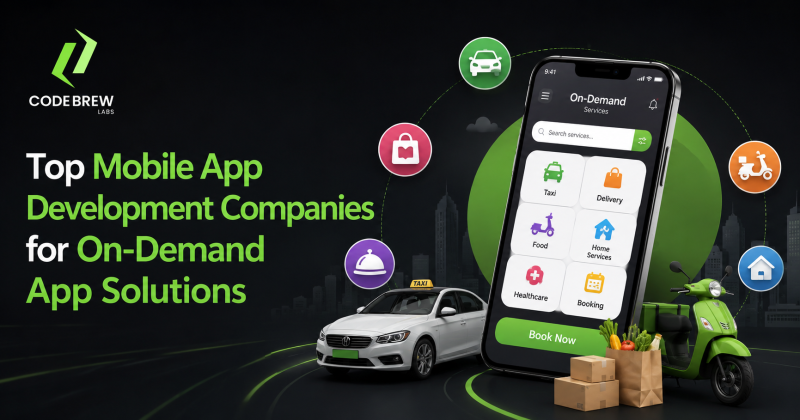
Top Mobile App Development Companies for On-Demand App Solutions
 Priyanshu codebrew
What happens when a customer books a home-cleaning service, orders groceries, requests a ride, or schedules a technician through an app? Behind that simple tap is a surprisingly complex system: location services, provider availability, payment processing, notifications, dispatch logic, customer support, and often real-time tracking.
That is why building an on-demand app is very different from building a basic mobile application.
If you are a startup founder testing a new marketplace or an enterprise expanding an existing service into digital channels, choosing the right development partner can determine how well the product performs once real users start placing orders.
For businesses targeting the UAE, a capable Mobile App Development Company in Dubai should understand more than iOS and Android development. It should know how to build location-aware platforms, multi-vendor marketplaces, delivery workflows, payment integrations, provider dashboards, and scalable backend systems.
Below are seven companies worth considering for on-demand app projects, along with the type of business each may suit best.
What Makes On-Demand App Development Different?
An on-demand app normally has several connected applications rather than a single customer-facing interface.
Think about a food delivery platform. The customer needs an ordering app. Restaurants need a partner dashboard or app. Drivers need a delivery application. Administrators need a control panel. All four systems have to communicate with the same backend.
The same pattern appears in ride-hailing, home services, healthcare bookings, logistics, beauty services, laundry, grocery delivery, and professional consultation platforms.
A strong development partner should therefore be comfortable with features such as real-time location tracking, automated provider assignment, scheduling, digital payments, ratings, push notifications, route management, chat, analytics, and administrative controls.
It also needs to understand what happens when demand increases. An application that works well for 500 users may need a very different architecture when thousands of customers, vendors, and service providers are active simultaneously.
1. Code Brew Labs
Code Brew Labs is a Dubai-based mobile app development company specializing in AI-powered mobile applications, enterprise software, and custom digital solutions for startups, SMEs, enterprises, and government organizations. With over 13 years of experience, 2,000+ successful projects, and a team of 650+ technology professionals, the company delivers scalable Android, iOS, and cross-platform applications that help businesses accelerate their digital transformation. By integrating technologies such as Artificial Intelligence, Machine Learning, Generative AI, Cloud Computing, and IoT, Code Brew Labs builds secure, innovative, and future-ready solutions across industries, including fintech, healthcare, retail, logistics, education, travel, and real estate.
Key Services
- Custom Mobile App Development
- AI App Development
- Android App Development
- iOS App Development
- Flutter & React Native Development
- Enterprise Software Development
- UI/UX Design
- Product Discovery & Strategy
- Cloud & Backend Development
- Quality Assurance & Maintenance
Why Choose Code Brew Labs
Code Brew Labs combines AI expertise with modern mobile technologies to build secure, scalable, and high-performing applications. Its end-to-end development approach, experienced team, and focus on innovation make it a trusted technology partner for businesses looking to launch AI-powered digital products and achieve long-term growth.
2. Dubai App Developers
Dubai App Developers is a leading AI app development company in Dubai, UAE, specializing in building enterprise-grade digital solutions for startups, enterprises, and government organizations. With a focus on innovation, scalability, and business automation, the company develops production-ready applications designed to help businesses improve efficiency, enhance customer experiences, and accelerate digital transformation.
The company offers expertise in AI-powered mobile applications, AI automation, AI agents and RAG, custom AI development, AI consulting, computer vision, NLP, cloud AI, and data engineering. Its solutions are designed to integrate with enterprise platforms while supporting UAE compliance requirements, Arabic language capabilities, and RTL interface design.
Core Services
- AI App Development
- Mobile App Development
- iOS App Development
- Android App Development
- AI Automation & RPA
- AI Agents & RAG
- Custom AI Development
- AI Consulting & Strategy
- Computer Vision & NLP
- Cloud AI & Data Engineering
- Enterprise Software Development
- Enterprise System Integration
- UI/UX Design
- AI Validation & Prototyping
- Deployment & Continuous Support
Industries Served
Fintech, Real Estate, Retail, Logistics, Government, Healthcare, Automotive, Travel, IoT, Entertainment, Telecom, Security, and Sports.
3. Royo Apps
Royo Apps is a mobile app development company specializing in on-demand applications, SaaS platforms, and AI-powered digital solutions for startups, SMEs, and enterprises. The company develops scalable Android, iOS, and cross-platform applications that help businesses launch branded marketplaces and digital platforms across industries such as healthcare, logistics, food delivery, eCommerce, transportation, and home services. With a focus on customization and rapid deployment, Royo Apps enables organizations to accelerate their digital transformation with flexible, business-ready solutions.
Key Services
- Custom Mobile App Development
- Android App Development
- iOS App Development
- Cross-Platform App Development
- On-Demand App Development
- SaaS Development
- Marketplace App Development
- UI/UX Design
- Cloud Solutions
- Maintenance & Support
Why Choose Royo Apps
Royo Apps combines AI capabilities with scalable mobile technologies to build customizable, user-friendly applications for businesses of all sizes. Its expertise in on-demand platforms, SaaS solutions, and end-to-end development makes it a reliable mobile app development company for organizations looking to launch and grow digital products efficiently.
4. Blocktech Brew
Blocktech Brew is a mobile app development company specializing in AI-powered mobile applications, blockchain, Web3, and custom software solutions. The company helps startups, SMEs, and enterprises build scalable Android, iOS, and cross-platform applications by combining Artificial Intelligence, blockchain, and cloud technologies. Its end-to-end development services enable businesses to launch secure, innovative, and future-ready digital products across various industries.
Key Services
- Custom Mobile App Development
- AI App Development
- Blockchain Development
- Web3 Development
- dApp Development
- Smart Contract Development
- Game Development
- UI/UX Design
- Enterprise Software Development
- Cloud Solutions
Why Choose Blocktech Brew
Blocktech Brew combines AI, blockchain, and mobile technologies to build secure, scalable, and high-performance applications. Its expertise in emerging technologies and end-to-end development makes it a trusted mobile app development company for businesses seeking innovative digital solutions.
5. Burj Code
Burj Code takes a highly focused approach to on-demand application development in Dubai. Its service offering covers use cases such as ride-hailing, food delivery, grocery, home services, beauty, fitness, pharmacy, and multi-vertical applications.
Its approach is particularly relevant for businesses where location and dispatch are central to the product.
A ride-hailing platform, for example, cannot rely on simple booking functionality. It needs driver availability, geographic matching, live location updates, routing, status changes, payment handling, and mechanisms for managing peak demand.
Burj Code describes a technology stack involving Flutter or React Native on the front end, with technologies such as NestJS, PostgreSQL/PostGIS, Redis, Socket.io, and payment integrations on the backend.
That technology combination makes sense for applications where real-time communication and geospatial queries are central to the experience.
For UAE-focused products, the company also highlights Arabic RTL support, AED payments, live tracking, and local regulatory considerations. Those details can matter when you are building specifically for Dubai rather than adapting an application designed for another market.
Best suited for: Dubai-based startups and enterprises building ride-hailing, delivery, home-service, or other location-dependent applications.
6. TechGropse
TechGropse offers dedicated on-demand app development services for UAE businesses and positions its solutions for startups, SMEs, and enterprises. Its service portfolio includes custom on-demand applications, AI-supported development, UAE data-compliance considerations, project management, and post-deployment support.
The company covers common on-demand sectors such as food delivery, grocery, logistics, healthcare, home services, and taxi booking.
One advantage of choosing a broader development agency is flexibility. Your initial project may start as a simple booking application, but later require an admin portal, AI recommendations, subscription management, loyalty features, or integration with enterprise systems.
That said, you should ask for examples that match your exact business model before signing a contract. Experience with generic mobile apps does not automatically mean a team understands complex dispatch or marketplace operations.
Best suited for: Startups and established businesses that want custom on-demand development with room for AI, integrations, and future expansion.
7. Emirates Graphic
Emirates Graphic is a Dubai-based digital agency offering mobile application design and development across areas including fintech, healthtech, logistics, and ecommerce. Its mobile development capabilities include native and cross-platform applications, real-time tracking, chat, dashboards, backend portals, and analytics.
Those capabilities line up well with many on-demand use cases.
Consider a healthcare-at-home application. Customers may need to book a professional, see the appointment status, communicate with the provider, receive notifications, and make payments. The service provider may need scheduling tools, customer information, route details, and a way to update appointment status.
That requires more than an attractive mobile interface.
Emirates Graphic also provides an end-to-end development process covering design, development, launch, and post-launch work.
Best suited for: Businesses looking for a Dubai-based agency combining mobile development, UX/UI, real-time features, dashboards, and broader digital services.
8. Innoveev
Innoveev is headquartered in Dubai Silicon Oasis and focuses on mobile, web, and AI product development for the Gulf region. Its UAE offering highlights work on Tamam, an on-demand services marketplace operating in the UAE.
That direct exposure to an on-demand marketplace makes the company worth considering for founders building service aggregation platforms.
An on-demand marketplace has a difficult balancing problem: you need enough service providers to satisfy customers, while providers need enough demand to stay active on the platform. The software therefore needs to support provider onboarding, service listings, bookings, availability, payments, notifications, and operational management.
Innoveev's combination of mobile development and AI capabilities may also be useful for businesses planning intelligent search, recommendations, customer support, or operational automation.
Best suited for: UAE startups and growing companies building marketplace products that combine mobile applications, web platforms, and AI capabilities.
Features Your On-Demand App Should Actually Have
It is easy to create a feature list that looks impressive on paper. The better approach is to start with the operational problem your app needs to solve.
Customer application
The customer side normally needs registration, search, service discovery, location selection, booking, scheduling, payment, order status, notifications, ratings, reviews, and customer support.
For a delivery business, live tracking can be especially valuable because customers want to know whether an order has been accepted, prepared, dispatched, and delivered.
Provider or driver application
The service-provider side should not be treated as an afterthought.
Providers may need availability controls, booking acceptance, navigation, earnings information, service history, chat, status updates, and document management.
For logistics and transportation platforms, driver workflows can become more complicated than the customer application itself.
Admin and operations dashboard
Your operations team needs visibility into what is happening across the platform.
A good dashboard can provide controls for users, providers, orders, payments, commissions, promotions, complaints, service areas, and reports.
For larger enterprises, the dashboard may also need role-based permissions and integrations with existing ERP, CRM, accounting, or customer-support systems.
Payments and monetization
The payment model should be designed before development begins.
You might charge customers per transaction, take a commission from providers, sell subscriptions, introduce premium memberships, or combine several models.
The architecture should support the chosen model without forcing a major rewrite later.
Location and dispatch
For many on-demand businesses, this is the heart of the application.
The platform may need to identify nearby providers, calculate estimated arrival times, assign jobs, optimize routes, and update order status in real time.
This is also where testing becomes critical. A workflow that performs well under normal traffic can behave differently when hundreds of providers become available or unavailable at once.
How AI Can Improve On-Demand Apps
AI has useful applications in on-demand platforms, but it should solve a measurable business problem rather than exist as a marketing feature.
Recommendation engines can suggest relevant services based on customer behavior. Predictive models can help estimate demand in different locations or time periods. AI assistants can handle routine customer questions, while intelligent routing can help improve delivery planning.
For a grocery platform, AI might recommend frequently purchased items. For a taxi application, it could help predict demand hotspots. For a home-services marketplace, it could rank providers according to availability, location, service category, and customer preferences.
Startups should be careful here. A simple rules-based system may be sufficient for an MVP. Adding sophisticated AI before you have enough reliable customer data can increase development cost without producing meaningful results.
How to Choose the Right Development Company
Do not select an agency based only on its portfolio screenshots.
Start by asking whether it has built the specific operational components your product requires. If you are developing a delivery platform, ask about dispatching, route management, driver applications, delivery proof, and real-time tracking.
Then discuss scalability.
Ask how the backend will handle increased traffic, how third-party integrations will be monitored, how application performance will be measured, and what happens if a payment or mapping service becomes temporarily unavailable.
You should also clarify ownership. Make sure your agreement covers source code, intellectual property, cloud accounts, design files, documentation, third-party services, and access to production systems.
For UAE projects, ask about Arabic and RTL support, payment providers, local data requirements, hosting preferences, and any industry-specific compliance obligations.
Finally, ask what happens after launch. An on-demand app is not finished when it reaches the App Store or Google Play. Bugs, operating-system updates, provider feedback, performance issues, and new business requirements will continue.
Why Code Brew Labs Can Be a Strong Choice for On-Demand App Development
For companies comparing a Mobile App Development Company in Dubai, Code Brew Labs stands out when the project needs a broad technology partner rather than a team focused only on one type of application.
Its Dubai offering covers on-demand applications alongside marketplaces, food delivery, transportation, healthcare, pickup and delivery, and other business applications.
The company also describes a process that begins with product validation and strategy before moving through design, development, testing, deployment, and ongoing support.
For an on-demand business, that broader approach can be useful because the application is only one part of the product. You also need operational workflows, backend infrastructure, dashboards, payment systems, integrations, and a roadmap for future releases.
Key services offered by Code Brew Labs
- On-demand app development
- Delivery and logistics applications
- Marketplace development
- Taxi and transportation apps
- Food and grocery apps
- iOS and Android development
- Flutter and React Native development
- UI/UX design
- Backend and API development
- AI integration
- Enterprise application development
- Maintenance and post-launch support
The Practical Takeaway
The best on-demand app development company is not necessarily the one with the longest feature list.
It is the partner that understands how your business actually operates.
A food delivery startup needs different engineering priorities from a healthcare booking platform. A taxi company needs sophisticated dispatching, while a home-services marketplace may care more about provider scheduling and customer-provider matching.
So before requesting development quotes, write down your core workflow: customer request → provider matching → booking → payment → fulfillment → completion → review.
Then ask each shortlisted company how it would build that workflow, what it would include in the MVP, what it would postpone, and how the architecture could grow later.
That conversation will tell you far more than a glossy portfolio.
For startups, the goal should be a focused first release that proves demand without creating unnecessary technical debt. For enterprises, the priority may be integration, security, governance, scalability, and compatibility with existing systems.
Choose the development partner around those realities, compare proposals carefully, and make sure the company you hire can support the product after launch—not just deliver the first version.
Source:
Click for the: Full Story
You might like








You Might Like this