



 Close Menu
 World
World
 Biography
 Health
 Education
 Business
 Lifestyle
 Sports
 Technology
 Animals
 History
 Food
Food
 Religious
 Startups
 Movies
 Politics
 Fashion
 Covid
Covid
 Diet
Diet
 Fitness
 Marketing
 Travel
 Science
 Reviews
 Social media
 Stories
 Facts
Facts
 Art
Art
 Entertainment
samiksha

Business
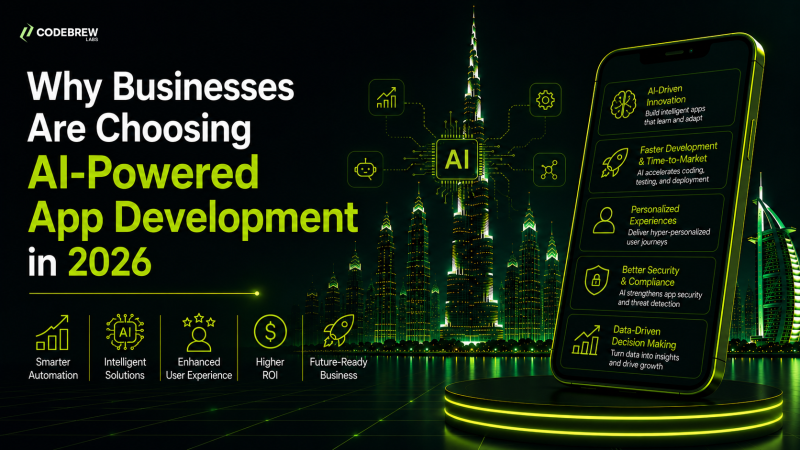
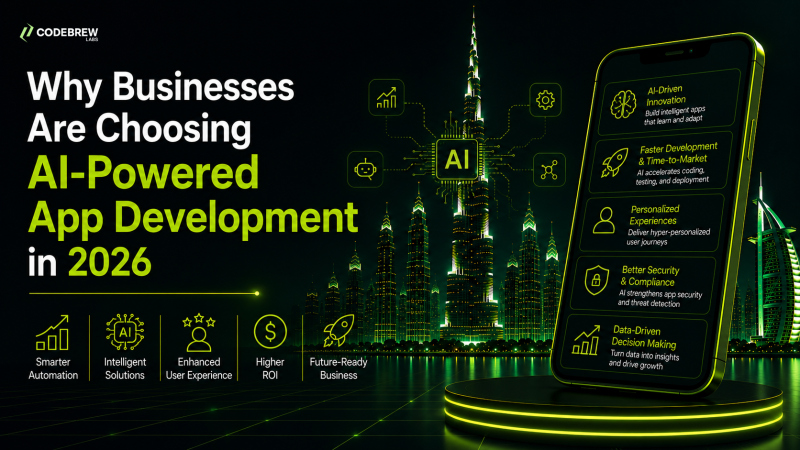
Why Businesses Are Choosing AI-Powered App Development in 2026?
 samiksha
Artificial intelligence is no longer something businesses consider for the distant future. In 2026, AI has become a practical part of how modern digital products are designed, developed, and experienced.
Mobile applications are at the center of this transformation.
Businesses that previously used apps primarily for transactions, communication, or customer engagement are now using AI to make those experiences more personalized, predictive, automated, and intelligent.
From AI-powered customer support and personalized recommendations to predictive analytics and autonomous AI agents, the role of AI in mobile applications has expanded significantly.
This is why more organizations are moving from traditional mobile app development toward AI-powered app development.
But what is driving this shift, and what does it mean for businesses planning a new application in 2026?
Let's explore.
What Is AI-Powered App Development?
AI-powered app development involves integrating artificial intelligence technologies into mobile or web applications to enable capabilities that go beyond predefined rules.
Traditional applications generally depend on programmed workflows.
For example, a conventional shopping app may display products based on categories, filters, and manually configured recommendations.
An AI-powered application can analyze user behavior, preferences, purchase history, search patterns, and contextual information to provide personalized recommendations.
AI can help applications:
- Understand natural language
- Personalize user experiences
- Predict customer behavior
- Automate repetitive tasks
- Analyze large datasets
- Generate content
- Recognize images and speech
- Provide intelligent recommendations
- Detect unusual patterns
- Assist users through conversational interfaces
- Automate complex workflows
The result is an application that can respond more intelligently to individual users and changing conditions.
Why AI-Powered Apps Are Becoming a Business Priority
The biggest reason businesses are adopting AI is simple: customers increasingly expect digital experiences to be faster, smarter, and more personalized.
Users interact with AI-powered products every day through search engines, recommendation systems, virtual assistants, productivity tools, and customer-service platforms.
As a result, expectations have changed.
A basic application may still function perfectly, but functionality alone is no longer enough to differentiate a digital product.
AI provides businesses with new ways to improve both the customer experience and internal operations.
1. AI Enables Personalized User Experiences
Personalization has become one of the strongest applications of AI.
Instead of providing identical experiences to every customer, an AI-powered app can adapt based on user behavior and preferences.
For example, an eCommerce application can recommend products based on previous purchases and browsing behavior.
A fitness application can create personalized workout recommendations.
A financial application can provide insights based on spending patterns.
A content platform can recommend relevant articles, videos, or products.
This creates a more relevant experience without requiring businesses to manually configure recommendations for every user.
2. AI Can Automate Customer Support
Customer support is another major area where businesses are adopting AI.
AI-powered chatbots and conversational assistants can answer common questions, guide users through processes, retrieve information, and escalate complex requests to human representatives.
Instead of replacing human support completely, AI can handle repetitive interactions while allowing customer-service teams to focus on more complicated issues.
For businesses, this can mean faster responses and greater availability.
For users, it can mean getting assistance without waiting for traditional support channels.
3. AI Agents Are Creating More Autonomous Apps
One of the most important developments in AI-powered app development is the rise of AI agents.
Traditional AI features generally respond to individual requests.
AI agents can go further by interpreting objectives, planning actions, interacting with systems, and completing multi-step workflows.
For example, instead of simply asking a travel app to find a hotel, a user could ask an AI assistant to:
- Understand their travel preferences
- Search available options
- Compare prices
- Recommend suitable accommodations
- Create an itinerary
- Assist with bookings
This shift from AI that answers to AI that acts could significantly change how applications are designed in the coming years.
4. AI Helps Businesses Make Better Decisions
Modern applications generate enormous amounts of data.
However, collecting data isn't enough.
Businesses need to understand what that data means.
AI can analyze large datasets and identify patterns that may not be immediately obvious to humans.
For example, an application could analyze customer activity to identify:
- High-value customers
- Churn risks
- Purchasing trends
- Demand patterns
- Fraud indicators
- Product preferences
- Operational inefficiencies
These insights can help businesses make more informed decisions.
5. AI Can Improve App Search
Traditional app search depends heavily on exact keywords.
AI-powered search can understand context and user intent.
For example, instead of searching for a specific product name, a customer could enter:
“I need a lightweight laptop for business travel under $1,000.”
An AI-powered search system can interpret the requirements and return more relevant results.
This can improve discoverability and reduce the effort required for users to find what they need.
6. Generative AI Is Changing App Experiences
Generative AI has expanded the possibilities of what applications can create dynamically.
Depending on the use case, apps can use generative AI for:
- Text generation
- Summaries
- Product descriptions
- Personalized recommendations
- Image generation
- Content assistance
- Conversational interfaces
- Document analysis
- Voice interactions
- Code assistance
For example, a productivity app could summarize lengthy documents, while a learning application could generate personalized explanations based on a student's level.
The important point is that generative AI should solve a genuine user problem rather than being included simply as a trend.
7. AI Can Improve Operational Efficiency
AI-powered applications aren't only useful for customer-facing experiences.
Businesses can also use AI internally.
An enterprise application could automate workflows such as:
- Data classification
- Document processing
- Report generation
- Lead qualification
- Inventory forecasting
- Employee assistance
- Workflow management
- Customer segmentation
Automating repetitive processes can allow employees to spend more time on strategic and creative work.
This is particularly valuable for businesses dealing with large volumes of information or repetitive operations.
8. On-Device AI Is Expanding Possibilities
Another important direction for AI-powered app development is on-device AI.
Rather than sending every request to a cloud-based AI service, certain AI workloads can be processed directly on the user's device.
This can offer potential benefits including:
- Faster responses
- Reduced network dependency
- Improved privacy for certain use cases
- Lower cloud processing requirements
- Better offline functionality
The right approach depends on the application, device capabilities, AI model, and privacy requirements.
A skilled app development company should evaluate cloud AI and on-device AI based on the specific product rather than treating either approach as universally better.
What Businesses Should Consider Before Building an AI-Powered App
AI can create tremendous opportunities, but adding AI to an application requires careful planning.
Start With the Business Problem
Don't begin with:
“Where can we add AI?”
Begin with:
“What problem are we trying to solve?”
Once the problem is clear, AI can be evaluated as one potential solution.
Consider Data Requirements
AI systems depend heavily on data.
Businesses should determine what data is available, how it will be collected, where it will be stored, and how it can be used responsibly.
Prioritize Security and Privacy
AI applications may process sensitive user information.
Security should therefore be incorporated into architecture and development from the beginning.
Businesses should consider authentication, access controls, encryption, secure APIs, data governance, and appropriate privacy practices.
Design the AI Experience Carefully
AI functionality should feel natural within the application.
Users should understand what the AI is doing, what information it uses, and when human intervention is available.
Good AI UX is about clarity and control, not simply adding a chatbot interface.
How an App Development Company Can Help
Building an AI-powered application requires expertise across multiple disciplines.
A development partner may need to handle:
Product Strategy → UX/UI → Mobile Development → Backend → AI Integration → APIs → Cloud Infrastructure → Security → Testing → Deployment → Continuous Optimization
This is why businesses should carefully evaluate an AI app development company rather than selecting a provider solely based on mobile development experience.
The right partner should understand both conventional application engineering and modern AI technologies.
Why Choose Code Brew Labs for AI-Powered App Development?
Code Brew Labs combines mobile application development with AI and emerging technologies to help businesses build intelligent digital products.
With 13+ years of industry experience, 2,500+ successfully delivered digital solutions, and 250+ developers, designers, and technology experts, the company works across mobile app development, AI, IoT, blockchain, and other technology areas.
For businesses exploring AI-powered applications, this combination of product development and emerging technology expertise can help turn an idea into a scalable digital product.
The focus should be on building an application where AI provides measurable value rather than adding artificial intelligence simply for marketing purposes.
The Future of AI-Powered App Development
The next generation of mobile applications will likely become increasingly adaptive and intelligent.
Instead of users navigating through multiple menus and screens to complete tasks, applications can increasingly understand intent and help users accomplish their goals more directly.
AI agents, multimodal interfaces, personalized experiences, predictive analytics, intelligent search, and on-device AI are all contributing to this evolution.
For businesses, the opportunity is significant.
The companies that start experimenting with AI today can learn how the technology fits their customers, workflows, and products before AI becomes an expected part of every digital experience.
Conclusion
AI-powered app development is becoming a strategic priority for businesses in 2026 because it can improve personalization, automation, decision-making, customer support, search, and overall user experience.
However, successful AI applications aren't created by simply connecting an AI API to an existing app.
They require thoughtful product strategy, strong UX, reliable software architecture, secure data practices, and a clear understanding of where AI creates genuine value.
For businesses planning their next digital product, the question is no longer simply whether AI belongs in the app.
Source:
Click for the: Full Story
You might like








You Might Like this