Close Menu
 World
World
 Biography
 Health
 Education
 Business
 Lifestyle
 Sports
 Technology
 Animals
 History
 Food
Food
 Religious
 Startups
 Movies
 Politics
 Fashion
 Covid
Covid
 Diet
Diet
 Fitness
 Marketing
 Travel
 Science
 Reviews
 Social media
 Stories
 Facts
Facts
 Art
Art
 Entertainment
Badal

Health
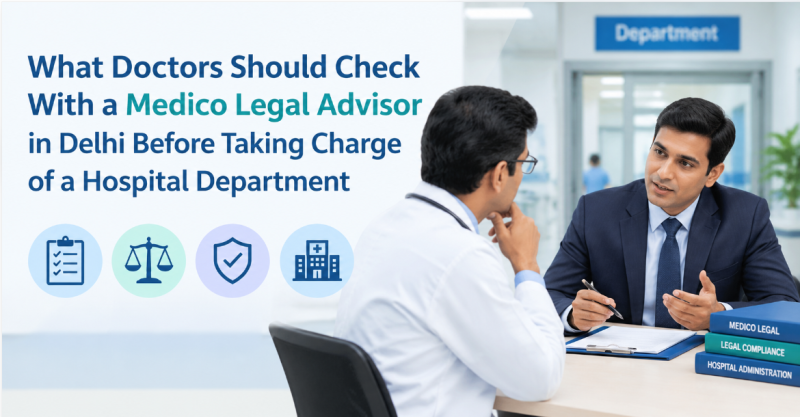
What Doctors Should Check With a Medico Legal Advisor in Delhi Before Taking Charge of a Hospital Department
 Badal
Badal
Taking charge of a department adds a layer of responsibility beyond your own patients. As head, you are expected to oversee clinical standards, staff conduct, documentation and complaint handling, and a problem in any of these can become your problem. The short answer to what you should check is this: confirm exactly what you are accountable for, what authority you actually hold, what insurance and institutional support exist, and what condition the department's records and processes are in. Speaking with a medico legal advisor in Delhi before you accept the role helps you test these points while you can still negotiate.
Many new heads of department discover inherited issues only after a complaint arrives: unsigned consent forms, unresolved incident reports, or protocols nobody follows. A practical medico legal guide in Delhi therefore needs to cover both your personal clinical practice and your supervisory duties.
This article is general information, not legal advice. Laws and regulatory guidance change, so confirm the current position with the National Medical Commission (NMC), your state medical council and a qualified lawyer.
Clarify Your Role, Authority and Accountability
The first question is what the appointment actually requires. A title alone does not define responsibility. Ask for a written description covering:
- Clinical duties, administrative duties and reporting lines.
- Authority over staffing, rosters, equipment requests and protocols.
- Responsibility for junior doctors, residents, nurses and technicians.
- Duty hours, on-call arrangements and emergency cover.
- Who you escalate to when resources are inadequate.
A common difficulty is accountability without authority. If you are expected to ensure safe care but cannot influence staffing or equipment, record your concerns in writing and ask management to respond. How responsibility is shared between you and the institution depends on the facts and the contract, so avoid assuming that either you or the hospital carries it entirely.
Medico Legal Advisor in Delhi: What to Review Before You Accept
A medico legal advisor in Delhi can help you read the appointment terms alongside the department's current state. Useful items to review together include:
- The appointment letter or agreement, including indemnity, termination and restrictive clauses.
- Whether the hospital's professional indemnity policy covers your supervisory role, and whether it covers claims made after you leave.
- Pending complaints, legal notices, consumer or council proceedings involving the department.
- Recent adverse events and how they were reviewed.
- Licences, registrations and accreditations the department relies on.
If you can, ask management for a summary of open disputes before you start. Knowing what you are inheriting is reasonable and professional, and it helps you separate past issues from those arising on your watch.
Records, Consent and Documentation Systems
Sample the department's records early. You do not need to audit everything, but a quick review of case sheets, consent forms, operation notes, discharge summaries and handover notes will show the standard in practice.
Check whether:
- Entries are dated, timed, legible and signed with name and registration number.
- Informed consent records show a real discussion of risks and alternatives, not just a signature.
- Investigation results are reviewed and acted on in a documented way.
- Corrections are made as dated addenda rather than overwriting.
- Records are stored securely and retrievable, with reference to the Digital Personal Data Protection Act, 2023 for patient data.
If the department also offers online consultations, confirm that identity checks, consent, history, advice and follow-up are recorded in the same way as for in-person visits, and that prescribing follows the Telemedicine Practice Guidelines of 2020. Read the current text directly rather than relying on summaries.
A realistic example: A new head of a surgical department learns months later that several consent forms were pre-signed by relatives without a doctor's explanation. A patient complains after a complication. Had the head sampled the records in the first weeks and introduced a simple rule that the operating surgeon documents the consent discussion, the gap could have been addressed early and recorded as a corrective step.
Complaints, Legal Notices and Patient Safety Processes
A department head is often the first person management turns to when a complaint arrives. Understand the system before you need it:
- How are patient complaints received, logged and answered?
- Who handles legal notices and communicates with insurers?
- Is there an incident reporting and adverse event review process?
- Are near-misses discussed as learning opportunities?
If a notice does arrive, these steps generally help:
- Read it carefully and note any deadline.
- Do not alter, add to or back-date any record.
- Preserve notes, reports, messages and system logs.
- Inform your indemnity insurer and hospital management.
- Avoid informal discussion with the patient or on social media.
- Seek medico-legal guidance before replying.
Strong clinical governance depends on honest reporting. Staff are more likely to report errors when they trust that the response will be fair and focused on patient safety.
Common Mistakes and a Practical Checklist
Mistakes to avoid
- Accepting the role without a written description of duties.
- Assuming the hospital's insurance covers your supervisory responsibilities.
- Ignoring inherited problems because they pre-date your appointment.
- Raising resource concerns verbally and not in writing.
- Leaving consent and documentation standards to individual habit.
- Reacting to a complaint by editing records.
- Seeking advice only after a dispute has escalated.
Before-you-start checklist
- Role, authority and reporting lines confirmed in writing
- Indemnity position clarified
- Open complaints and notices disclosed
- Sample of records reviewed
- Consent practice checked
- Complaint and incident procedures understood
- Resource concerns documented
- Independent legal advice considered
When to Seek Professional Medico-Legal Guidance
Consider advice before signing an appointment with unusual terms, when you find significant documentation or consent problems, when serious adverse events are unresolved, or when a complaint or notice arrives. Dr. Vimal Kant Goyal is a practical medico-legal guide for doctors who explains how such situations are commonly approached.
Conclusion
Taking charge of a department is a clinical, administrative and legal responsibility at once. Define your role in writing, confirm insurance, learn about open disputes, sample the records, check consent practice and understand how complaints are handled. Consulting a medico legal advisor in Delhi at this stage helps you start from an informed position, but steady documentation and open communication remain your strongest foundation. Raise concerns early, keep your own records clear, and keep patient safety at the centre of every decision.
Frequently Asked Questions
1. Am I personally responsible for problems that existed before I became head of department?It depends on the facts. Your responsibility generally relates to your own conduct and your supervisory duties from the time you take charge. Documenting the condition of the department when you start, and the steps you take to address problems, is sensible.
2. Should I speak to a medico legal advisor before accepting the post?It is worthwhile, particularly where the terms include indemnity, termination or restrictive clauses, or where the department has open disputes. Early advice gives you room to negotiate.
3. How do I choose a top medicolegal advisor in Delhi?Superlatives are unreliable. Look for relevant experience with doctors' contracts, complaints and notices, verifiable credentials, a clear explanation of what the advice covers and honest, cautious guidance. Be wary of anyone who promises outcomes.
4. Does the hospital's insurance cover my role as department head?Not necessarily. Cover depends on the policy terms, your role and the type of claim. Ask for written confirmation and consider personal indemnity cover if gaps exist.
5. What should I record when I raise a safety or resource concern?Note the date, the issue, the possible risk to patients, who you informed and any response. A short written message to management is usually enough and creates a clear record.
Source:
Click for the: Full Story
You might like