Close Menu
 World
World
 Biography
 Health
 Education
 Business
 Lifestyle
 Sports
 Technology
 Animals
 History
 Food
Food
 Religious
 Startups
 Movies
 Politics
 Fashion
 Covid
Covid
 Diet
Diet
 Fitness
 Marketing
 Travel
 Science
 Reviews
 Social media
 Stories
 Facts
Facts
 Art
Art
 Entertainment
samiksha
Business
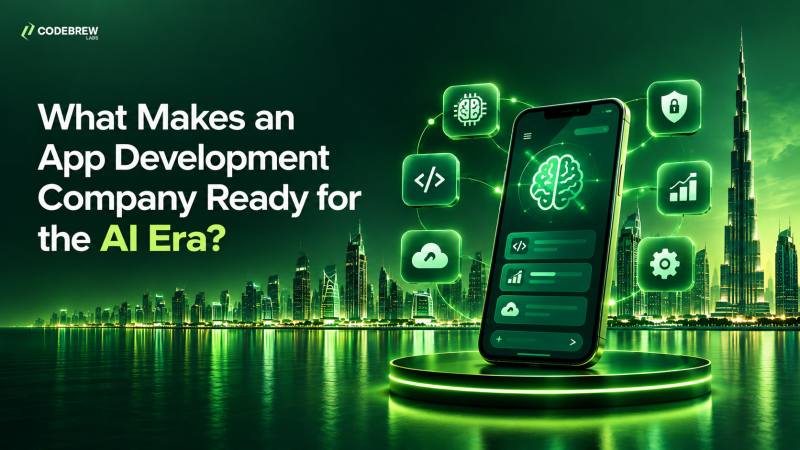
What Makes an App Development Company Ready for the AI Era?
 samiksha
Artificial intelligence is changing the way businesses think about digital products. Mobile apps are no longer limited to fixed features and simple interactions. Businesses are now exploring applications that can understand users, automate repetitive tasks, deliver personalized experiences, and support faster decision-making.
This shift is also changing what businesses expect from an app development company.
A development partner in 2026 needs to understand more than mobile platforms and programming frameworks. It needs to know how AI, automation, cloud technology, data, security, and user experience can work together to create useful digital products.
But being ready for the AI era does not mean adding AI to every application. It means understanding where intelligent technology can create genuine value and how it can be introduced without compromising usability, security, or scalability.
Understanding AI Beyond the Hype
AI is one of the most discussed technologies in business, but not every AI feature makes an application better.
A capable development company should first understand the business problem before recommending an AI solution.
For example, an eCommerce business may benefit from AI-powered product recommendations. A customer service platform may use an AI assistant to handle common questions. A business management application could use AI to summarize information or automate repetitive workflows.
The technology should support the product's purpose rather than become the purpose itself.
An AI-ready development partner should therefore be able to explain both the opportunities and limitations of different AI approaches.
Ability to Build AI-Powered App Features
Modern mobile applications can use AI in many different ways.
Depending on the business requirement, an application may include:
- AI-powered chat assistants
- Intelligent search
- Personalized recommendations
- Voice-based interactions
- Automated content generation
- Image and document analysis
- Predictive insights
- Smart notifications
- AI-powered customer support
- Workflow automation
The right features will depend on the application and its users.
A development partner should be able to identify which capabilities can improve the customer journey and which ones may add unnecessary complexity.
Strong Data Handling Capabilities
An application may need to collect, process, organize, and analyze large amounts of information before intelligent features can provide useful results.
This makes data architecture an important consideration when choosing a development company.
The development team should understand how application data is stored, processed, accessed, and protected. It should also be able to connect relevant data sources while maintaining appropriate security and privacy controls.
Poor data handling can affect both application performance and the reliability of AI-powered features.
Integration With Modern AI Models and Services
Businesses have access to a growing range of AI models and services.
An AI-ready development company should understand how to integrate appropriate AI capabilities into applications through APIs, cloud services, model platforms, or other suitable technologies.
This does not necessarily mean building an AI model from scratch.
In many cases, businesses can use existing AI models and customize the surrounding application experience to meet specific requirements.
The development team should be able to evaluate different options based on factors such as cost, performance, privacy, response quality, scalability, and business requirements.
Focus on Practical AI Use Cases
One of the most important qualities of an AI-ready development partner is the ability to focus on practical applications.
Businesses should ask:
What problem will this AI feature solve?
If the answer is unclear, the feature may not be necessary.
For example, adding an AI chatbot to an application may sound useful, but if customers primarily need a simple search function, improving search may provide a better experience.
Similarly, an automated recommendation engine may be valuable for a large marketplace but unnecessary for a simple internal business application.
A strong development partner should help businesses identify meaningful use cases instead of simply following technology trends.
AI Agents Are Changing Application Workflows
AI agents are becoming another important area of digital product development.
Unlike basic AI features that respond to individual prompts, AI agents can potentially handle multi-step tasks based on defined goals and permissions.
For businesses, this could support workflows such as customer assistance, information retrieval, appointment coordination, internal processes, and other repetitive activities.
However, agent-based systems require careful planning.
Businesses need to consider permissions, data access, human oversight, security, error handling, and the boundaries within which an agent can operate.
An AI-ready development company should understand these considerations before implementing agent-based functionality.
Scalable Architecture Matters More Than Ever
AI-powered applications can have different infrastructure requirements from traditional mobile apps.
Depending on the solution, applications may need to process large volumes of data, communicate with external AI services, manage API requests, and handle changing user demand.
This makes scalable architecture particularly important.
A development partner should plan for future growth rather than build an application that works only under today's conditions.
Scalability may involve cloud infrastructure, efficient APIs, modular architecture, caching, database optimization, monitoring, and other technical approaches.
The exact solution will depend on the application, but the underlying principle remains the same: the product should have room to grow.
Security Needs to Be Built Into AI Applications
AI introduces additional security considerations.
Applications may send information to external AI services, process user-generated content, or use business data to provide personalized results.
Businesses therefore need to understand what information is being processed and where it is going.
An AI-ready development company should consider areas such as:
- Data encryption
- Access controls
- Secure API communication
- Authentication
- Data privacy
- Sensitive information handling
- AI service permissions
- Monitoring and logging
- Secure storage
Security should be considered during architecture and development rather than added after the application is complete.
User Experience Still Comes First
Advanced technology does not automatically create a better app.
Users may not care whether an application uses a sophisticated AI model if the app is slow, confusing, or difficult to navigate.
This is why UX remains important in AI-powered application development.
AI features should feel natural within the product.
For example, an AI assistant should be easy to access without interrupting the user's main task. Personalized recommendations should be relevant rather than overwhelming. Automated actions should be understandable and, where appropriate, give users control.
An AI-ready development company should combine intelligent technology with thoughtful product design.
Strong Testing and Monitoring
AI-powered applications require testing beyond traditional software checks.
The development team may need to evaluate how the AI responds to different types of inputs, how it handles unexpected requests, and whether results remain relevant.
Testing can also cover:
- Application performance
- AI response quality
- API reliability
- Security
- Data handling
- User experience
- Error scenarios
- System performance under increased demand
Monitoring after launch is equally important.
AI services, models, APIs, and user behavior can change over time. Continuous monitoring helps businesses identify problems and improve the product.
Flexible Technology Choices
The AI landscape is changing quickly.
New models, frameworks, platforms, and tools are introduced regularly. A development partner should therefore avoid building an application around technology choices that unnecessarily limit future flexibility.
Modular architecture can make it easier to replace or upgrade individual services without rebuilding the entire application.
For businesses, this can be especially valuable as AI technology continues to develop.
The goal is not to predict exactly which AI technology will dominate several years from now. It is to create a product that can adapt as technology changes.
Ability to Combine AI With Automation
AI becomes even more useful when it works together with automation.
For example, an AI system could analyze a customer request, classify it, and automatically route it to the correct business workflow.
An application could use AI to process information and automation to trigger the next action.
This combination can reduce repetitive work while helping employees focus on tasks that require human decision-making.
A capable development company should understand how these technologies can work together rather than treating AI as an isolated feature.
Business Understanding Is Just as Important as Technical Skills
An AI-ready development company should understand business objectives, not just technology.
The team should ask questions about:
- Revenue goals
- Customer needs
- Operational challenges
- Target markets
- Existing systems
- Growth plans
- Business risks
This helps ensure that technology decisions support the larger business strategy.
For example, an AI feature that saves employees several hours every week may provide more value than a highly advanced feature that customers rarely use.
Technology decisions should ultimately connect back to measurable business needs.
Ongoing Development Is Becoming Essential
The launch of an AI-powered application should be viewed as the beginning rather than the end.
As customers use the product, businesses can identify new requirements, improve existing features, and discover additional opportunities for automation and personalization.
AI technology itself will also continue to change.
This makes ongoing maintenance and development important.
Businesses should look for development partners that can provide support beyond the initial launch, including updates, performance improvements, security enhancements, integrations, and new AI capabilities.
Questions to Ask an AI-Ready Development Company
Before selecting a development partner, businesses can ask:
- What AI solutions have you implemented?
- Which AI features would make sense for our product?
- How will our data be handled?
- Which AI models or services do you recommend and why?
- How will the application scale as usage grows?
- How will AI responses be tested?
- What security measures will be implemented?
- Can the architecture support future AI upgrades?
- What post-launch support is available?
The answers can reveal whether a company is genuinely prepared to build AI-powered products or is simply adding AI terminology to its services.
Conclusion
An AI-ready app development company is not defined by how many AI tools it can mention. It is defined by how effectively it can use intelligent technology to solve real business and customer problems.
Businesses should look for development partners that combine AI capabilities with strong product strategy, scalable architecture, data management, security, UI/UX, automation, testing, and long-term support.
In 2026, successful applications will increasingly combine mobile experiences with intelligent services and connected business workflows. Companies that plan for this shift can create digital products that are not only useful today but also adaptable as technology continues to evolve.
Code Brew Labs helps businesses build modern mobile and digital solutions that incorporate AI, automation, cloud technologies, and scalable architectures. Its approach focuses on connecting emerging technology with practical business requirements to create applications designed for changing digital needs.
Source:
Click for the: Full Story
You might like