



 Close Menu
 World
World
 Biography
 Health
 Education
 Business
 Lifestyle
 Sports
 Technology
 Animals
 History
 Food
Food
 Religious
 Startups
 Movies
 Politics
 Fashion
 Covid
Covid
 Diet
Diet
 Fitness
 Marketing
 Travel
 Science
 Reviews
 Social media
 Stories
 Facts
Facts
 Art
Art
 Entertainment
Deepak

Health
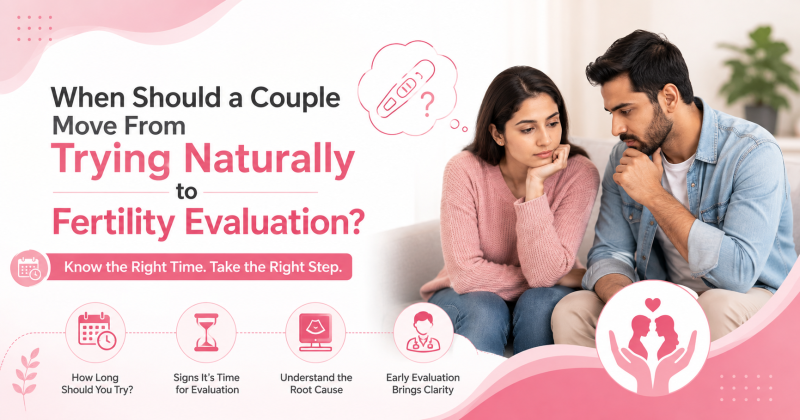
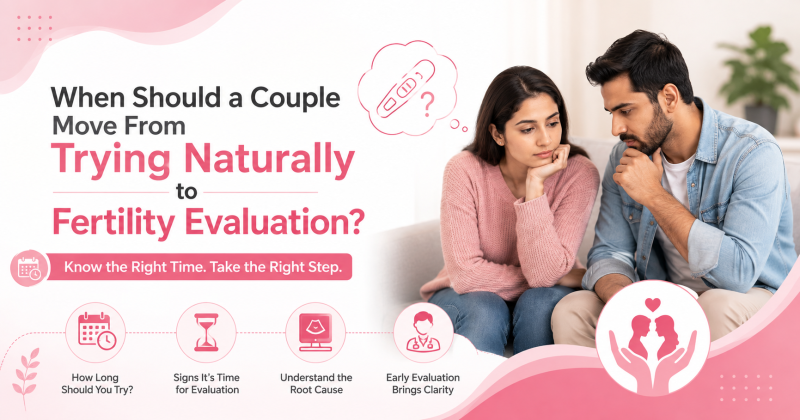
When Should a Couple Move From Trying Naturally to Fertility Evaluation?
 Deepak
Trying to conceive naturally is often filled with hope, patience, and a fair amount of uncertainty. Most couples expect it to happen within a few months, and for many, it does. But when weeks turn into months without a positive result, a common question arises: is this still normal, or is it time to seek medical guidance?
Knowing when to shift from waiting to actively seeking a fertility evaluation can make a meaningful difference. Earlier assessment often means more time to understand the cause and explore appropriate next steps, guided by the best female infertility in Delhi.
How Long Is "Normal" When Trying to Conceive?
For most healthy couples, pregnancy occurs within the first year of regular, unprotected intercourse. Fertility specialists commonly use the following general guidelines:
- Under 35 years: Consider evaluation after 12 months of trying without success
- 35 years and above: Consider evaluation after 6 months of trying without success
- 40 years and above: Evaluation is often recommended sooner, given the natural decline in egg quantity and quality with age
These are general benchmarks, not strict rules. Some situations call for earlier evaluation, regardless of how long a couple has been trying.
Signs That Suggest You Shouldn't Wait
Certain symptoms or history indicate that it may be wise to consult a gynecologist sooner rather than later:
- Irregular, absent, or unusually painful periods
- Known conditions such as PCOS, endometriosis, or fibroids
- History of pelvic infections or previous abdominal or pelvic surgery
- Two or more miscarriages
- Known male-factor issues, such as a previous low sperm count diagnosis
- Either partner has an existing thyroid, diabetes, or autoimmune condition
- One or both partners are approaching or past their late 30s
If any of these apply, waiting the full year before seeking help may not be necessary or advisable.
Why Timing Matters in Fertility Care
Fertility naturally changes over time, particularly for women, as ovarian reserve gradually declines with age. This doesn't mean pregnancy becomes impossible with age, but it does mean that identifying and addressing potential issues earlier can offer more options and clearer answers.
Delaying evaluation unnecessarily can sometimes mean losing valuable time, especially in cases where a specific, treatable cause exists but hasn't yet been identified.
What Happens During a Fertility Evaluation?
A fertility evaluation is a structured process designed to understand what may be affecting conception. It typically involves both partners, since infertility can stem from either side or a combination of factors.
For the Female Partner
- Detailed menstrual and medical history
- Hormonal blood tests (including ovarian reserve markers)
- Pelvic ultrasound to assess the uterus and ovaries
- Assessment of ovulation patterns
- Tubal patency testing, if indicated
For the Male Partner
- Semen analysis to assess sperm count, motility, and morphology
- Relevant medical history and lifestyle review
This evaluation helps determine whether the delay is linked to ovulation irregularities, structural issues, hormonal imbalances, male-factor infertility, or a combination of causes. In some cases, no clear cause is identified initially, which itself provides direction for the next steps.
Common Misconceptions That Delay Evaluation
Many couples wait longer than necessary because of assumptions that aren't always accurate:
- "We're both healthy, so it will happen eventually."
- General health doesn't always reflect reproductive health. Ovulation issues or mild hormonal imbalances can exist without other symptoms.
- "Fertility testing means something is definitely wrong."
- An evaluation is diagnostic, not a confirmation of a problem. Many couples are found to have manageable or unexplained factors.
- "We should keep trying a bit longer before involving a doctor."
- While understandable, this can sometimes delay identifying a treatable issue, particularly for women closer to or above 35.
The Emotional Side of Waiting
The uncertainty of trying to conceive without success can be emotionally taxing, often more than people expect. Feelings of frustration, self-doubt, or anxiety are common and valid. Seeking a fertility evaluation is not an admission of failure; it's a proactive step toward clarity, and often brings relief simply by replacing uncertainty with information.
How Dr. Poonam Goyal Approaches Fertility Evaluation
Dr. Poonam Goyal, a gynecologist and fertility specialist practicing in Delhi, focuses on understanding each couple's individual history and circumstances before recommending any tests or next steps. This personalized approach helps ensure that evaluation and any subsequent care are relevant to the couple's specific situation, rather than following a one-size-fits-all process.
For couples navigating female infertility in Delhi, this means starting with a thorough conversation and assessment, so that any recommendations are grounded in a clear understanding of what's actually happening.
Final Thoughts
There is no single "right" time to seek fertility evaluation, but general guidelines, combined with individual health history, can help couples make an informed decision rather than waiting indefinitely out of uncertainty. If conception hasn't occurred within the expected timeframe, or if specific risk factors are present, consulting a gynecologist sooner can provide clarity and, where needed, a path forward.
Frequently Asked Questions
1. How long should we try naturally before seeing a doctor?
Generally, couples under 35 are advised to try for about a year, and those 35 or older for about six months, before seeking a fertility evaluation. This can vary based on individual health history.
2. Does seeking evaluation mean we will need IVF or other treatment?
Not necessarily. An evaluation is meant to identify the cause, if any, behind the delay. Many couples are found to need only minor guidance or monitoring, while others may require more specific treatment.
3. Can irregular periods be a sign of infertility?
Irregular periods can indicate ovulation irregularities, which may affect the chances of conception. It's worth discussing this with a gynecologist rather than assuming it's unrelated.
4. Is age really that significant a factor in fertility?
Yes, particularly for women, as egg quantity and quality naturally decline with age. This is why evaluation timelines are shorter for women aged 35 and above.
5. What should we bring to our first fertility consultation?
It helps to bring a record of menstrual cycles, any previous test results, details of past pregnancies or miscarriages, and a general medical history for both partners.
Source:
Click for the: Full Story
You might like








You Might Like this