



 Close Menu
 World
World
 Biography
 Health
 Education
 Business
 Lifestyle
 Sports
 Technology
 Animals
 History
 Food
Food
 Religious
 Startups
 Movies
 Politics
 Fashion
 Covid
Covid
 Diet
Diet
 Fitness
 Marketing
 Travel
 Science
 Reviews
 Social media
 Stories
 Facts
Facts
 Art
Art
 Entertainment
Deepak

Health
Why Can Pregnancy Take Longer Even When Both Partners Seem Healthy?
 Deepak
For many couples, the assumption is simple: if both partners are healthy, eating well, exercising, and have no obvious medical issues, pregnancy should happen quickly. So when months pass without a positive result, it can feel confusing, even alarming. The truth is that fertility is influenced by far more than general health, and several subtle factors can delay conception even in couples who feel completely fine.
Understanding these hidden factors is the first step toward addressing them — and knowing when it may help to consult a specialist in female fertility in Delhi.
Feeling Healthy Doesn't Always Mean Being Fertile
General health and reproductive health are related, but they are not the same thing. A person can have normal energy levels, a balanced diet, and no visible symptoms, while still experiencing underlying issues such as:
- Subtle hormonal imbalances
- Irregular or silent ovulation problems
- Mild structural issues in the reproductive organs
- Egg quality changes that come with age
- Undiagnosed conditions like thyroid dysfunction or PCOS in a mild form
These factors often don't cause noticeable symptoms in daily life, which is why couples may not suspect anything is wrong until they start trying to conceive.
Common Reasons Pregnancy May Take Longer
1. Age-Related Changes in Fertility
Fertility naturally declines with age, particularly after the early 30s for women. Egg quantity and quality reduce gradually, which can make conception take longer even without any diagnosed medical condition. Male fertility can also be affected by age, though the decline is usually slower.
2. Irregular or Undetected Ovulation Issues
Ovulation doesn't always follow a textbook 28-day cycle. Some women ovulate irregularly, ovulate late, or occasionally skip ovulation altogether without realizing it, since periods may still appear roughly on schedule. This can significantly narrow the fertile window each month.
3. Lifestyle and Environmental Factors
Even in generally healthy individuals, certain everyday factors can affect fertility over time:
- Chronic stress and disrupted sleep patterns
- Excessive caffeine or alcohol intake
- Smoking or exposure to smoking
- Being significantly underweight or overweight
- Sedentary lifestyle or, conversely, excessive high-intensity exercise
4. Timing and Frequency of Intercourse
One of the most overlooked reasons for delayed conception is simply timing. The fertile window is short, typically a few days around ovulation, and busy schedules, work stress, or lack of awareness about this window can reduce the chances of conception each cycle.
5. Mild or Undiagnosed Reproductive Conditions
Conditions such as mild endometriosis, small uterine fibroids, or slight hormonal fluctuations may not cause pain or visible symptoms but can still interfere with conception. These are often only identified through targeted fertility evaluation.
6. Male Fertility Factors
Fertility challenges are not always about the female partner. Sperm count, motility, and morphology can be affected by lifestyle, stress, heat exposure, or underlying health conditions, even when a man feels physically well.
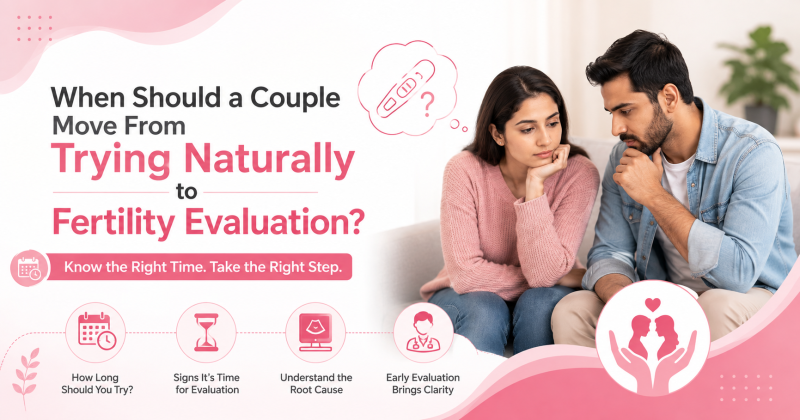
When Should Couples Consider a Fertility Evaluation?
Most fertility specialists, including those offering female fertility in Delhi, generally recommend seeking evaluation if:
- You are under 35 and have been trying to conceive for over a year without success
- You are 35 or older and have been trying for more than six months
- You have irregular or absent periods
- You have a known history of pelvic infections, endometriosis, or previous surgeries
- You have experienced recurrent pregnancy loss
Seeking guidance earlier rather than later allows more time to identify the cause and explore appropriate options, without unnecessary delay or anxiety.
What Does a Fertility Evaluation Usually Involve?
A structured evaluation helps uncover reasons that may not be obvious otherwise. This typically includes:
- Detailed medical and menstrual history for both partners
- Hormonal blood tests to assess ovarian reserve and thyroid function
- Ultrasound scans to check the uterus and ovaries
- Semen analysis for the male partner
- Tubal patency tests, if required, to check whether the fallopian tubes are open
Based on these results, a gynecologist can determine whether the delay is due to a specific, correctable factor or whether further specialized fertility support is needed.
Simple Steps That May Support Conception
While not a substitute for medical evaluation, certain habits can support overall reproductive health:
- Track ovulation using calendar methods, apps, or ovulation predictor kits
- Maintain a balanced diet rich in whole foods, and manage weight within a healthy range
- Reduce alcohol and quit smoking
- Manage stress through adequate sleep, relaxation techniques, or counseling if needed
- Avoid unnecessary heat exposure (saunas, hot tubs) for male partners trying to conceive
These steps won't resolve every fertility issue, but they create a healthier foundation while any medical concerns are being assessed.
A Reassuring Perspective
Delayed conception, even in seemingly healthy couples, is common and often explainable. Many couples who consult a gynecologist or fertility specialist discover a specific, manageable reason behind the delay, ranging from timing issues to mild hormonal factors, rather than a major underlying problem.
Dr. Poonam Goyal, a gynecologist and fertility specialist based in Delhi, works with couples to understand their individual fertility profile through detailed evaluation, rather than relying on assumptions. This approach helps identify the actual cause of delay and outlines realistic, medically sound next steps.
Final Thoughts
Feeling healthy does not always mean every aspect of reproductive function is functioning optimally. Pregnancy involves a complex interplay of timing, hormones, egg and sperm quality, and reproductive anatomy, any of which can quietly affect conception even without visible symptoms.
If you and your partner have been trying to conceive for a while without success, a timely consultation focused on female fertility in Delhi can help clarify what's happening and what options are available, rather than leaving you to guess.
Frequently Asked Questions
1. Is it normal to take more than a year to get pregnant even if we're both healthy?
Yes, it can be normal, but it's also worth having an evaluation. Many factors affecting fertility, such as ovulation timing or mild hormonal imbalances, are not related to general health and may not be obvious without testing.
2. Can stress alone delay pregnancy?
Chronic stress can affect hormone levels and ovulation patterns, potentially contributing to delayed conception. However, stress is rarely the sole cause, so it's best evaluated alongside other factors.
3. Do irregular periods always mean infertility?
Not necessarily, but irregular periods can indicate ovulation irregularities that may affect the chances of conception each month. A gynecologist can assess the underlying cause.
4. When should we see a fertility specialist instead of waiting longer?
If you're under 35 and have tried for over a year, or 35 and above and have tried for over six months, it's advisable to seek an evaluation rather than continuing to wait.
5. Can lifestyle changes alone help us conceive faster?
Lifestyle changes can support reproductive health, but they may not resolve underlying medical causes. If a specific condition is contributing to the delay, a proper diagnosis and tailored guidance are important alongside lifestyle improvements.
Source:
Click for the: Full Story
You might like








You Might Like this