Close Menu
 World
World
 Biography
 Health
 Education
 Business
 Lifestyle
 Sports
 Technology
 Animals
 History
 Food
Food
 Religious
 Startups
 Movies
 Politics
 Fashion
 Covid
Covid
 Diet
Diet
 Fitness
 Marketing
 Travel
 Science
 Reviews
 Social media
 Stories
 Facts
Facts
 Art
Art
 Entertainment
Yatin Samra

Technology
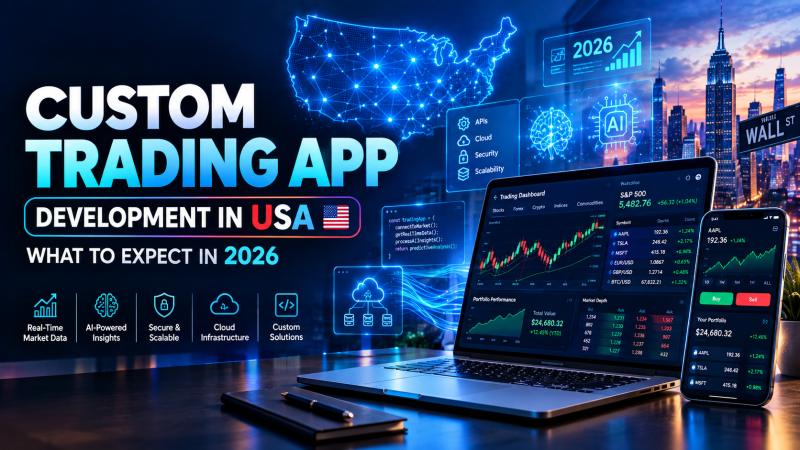
10 Custom Trading App Development Trends to Watch in the USA in 2026
 Yatin Samra
The technologies used for trading are moving into more digital, data-driven, and automated areas. Traders need to have quick access to market data, easy-to-use account management, secure transactions, and other tools that will help them analyze and understand more complicated financial information.
The mentioned situation brings new opportunities to those businesses that want to build a trading platform. But the creation of the trading app in the USA is not just about adding the chart and the possibility to buy/sell. There are many factors that influence the development strategy of trading apps.
Here are 10 trends and considerations shaping custom trading app development in 2026.
1. AI-Assisted Trading Experiences
Artificial intelligence is becoming an important technology for processing large amounts of financial information.
Rather than positioning AI as an autonomous decision-maker, platforms can use it to assist users with tasks such as:
- Summarizing market news
- Organizing financial information
- Explaining market terminology
- Generating research summaries
- Creating customizable alerts
- Highlighting relevant portfolio information
The exact functionality should depend on the platform's business model and applicable regulatory requirements.
AI features that cross into investment advice or automated trading require particularly careful consideration.
2. More Personalized Trading Dashboards
A single dashboard does not necessarily work for every user.
Custom trading platforms can provide personalized layouts based on user preferences, experience levels, watchlists, and frequently accessed information.
For example, one user may prioritize portfolio performance while another may focus on market charts and watchlists.
Personalization can make complex financial information easier to navigate without changing the underlying trading infrastructure.
3. Faster Market-Data Experiences
Market data is central to digital trading.
Modern applications need reliable systems for handling prices, quotes, charts, financial news, and other relevant information. Businesses may integrate third-party market-data providers depending on their asset classes and licensing arrangements.
As platforms grow, the architecture must be capable of handling increased data volumes and concurrent users.
4. Stronger Identity and Fraud Protection
Financial platforms remain attractive targets for account takeover and other forms of fraud.
Security-focused development can include:
- Multi-factor authentication
- Biometric authentication
- Device recognition
- Session management
- Login notifications
- Transaction monitoring
- Risk-based authentication
- Suspicious-activity detection
Security should be incorporated throughout the application rather than treated as an isolated feature.
5. More API-Driven Financial Ecosystems
A trading app often relies on several external services.
Depending on the business model, developers may need integrations with brokerage providers, market-data services, banking infrastructure, identity-verification systems, payment providers, analytics services, and compliance tools.
An API-first architecture can help create a flexible platform where individual services can be updated or replaced without rebuilding the entire application.
6. Mobile and Web Trading Together
Although mobile applications remain important, many users also expect access through web interfaces.
Businesses can develop complementary mobile and web experiences that share the same underlying account, portfolio, and trading infrastructure.
This approach allows users to switch between devices while maintaining access to their relevant information and settings.
7. Advanced Portfolio Analytics
Trading platforms are moving beyond simple account balances.
Advanced analytics can help users visualize:
- Portfolio allocation
- Historical performance
- Trading activity
- Asset exposure
- Gains and losses
- Watchlist movements
- Other relevant account metrics
These tools can be particularly useful when presented through clear visualizations rather than overwhelming users with raw data.
8. Flexible Monetization Models
A custom trading application can support different revenue approaches depending on its business structure.
Potential models include:
- Subscription plans
- Platform or service fees
- Premium analytics
- Enterprise licensing
- Transaction-related revenue where permitted
- Additional paid services
The appropriate model should be consistent with the platform's target audience, services, and regulatory framework.
9. Compliance Built Into the Product
For businesses operating in the USA, compliance cannot simply be treated as a final checklist before launch.
The product's functionality can influence regulatory obligations. Areas such as customer onboarding, financial advice, order handling, custody, disclosures, recordkeeping, and digital assets may involve different requirements.
This is why businesses planning to make trading software should involve qualified legal and compliance professionals alongside their technical teams.
Building compliance-related workflows into the product from the beginning can also reduce costly changes later.
10. Scalable and Resilient Infrastructure
Trading activity can change quickly during periods of high market volatility.
A platform therefore needs infrastructure capable of handling increases in users, requests, data, and system activity.
Development teams may consider:
- Cloud infrastructure
- Load balancing
- Database optimization
- Redundant services
- Automated monitoring
- Backup systems
- Disaster recovery
- Performance testing
Reliability is particularly important for financial applications because users expect their account information and platform functionality to remain accessible when they need it.
What Should Businesses Consider Before Development?
Technology trends are useful, but they should not determine the product strategy by themselves.
Before development begins, businesses should define several fundamentals.
Target Audience
Is the application intended for retail investors, active traders, professional users, financial institutions, or another audience?
Supported Assets
Will the platform support equities, ETFs, options, futures, digital assets, or other financial instruments?
Business Model
How will the company generate revenue, and what services will it provide to customers?
Regulatory Structure
Which regulatory obligations apply to the proposed business activities?
Technology Infrastructure
Which brokerage, market-data, identity, payment, analytics, and compliance providers need to be integrated?
Security Requirements
What personal, financial, and transactional information will the platform collect, and how will it be protected?
How Much Does Custom Trading App Development Cost?
The cost of developing a trading platform varies significantly because every project has different requirements.
Factors that can influence development costs include:
- Number of supported platforms
- UI/UX complexity
- Trading functionality
- Number of financial instruments
- Third-party integrations
- Market-data requirements
- AI functionality
- Security architecture
- Compliance requirements
- Backend complexity
- Testing requirements
- Ongoing infrastructure costs
A basic financial application and a full-featured trading ecosystem should not be expected to have the same development budget.
A more practical approach is to define the MVP first, identify essential integrations, and then estimate development based on the actual technical scope.
A Smart Approach to Building a Trading Platform
A successful project typically starts with business and product discovery rather than immediate coding.
Phase 1: Research
Identify the target market, customer requirements, competitors, regulations, and technical dependencies.
Phase 2: Product Definition
Create the feature roadmap and determine which functions belong in the initial MVP.
Phase 3: UX/UI Design
Design the user journeys for registration, verification, portfolio management, market research, order placement, and account management.
Phase 4: Development
Build the frontend, backend, APIs, databases, integrations, security systems, and administrative tools.
Phase 5: Testing
Conduct security, performance, usability, integration, and functional testing.
Phase 6: Deployment
Release the platform through a controlled production environment and monitor its performance.
Phase 7: Continuous Development
Use customer feedback, analytics, technology improvements, and changing business requirements to guide future releases.
Why Custom Development Can Be Valuable
Off-the-shelf solutions can provide a faster starting point, but custom development offers greater control over the product architecture and user experience.
Businesses can design functionality around their specific operating model, select integrations that fit their needs, and create differentiated user experiences.
Custom development can also make it easier to build a long-term product roadmap rather than being limited to the functionality offered by an existing platform.
Conclusion
In the United States of America, custom trading app development is moving towards a new stage based on technology, which involves using artificial intelligence, personalization, API integration, security, analytics, and scalable infrastructure.
Nevertheless, creating an advanced trading application cannot be limited to software development only because the project must ensure that technology works well in conjunction with the business model, financial products, customers' expectations, security requirements, and regulation.
Thus, companies that plan to develop a trading platform might start with developing a minimum viable product with a compliance and technology strategy in mind.
Also, companies that develop trading software might consider using artificial intelligence and advanced analytics to provide a more intelligent experience for their users in a responsible way and within regulatory boundaries.
Click on the link below to learn more about trading platform development and watch the video.
Source:
Click for the: Full Story
You might like