Close Menu
 World
World
 Biography
 Health
 Education
 Business
 Lifestyle
 Sports
 Technology
 Animals
 History
 Food
Food
 Religious
 Startups
 Movies
 Politics
 Fashion
 Covid
Covid
 Diet
Diet
 Fitness
 Marketing
 Travel
 Science
 Reviews
 Social media
 Stories
 Facts
Facts
 Art
Art
 Entertainment
Priyanshu codebrew
Technology
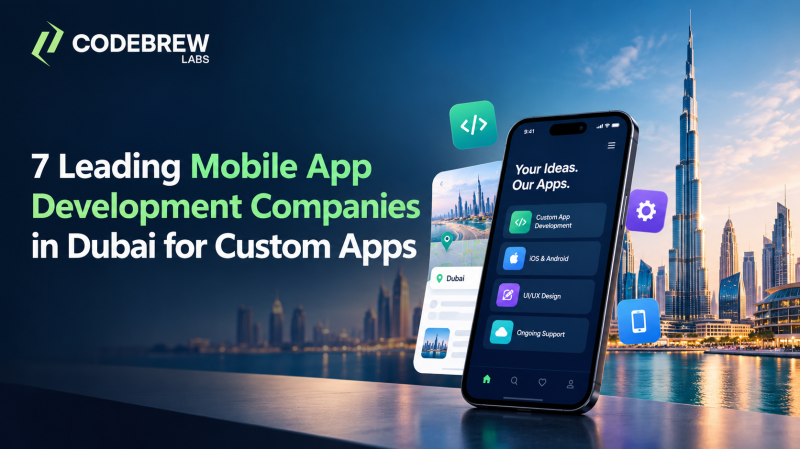
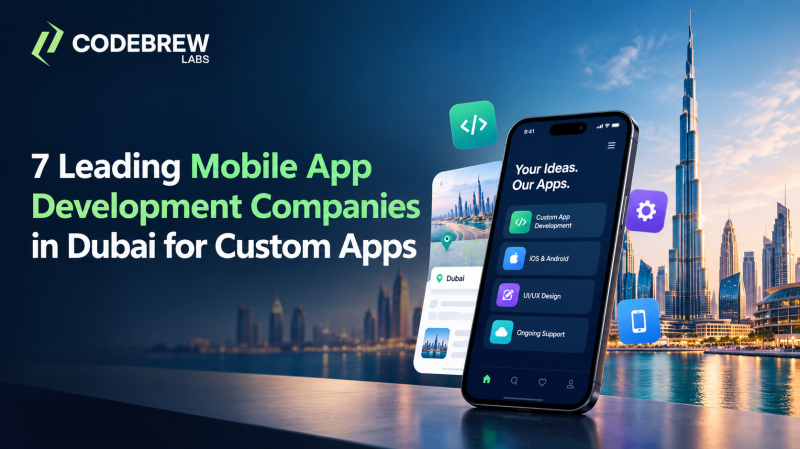
7 Leading Mobile App Development Companies in Dubai for Custom Apps
 Priyanshu codebrew
What happens when your business has a strong app idea, but the first version is built around the wrong architecture? You may end up spending months fixing performance issues, rebuilding integrations, or redesigning screens that should have been tested before development started.
That is why choosing a Mobile App Development Company in Dubai is about more than finding developers who can write iOS or Android code. The right partner needs to understand your product, users, integrations, security requirements, and plans for growth.
Dubai also adds a few practical considerations of its own. Arabic and English experiences, RTL interfaces, local payment systems, UAE-specific compliance requirements, and integrations with regional platforms can all affect how an app should be designed from the beginning.
For startups, the challenge is usually speed without creating technical debt. For enterprises, it is more often about integration, security, governance, scalability, and long-term support.
With that in mind, here are seven companies worth considering when you're evaluating custom mobile app development in Dubai.
What to Look for in a Custom App Development Partner
Before comparing companies, define what “custom” actually means for your project.
A custom application may be a customer-facing retail app, an employee mobility platform, a marketplace, a logistics application, a fintech product, or a mobile interface connected to an existing ERP or CRM. Each requires a different technical approach.
You should therefore look beyond a company's list of programming languages. Ask how it handles discovery, UX research, backend architecture, API integrations, quality assurance, deployment, analytics, and post-launch maintenance.
The technology choice matters too. Native iOS and Android development can make sense when platform-specific performance or functionality is critical. Flutter or React Native may be more practical when you want one shared codebase across platforms. Neither approach is automatically right for every project.
And if your app will serve UAE customers, discuss Arabic RTL support, payment integrations, identity systems, data handling, and localization before development begins, not after the interface has already been designed.
1. Code Brew Labs
Code Brew Labs is a Dubai-focused technology company that works across custom mobile applications, enterprise software, AI-powered products, and connected digital platforms. Its mobile offering covers native iOS and Android development alongside Flutter and React Native, with services extending into backend engineering, cloud infrastructure, PWAs, wearables, IoT integrations, and post-launch support.
For startups, Code Brew Labs can fit projects that need to move from product concept or MVP toward a more mature platform. For enterprises, its broader engineering scope is relevant when the mobile application is only one part of a larger digital system.
The company's distinguishing quality is the breadth of its delivery model. Rather than treating the mobile app as an isolated frontend, it can approach product strategy, architecture, development, integrations, cloud, AI, and ongoing engineering as connected parts of the same project.
That can be particularly useful when you're building a marketplace, fintech platform, healthcare application, logistics product, or enterprise mobility solution where the mobile interface depends heavily on backend systems.
Best suited for: Startups, SMEs, enterprises, and organizations building substantial digital products.
2. Dubai App Developer
Dubai App Developer focuses on mobile applications alongside AI development and cloud engineering. Its services include native iOS and Android development, Flutter, React Native, custom UI/UX, AI agents, cloud services, and post-launch support.
The company's positioning makes it particularly relevant for businesses that don't want a mobile app developed separately from their AI or cloud strategy. A startup, for example, could begin with a customer-facing application and later introduce AI-powered workflows or intelligent automation. An enterprise could approach the same stack from the opposite direction, connecting an app with existing business systems and cloud infrastructure.
Its distinguishing quality is the combination of mobile development with AI-agent and cloud capabilities. That makes the company worth considering when AI is expected to be part of the product rather than an optional feature added later.
Best suited for: Startups and enterprises building mobile products with AI, cloud, or GCC-specific requirements.
3. Royo Apps
Royo Apps takes a somewhat different approach to custom development. Alongside iOS, Android, Flutter, and React Native development, the company offers configurable software foundations for business models such as delivery, transportation, marketplaces, consultations, and other on-demand services.
That model can be useful for a startup that needs a proven functional foundation but still wants to customize the product around its brand and operating model. Instead of starting every feature from a blank screen, a business can begin with an existing structure and adapt it to its requirements.
For larger organizations, however, you should establish early whether a configurable foundation can accommodate your integration, governance, security, and workflow requirements. Highly specialized enterprise systems may require more bespoke architecture.
The distinguishing quality here is the combination of custom development with ready-to-customize product foundations. Businesses can adapt established application structures rather than building every component from scratch.
Best suited for: Startups, SMEs, and businesses launching marketplace, delivery, mobility, or on-demand applications.
4. Blocktech Brew
Blocktech Brew has a broader technology profile centered strongly around blockchain, Web3, gaming, and emerging digital platforms. Its development work includes blockchain applications, wallets, decentralized applications, metaverse products, and mobile games.
For a conventional business application, you would want to examine the company's relevant mobile portfolio rather than choosing it simply because it offers app development. But if your custom mobile product involves blockchain, digital assets, gaming, AR/VR, or other specialized technology, that focus becomes much more relevant.
Its mobile gaming practice covers iOS, Android, and cross-platform development, with capabilities spanning game development, migration, testing, and launch.
The distinguishing quality is specialization. Blocktech Brew is particularly interesting for products where blockchain or gaming technology is central to the proposition rather than incidental.
Best suited for: Startups and businesses working on Web3, blockchain, gaming, fitness, or specialized technology products.
5. Darb Productions
Darb Productions is a Dubai-based technology company offering mobile and custom software development for businesses. Its mobile services cover iOS, Android, cross-platform development, backend development, UI/UX, app-store publishing, maintenance, and integrations.
For a startup, that combination can be practical when the initial product needs both mobile development and a working backend rather than just an interface prototype. SMEs can also benefit from having product design, development, deployment, and ongoing updates handled by one team.
Darb also works with larger organizations, although enterprises with complex governance structures should evaluate its capabilities against their specific security, integration, and procurement requirements.
Its distinguishing quality is its focus on regional implementation details that can otherwise become late-stage development problems, particularly payments, Arabic UX, backend connectivity, and app-store deployment.
Best suited for: UAE startups, SMEs, and businesses needing a full mobile-plus-backend product team.
6. Codeeaq
Codeeaq is a Dubai-based technology company offering native and cross-platform mobile development for startups, enterprises, and organizations with more complex technology requirements. Its mobile services include native development, Flutter, React Native, Arabic RTL interfaces, identity integrations, and local payment integrations.
The company's wider technology portfolio includes AI, enterprise software, cloud infrastructure, DevOps, and business technology solutions. That broader capability is relevant when your mobile application needs to communicate with existing enterprise systems rather than operating as a standalone consumer product.
For startups, the combination of mobile and AI services can support products that need to evolve beyond a basic MVP. For enterprises, its broader enterprise-technology background can be useful when the application needs to connect with internal platforms and workflows.
Its distinguishing quality is the intersection between mobile development and enterprise technology, with attention to Arabic experiences and regional integrations.
Best suited for: Enterprises, organizations with complex technology environments, and startups building applications that connect to larger business systems.
7. Techanic Infotech
Techanic Infotech has a strong focus on startup development, covering MVP development, custom mobile applications, SaaS products, AI applications, product consulting, cloud development, and post-launch support.
This makes the company particularly relevant for founders who are still shaping the product rather than simply outsourcing a finished specification. Its approach combines product strategy and UI/UX with engineering, which can help when requirements are still evolving.
That said, startups should still ask for clarity around what is included in an MVP, who owns the source code, how architecture decisions are documented, and what happens when the product moves from its first release into a higher-volume environment.
The distinguishing quality is its explicit startup orientation. Instead of presenting mobile development only as an engineering service, the company approaches it around MVP validation, product development, and future scaling.
Best suited for: Early-stage startups, founders validating an MVP, and businesses moving from prototype to scalable product.
How to Choose Between These Dubai App Development Companies
There is no single development model that works for every business.
If you're building a complex enterprise mobility platform, start by examining architecture, integration capabilities, security processes, support arrangements, and experience with systems similar to yours. A visually impressive portfolio doesn't tell you whether a team can handle an ERP integration or a high-volume transaction workflow.
For a startup, the questions are different. You need to know how quickly the team can turn an idea into a testable product, how much of the first release should actually be built, and whether the architecture will allow you to add users and functionality without rewriting everything six months later.
Compare the Development Approach, Not Just the PriceTwo companies can quote very different prices for what appears to be the same application.
One proposal may include product discovery, UX research, backend infrastructure, QA automation, analytics, deployment, and maintenance. Another may cover only UI design and application development.
So compare the scope line by line.
Ask who owns the source code. Ask whether third-party services are included. Ask how API integrations will be handled. Ask what happens after launch. And ask whether the quoted architecture is designed for your expected first-year usage or simply for the initial release.
Consider Native Versus Cross-Platform DevelopmentNative iOS and Android development can make sense when your application depends heavily on platform-specific capabilities, advanced device features, or highly optimized performance.
Cross-platform development can reduce duplication when both platforms share most of the same product experience. Flutter and React Native are common choices for this model, and several companies on this list offer both.
The decision should come from the product requirements, not from whichever framework happens to be fashionable.
Treat Localization as a Product DecisionIf your application targets customers in Dubai or the wider GCC, Arabic support should not be treated as a translation task at the end of development.
RTL navigation, typography, layouts, forms, search behavior, dates, currencies, and content hierarchy can all affect the user experience. The same applies to regional payment methods and identity integrations.
Discuss these requirements during discovery and design. Changing the structure of an application later to accommodate RTL layouts or regional workflows can take considerably more effort than planning for them from the beginning.
Don't Stop Evaluating Once the App LaunchesThe first public release is the beginning of the product's operating life, not the finish line.
Real users will expose problems that weren't obvious during testing. Analytics will show which features matter and which don't. Your sales team may request new workflows. Customers will ask for new payment methods or languages. And your backend requirements will change as usage grows.
A development partner that can support monitoring, bug fixes, security updates, performance improvements, and feature releases can therefore be more useful than a team that simply hands over the finished build.
The Practical Next Step
Choosing a Mobile App Development Company in Dubai should start with your product requirements, not a vendor's sales pitch.
Write down the core user journey, platforms, must-have integrations, target market, language requirements, expected launch stage, and what you need the app to accomplish during its first year. Then send the same brief to several companies and compare their proposed architecture, delivery scope, timeline, ownership terms, support model, and assumptions.
For an enterprise, pay particular attention to integrations, security, governance, and long-term maintenance. For a startup, focus closely on MVP scope, product iteration, development ownership, and the team's ability to scale with you.
The strongest proposal isn't necessarily the longest or cheapest. It is the one that clearly explains what will be built, why it will be built that way, what it will cost to operate, and how the product can evolve after launch.
That is the standard you should use when evaluating your next custom app development partner in Dubai.
Source:
Click for the: Full Story
You might like