Close Menu
 World
World
 Biography
 Health
 Education
 Business
 Lifestyle
 Sports
 Technology
 Animals
 History
 Food
Food
 Religious
 Startups
 Movies
 Politics
 Fashion
 Covid
Covid
 Diet
Diet
 Fitness
 Marketing
 Travel
 Science
 Reviews
 Social media
 Stories
 Facts
Facts
 Art
Art
 Entertainment
Yatin Samra

Technology
10 Key Legal and Compliance Requirements to Understand Before Building Fleet Management Software in the US
 Yatin Samra
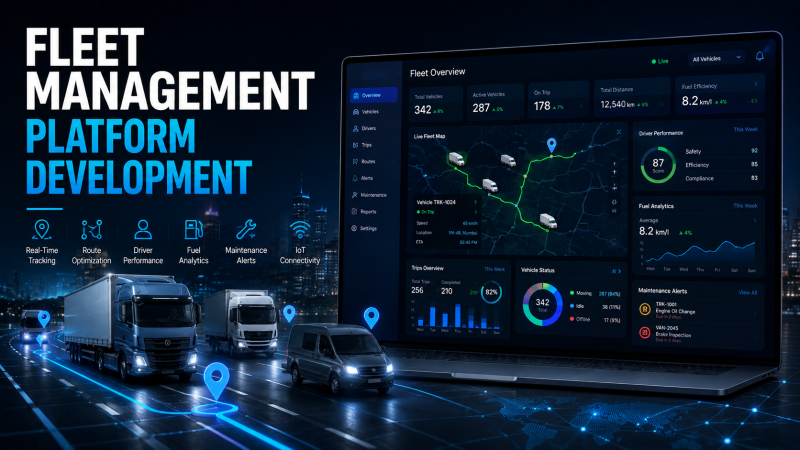
Fleet management software is increasingly becoming a key component for transportation companies. These systems help them monitor their vehicles and drivers, track maintenance, calculate routes, check on fuel usage, and collect operational data in real-time.
However, the more a fleet becomes integrated into one platform, the more significant the legal aspect of this system becomes.
For organizations planning fleet management software development, understanding these ten areas can help create a more secure, adaptable, and responsible solution.
Understanding these ten aspects may be useful for companies that plan to develop a fleet management software platform.
1. Understand Which Transportation Regulations Apply
The first step is identifying the regulations relevant to the fleet and its operations.
Not every fleet is subject to the same requirements. Commercial carriers, private fleets, delivery businesses, passenger transportation companies, and specialized operators can have different regulatory obligations.
Depending on the business model, the software may need to support information related to driver records, vehicle inspections, hours of service, maintenance, or operational reporting.
Before development begins, businesses should map the regulatory requirements that the platform is expected to support.
This prevents the technology team from building workflows that later need significant redesign.
2. Build Privacy Into Vehicle and GPS Tracking
GPS tracking is one of the most useful functions of fleet software, but location information can also become sensitive personal data when it is associated with an identifiable driver.
The platform should clearly establish:
- What location data is collected
- When tracking takes place
- Why it is collected
- Who can access it
- How long it is retained
- When it is deleted
Employee communication is also important.
Drivers should understand the purpose and scope of monitoring rather than discovering tracking capabilities after the system has already been deployed.
Because privacy requirements can vary across US jurisdictions, businesses should evaluate the laws applicable to their operations instead of assuming that a single national approach covers every situation.
3. Consider State Privacy Laws
The US does not operate under one comprehensive consumer privacy framework that applies identically to every organization and situation.
Depending on the platform, business activities, and users involved, state privacy laws may become relevant.
Fleet software can potentially process names, contact details, precise location information, device identifiers, employment-related information, and other data categories.
A privacy-conscious platform can support compliance by providing appropriate controls for data access, correction, deletion, retention, and sharing where required.
The architecture should also make it possible to adapt to new privacy requirements as the regulatory landscape changes.
4. Handle Electronic Driver Records Carefully
Digital records have become central to fleet operations.
A platform may maintain information about driver activity, inspections, duty status, incidents, training, and other operational events.
Where electronic logging requirements apply, the software needs to support the relevant regulatory requirements and preserve data integrity.
This means developers should think beyond the screen where information is displayed.
The backend must also ensure that records are accurately captured, securely stored, appropriately modified, and available for required reporting or review.
5. Establish Strong Audit Trails
A fleet platform may have dozens of users making changes every day.
An administrator may modify a vehicle record. A manager may assign a driver. A technician may update a maintenance entry. A dispatcher may change a route.
A reliable audit trail can record these activities.
An effective audit system can show:
Who → Changed what → When → From which value → To which value
This creates greater accountability and can help businesses investigate operational disputes or compliance issues.
Audit trails are particularly valuable when fleet software is used as an authoritative business record.
6. Protect Employee and Driver Information
Fleet platforms may function as employee-management systems as well as vehicle-management tools.
Driver profiles can contain personal details, performance information, schedules, safety records, and other employment-related data.
Access should therefore be based on business need.
Role-based permissions can ensure that drivers, dispatchers, fleet managers, HR teams, administrators, and technical staff only see the information relevant to their responsibilities.
This reduces unnecessary exposure and supports a broader privacy-by-design strategy.
7. Secure Telematics and Connected Devices
Modern fleets can include a large ecosystem of connected hardware.
GPS units, telematics devices, vehicle sensors, dashcams, fuel systems, and diagnostic tools may all send information to the central platform.
Each device and connection can introduce security risks.
A secure architecture should consider:
- Device authentication
- Encrypted communication
- API security
- Firmware management
- Access controls
- Device deactivation
- Security monitoring
The platform should also have a process for handling devices that are lost, replaced, compromised, or retired.
8. Manage Dashcam and Video Data Responsibly
Video has become increasingly common in fleet operations.
Dashcams can help investigate accidents, improve safety programs, and provide valuable evidence. However, recordings can also contain identifiable individuals, vehicle locations, and other sensitive information.
Businesses should establish clear policies for:
- When recording occurs
- What cameras capture
- Who can view recordings
- How long footage is retained
- When footage can be shared
- How recordings are securely deleted
If advanced technologies such as facial recognition or other biometric capabilities are introduced, additional legal considerations may apply.
The principle should be simple: collect only what is necessary for a legitimate purpose and protect it appropriately.
9. Review Third-Party Software and Data Providers
Fleet platforms often rely on external services.
Mapping providers may supply route information. Telematics companies may provide vehicle data. Cloud providers may host infrastructure. Payment services may process transactions. Analytics tools may collect usage information.
Each vendor can introduce a new data-processing relationship.
Before integration, businesses should understand:
- What data the provider receives
- Where the information is stored
- How it is protected
- How long it is retained
- Whether it is shared with subprocessors
- What happens if the relationship ends
Vendor agreements should clearly define responsibilities rather than leaving data protection assumptions undocumented.
10. Prepare for Security Incidents and Data Breaches
Even a well-designed platform can face security incidents.
A fleet software provider should have a documented response process for situations involving compromised accounts, unauthorized access, lost devices, exposed information, or infrastructure attacks.
An incident-response framework can establish:
- How an incident is detected
- Who is responsible for investigating it
- How affected systems are contained
- How evidence is preserved
- How recovery is performed
- What notifications may be required
The applicable notification requirements can vary depending on the type of data and jurisdiction involved, so organizations should obtain appropriate legal advice when developing their response procedures.
To know more about this, click the video link below to explore the legal and compliance considerations businesses should evaluate before developing fleet management software.
https://youtu.be/U1B2Obr83EY?si=4p9yqw-HV_aF1Ler
Why Compliance Should Be Part of the Product Architecture
Legal requirements can influence technical decisions.
For example, a privacy requirement may affect database design. A retention policy may influence storage architecture. Driver permissions may shape the account-management system. Audit requirements may determine how records are versioned.
This is why compliance should be introduced during the planning stage.
A practical development process can look like this:
Identify requirements → Map data → Define controls → Build workflows → Test compliance → Monitor changes
This approach is generally more effective than developing the complete product first and attempting to retrofit compliance afterward.
Designing for the USA and Beyond
The USA should be treated as a collection of regulatory environments rather than a completely uniform market.
A fleet software platform may need to accommodate federal requirements alongside state-specific privacy and employment considerations.
The UAE provides another useful example of why market-specific planning matters. Businesses expanding their fleet technology into the UAE should evaluate the local privacy, transportation, employment, and technology requirements relevant to their operations rather than simply duplicating their US configuration.
A flexible architecture can make this easier.
Configurable permissions, data-retention rules, consent mechanisms, reporting workflows, and regional settings can help the same core platform adapt to different operating environments.
Compliance Can Support Better Product Design
Compliance is often viewed as a restriction.
In practice, it can also encourage better software.
Clear data policies can reduce unnecessary collection. Strong access controls can simplify administration. Audit trails can improve accountability. Transparent tracking policies can strengthen employee communication. Security controls can protect both the business and its users.
For companies investing in fleet management software development, these benefits make compliance relevant not only to legal teams but also to product managers, developers, security specialists, and business leaders.
Final Takeaway
Designing fleet management systems in the United States calls for more than just vehicle tracking and routing.
Such systems might be expected to take into account transportation rules, privacy protection, driving behavior monitoring, record keeping in an electronic form, employee information, connected devices, video footage, external service providers, cybersecurity and incident response measures.
The specific requirements will be determined by the nature of the business model, information involved, nature of the fleet, locations where operations take place, and existing legislation.
The most rational way is to consider all these issues before designing the product.
With proper planning of legal aspects, cybersecurity infrastructure and product architecture, firms will be able to create fleet management systems that are not only efficient from an operational point of view but also better positioned for future regulations and market expansion to, for example, the USA and UAE.
Source:
Click for the: Full Story
You might like