Close Menu
 World
World
 Biography
 Health
 Education
 Business
 Lifestyle
 Sports
 Technology
 Animals
 History
 Food
Food
 Religious
 Startups
 Movies
 Politics
 Fashion
 Covid
Covid
 Diet
Diet
 Fitness
 Marketing
 Travel
 Science
 Reviews
 Social media
 Stories
 Facts
Facts
 Art
Art
 Entertainment
Pothera ERP

Technology
The ERP Software Costs Businesses Often Overlook During Vendor Evaluation
 Pothera ERP
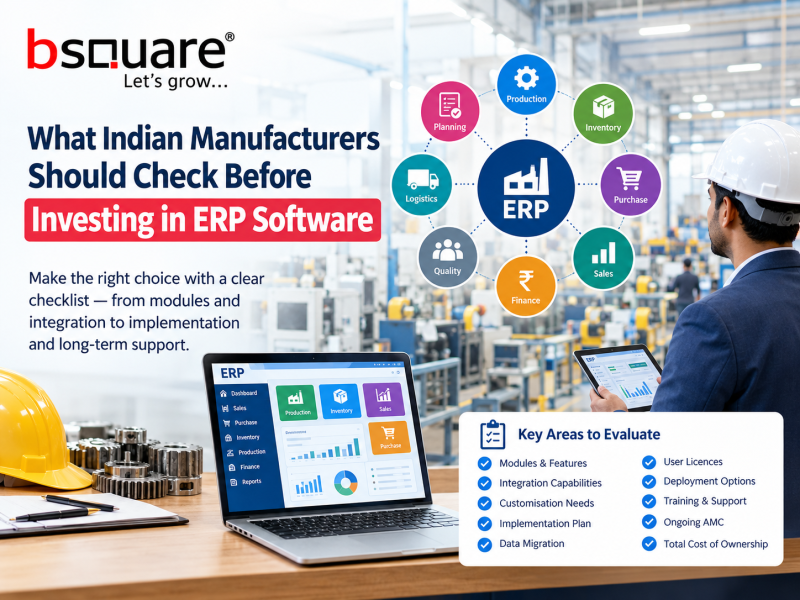
Look beyond the licence price. Understand users, modules, implementation, customisation, deployment, and AMC before investing in ERP Software.
Choosing ERP Software is a major decision for a growing business. Many companies compare vendors by looking at the software price first.
But the initial licence or subscription amount is only one part of the total investment.
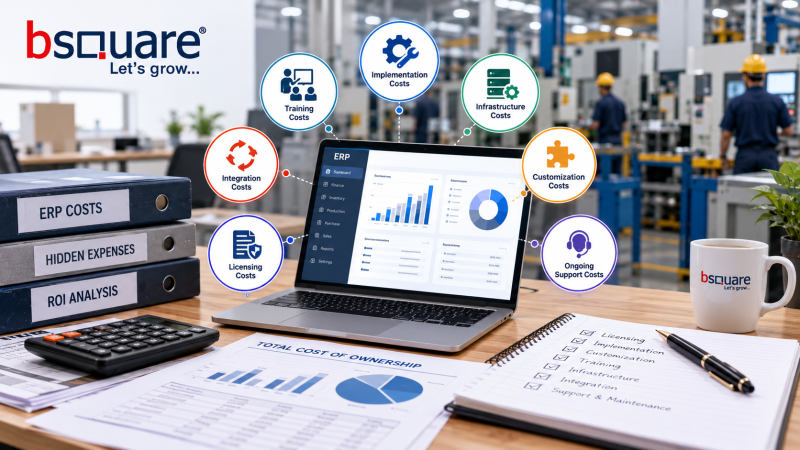
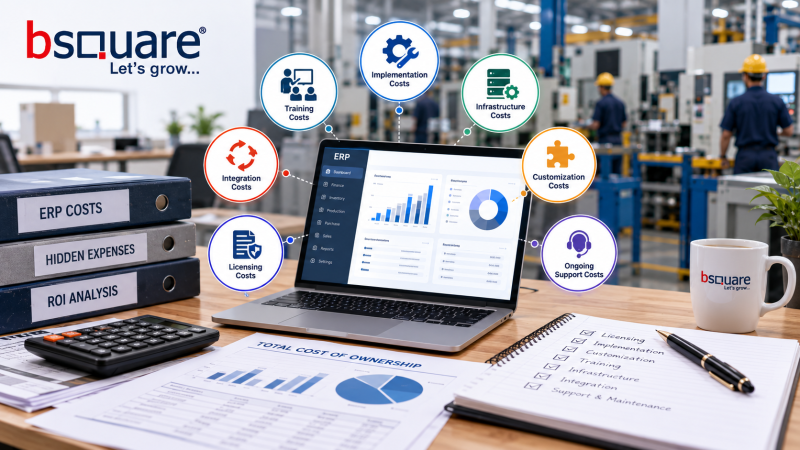
During an ERP evaluation, businesses should understand all possible cost drivers. User licences, modules, implementation, customisation, deployment, training, integrations, and annual maintenance can affect the final budget.
This is especially important for Indian manufacturing businesses evaluating ERP software cost in India.
Why ERP Costs Can Be Difficult to Compare
ERP pricing is rarely the same for every business.
Two companies may select the same ERP Software but have very different costs because their requirements are different.
One company may need only a few users and standard modules. Another may require multiple locations, more users, custom workflows, integrations, data migration, and extensive implementation support.
Therefore, businesses should compare scoped quotations rather than comparing one headline price.
Bsquare Solutions recommends understanding the complete scope before making a vendor decision.
1. Licence or Subscription Cost
The first cost most businesses notice is the ERP licence or subscription.
Depending on the ERP model, pricing may be based on users, modules, locations, transactions, or other factors.
Ask the ERP Software Company exactly what the quoted licence covers.
Also confirm whether the licence is one-time, recurring, user-based, module-based, or based on another commercial structure.
2. User Cost
The number and type of users can directly influence ERP costs.
A business may have users from sales, purchase, inventory, production, finance, management, and other departments.
Some ERP systems may have different user categories or access levels.
Before signing an agreement, estimate current users and likely future users.
Ask how adding users later will affect the overall cost.
3. Module Cost
ERP systems are usually divided into different functional areas.
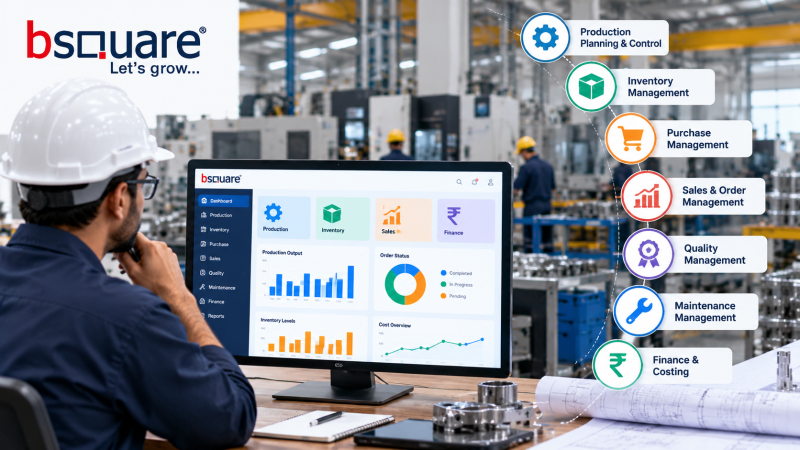
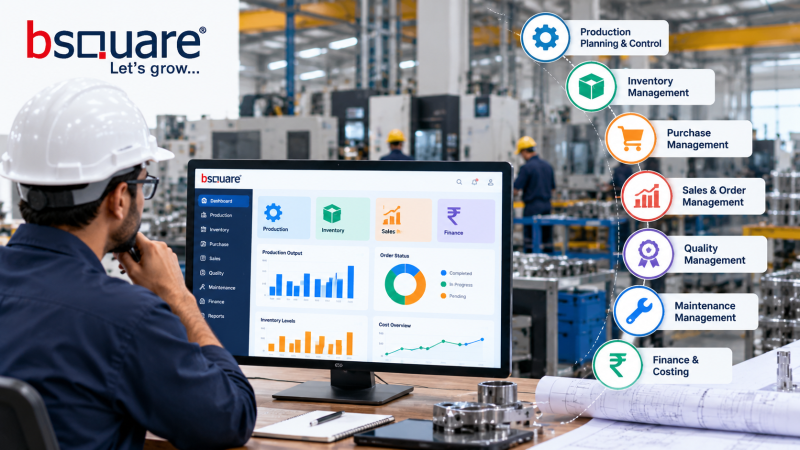
These may include:
· Finance and accounting
· Sales
· Purchase
· Inventory
· Production
· Quality
· CRM
· HR and payroll
· Maintenance
· Reporting
Not every business needs every module.
However, businesses should clearly identify which modules are included in the quotation and which are additional.
FAQ: How Much Does Manufacturing ERP Software Cost in India?
Manufacturing ERP software cost in India varies based on users, modules, deployment, customisation, implementation, integrations, and support. A scoped quotation is more reliable than a generic price.
4. Deployment Cost
ERP can be deployed in different ways depending on the vendor and business requirements.
Deployment-related costs may include cloud infrastructure, hosting, server requirements, security configuration, backups, or other technical services.
Ask the ERP Software Company to clearly explain which deployment expenses are included.
Also understand whether infrastructure costs are recurring or one-time.
5. Customisation Cost
Every manufacturing business has its own processes.
Some companies may require custom reports, approval workflows, screens, integrations, calculations, or specialised processes.
Customisation can increase the overall ERP investment.
Before implementation, separate standard functionality from customised requirements.
This helps businesses understand what they are actually paying for.
6. Implementation Cost
Implementation is one of the most commonly overlooked ERP costs.
It may include:
· Process study
· Configuration
· Data migration
· Testing
· User training
· Deployment
· Go-live assistance
The implementation effort depends on business complexity.
A simple implementation and a multi-location manufacturing implementation should not be expected to have the same cost.
FAQ: What Additional ERP Implementation Costs Should I Consider?
Businesses should consider process analysis, configuration, data migration, customisation, integrations, testing, training, deployment, go-live support, and post-implementation assistance when budgeting for ERP implementation.
7. Data Migration Cost
Moving data from existing software or spreadsheets into the new ERP requires planning.
Businesses may have customer, supplier, item, opening balance, inventory, transaction, or historical records.
The quality and volume of data can affect migration effort.
It is important to decide what data needs to be migrated and what can remain archived.
Data cleansing may also require additional effort if existing records contain duplicates or errors.
8. Integration Cost
Businesses rarely use ERP in complete isolation.
They may need integrations with accounting systems, CRM applications, e-commerce platforms, payment systems, banking services, logistics applications, or other business tools.
Every integration should be identified during the evaluation stage.
Ask whether it is standard, configurable, or requires custom development.
FAQ: Can ERP Customisation Increase the Total ERP Cost?
Yes. Custom workflows, reports, integrations, specialised calculations, and industry-specific requirements can increase implementation costs. Businesses should scope customisation before signing the agreement.
9. Training and Change Management
Employees need to understand the new system before going live.
Training may be required for different departments and user groups.
Manufacturing teams, stores, purchase, sales, finance, and management may all use different ERP functions.
The required training effort should therefore be discussed during implementation planning.
Better user adoption can also reduce operational problems after go-live.
10. AMC and Ongoing Support Cost
ERP costs do not necessarily end after implementation.
Businesses may have ongoing support, maintenance, upgrades, hosting, or AMC requirements depending on the ERP model.
Ask the vendor:
· What support is included?
· What does AMC cover?
· Are upgrades included?
· How are additional support requests charged?
· What are the response and escalation processes?
Understanding these terms helps businesses plan their long-term ERP budget.
FAQ: What Is AMC in ERP Software?
AMC means Annual Maintenance Contract. It generally covers agreed maintenance or support services, but exact coverage varies by vendor and should be clearly defined in the commercial proposal.
Understanding ERP Software Cost in India
There is no single ERP price that is suitable for every Indian business.
The final cost depends on the scope of the implementation.
For a manufacturing company, factors such as production processes, number of users, locations, modules, integrations, data
Source:
Click for the: Full Story
You might like