Close Menu
 World
World
 Biography
 Health
 Education
 Business
 Lifestyle
 Sports
 Technology
 Animals
 History
 Food
Food
 Religious
 Startups
 Movies
 Politics
 Fashion
 Covid
Covid
 Diet
Diet
 Fitness
 Marketing
 Travel
 Science
 Reviews
 Social media
 Stories
 Facts
Facts
 Art
Art
 Entertainment
Pothera ERP

Technology
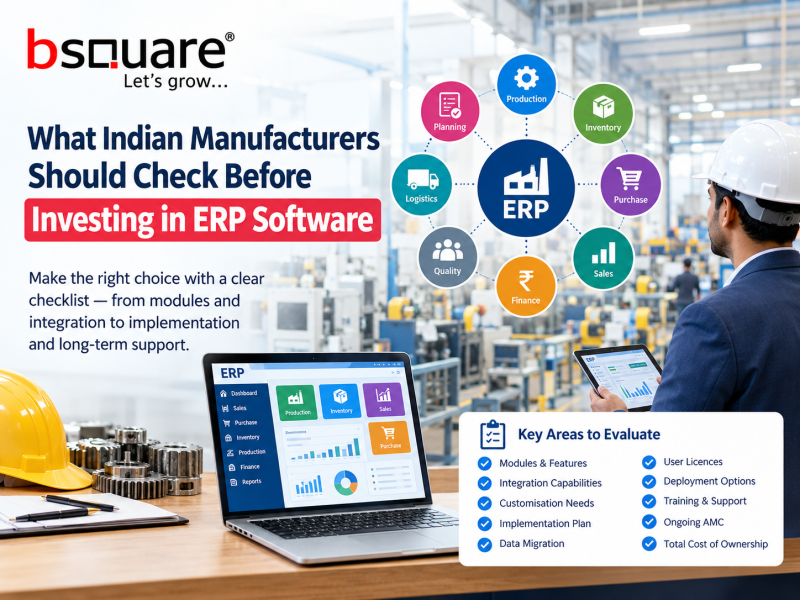
What Indian Manufacturers Should Check Before Investing in ERP Software
 Pothera ERP
Choose Manufacturing ERP that connects operations, supports Indian compliance, and delivers practical business value.
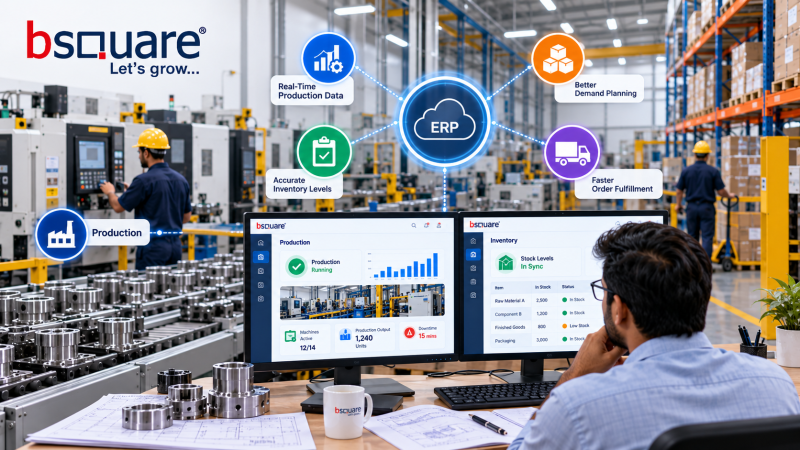
For Indian manufacturers, investing in ERP Software is a major business decision. The right system can connect production, inventory, purchasing, sales, finance, quality, and other functions on one platform.
However, every ERP is not designed for manufacturing. A system may look impressive during a sales presentation but may not match your actual shop-floor processes.
Before making a decision, manufacturers should evaluate the ERP Software around their real workflows, compliance needs, implementation approach, and long-term support.
1. Understand Your Manufacturing Workflows First
Before comparing ERP vendors, document how your business currently works.
Check your complete workflow from purchase and inventory to production, quality control, sales, dispatch, and accounting.
Ask whether the ERP can connect these activities instead of treating each department as a separate system.
For example, when a sales order is confirmed, the system should ideally support the related planning, material requirements, production, inventory movements, and dispatch processes.
This connected approach is one of the most important things to check in a Manufacturing ERP software.
2. Ask for a Practical ERP Demonstration
Do not select ERP Software only because of a brochure or presentation.
Ask the vendor to demonstrate your actual business scenarios.
Give the vendor examples such as:
- Creating a sales order
- Checking raw material availability
- Creating production requirements
- Managing BOMs
- Recording production
- Tracking inventory
- Handling quality checks
- Generating invoices
- Monitoring receivables
A practical demonstration helps your team understand whether the ERP can handle daily operations without unnecessary complexity.
3. Check Manufacturing Module Coverage
Manufacturing companies have different requirements depending on their industry and production model.
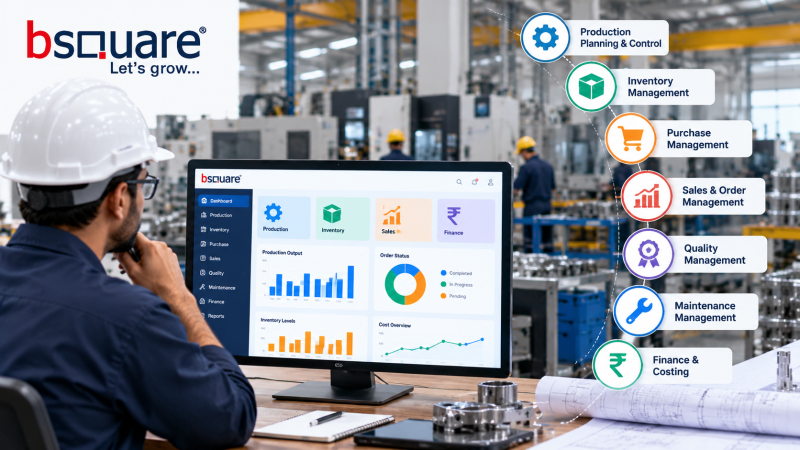
Before investment, check which modules are included and which require additional customization.
Important areas may include:
- Production planning
- Bill of Materials
- Material Requirements Planning
- Inventory management
- Purchase management
- Sales management
- Quality management
- Job work
- Maintenance
- Finance and accounting
- GST and invoicing
- Business reporting
Bsquare Solutions recommends checking approved module coverage carefully before signing an ERP agreement. This helps avoid unexpected gaps after implementation.
4. Verify Indian GST and E-Invoicing Readiness
Indian manufacturers must consider local compliance while selecting ERP Software.
The system should support relevant GST processes and provide appropriate invoicing capabilities.
GST and e-invoicing readiness should be demonstrated rather than simply mentioned in a proposal.
Ask the ERP provider how the system handles tax calculations, invoices, credit notes, reporting, and other applicable compliance requirements.
For growing manufacturers, compliance-ready ERP can reduce manual work and improve transaction accuracy.
5. Understand Implementation Responsibility
ERP implementation is not only a software installation.
It involves data preparation, process configuration, user training, testing, migration, and operational support.
Before selecting a vendor, clearly understand who will handle each implementation activity.
Ask:
- Who manages implementation?
- Who prepares the database?
- Who migrates existing data?
- Who trains employees?
- Who performs testing?
- Who provides post-go-live support?
A clear implementation responsibility matrix can prevent confusion later.
6. Check Integration Between Departments
A good Manufacturing ERP should reduce information gaps between departments.
Production should have access to relevant material information. Purchase teams should understand requirements. Sales teams should see order status. Finance should receive accurate transaction information.
This connected structure can help management get a clearer view of business performance.
The objective is not simply to digitize individual departments. The objective is to connect the complete manufacturing business workflow.
7. Evaluate Ease of Use
An ERP can have hundreds of features, but employees may struggle if the system is complicated.
Ask employees from production, stores, purchase, sales, finance, and management to participate in the evaluation.
Their feedback is valuable because they will use the system every day.
A practical ERP should provide useful information without making routine tasks unnecessarily difficult.
8. Ask About Ongoing Support
ERP implementation does not end when the software goes live.
Your business will continue to need technical support, user assistance, configuration changes, updates, and process guidance.
Before signing the contract, understand the vendor's support model.
Check response times, support channels, escalation procedures, update policies, and ongoing maintenance responsibilities.
9. Consider Pothera for Connected Manufacturing
Pothera, from Bsquare Solutions, is designed around connected business processes for manufacturers and other growing businesses.
When evaluating Pothera or any Manufacturing ERP, businesses should review the approved module coverage against their actual requirements.
Manufacturers should also verify how GST and e-invoicing requirements are supported for their specific operations.
The right choice should ultimately come from a practical evaluation—not just a feature comparison.
Frequently Asked Questions
What should manufacturers check before buying ERP Software?
Manufacturers should evaluate workflow integration, manufacturing modules, GST and e-invoicing readiness, implementation responsibility, usability, data migration, training, support, and scalability before selecting ERP Software.
Why is a practical ERP demonstration important?
A practical demonstration shows how the ERP handles real manufacturing activities such as production planning, inventory, purchasing, sales, quality, invoicing, and reporting.
Why should Indian manufacturers check GST and e-invoicing readiness?
Indian manufacturers need ERP Software that can support applicable GST processes and e-invoicing requirements, helping reduce manual work and improve transaction accuracy.
What makes Manufacturing ERP different from regular ERP?
Manufacturing ERP focuses on production-specific processes such as BOMs, production planning, material requirements, inventory, quality, job work, and shop-floor operations.
What should companies ask about ERP implementation?
Companies should clarify who handles configuration, data migration, testing, employee training, go-live support, issue resolution, and ongoing maintenance before signing the ERP agreement.
Final Thoughts
Choosing ERP Software is a long-term business decision for Indian manufacturers. The best system is not necessarily the one with the largest feature list.
Manufacturers should choose an ERP that connects their workflows, demonstrates real business processes, supports Indian compliance, has clear implementation ownership, and provides dependable ongoing support.
For businesses evaluating Manufacturing ERP, Bsquare Solutions and Pothera can be considered as part of the evaluation process. The final decision should be based on practical demonstrations, approved module coverage, business requirements, GST and e-invoicing readiness, and long-term implementation support.
Source:
Click for the: Full Story
You might like