Close Menu
 World
World
 Biography
 Health
 Education
 Business
 Lifestyle
 Sports
 Technology
 Animals
 History
 Food
Food
 Religious
 Startups
 Movies
 Politics
 Fashion
 Covid
Covid
 Diet
Diet
 Fitness
 Marketing
 Travel
 Science
 Reviews
 Social media
 Stories
 Facts
Facts
 Art
Art
 Entertainment
Pothera ERP

Technology
From Accounting Software to Integrated Operations: A Manufacturing Business Guide
 Pothera ERP
Moving from accounting software to ERP can connect finance, inventory, production, sales, and operations for better business visibility.
Many Indian manufacturing businesses start with accounting software such as Tally. It is useful for managing accounts, taxation, invoices, and financial records.
But as the business grows, accounting may no longer be the only requirement.
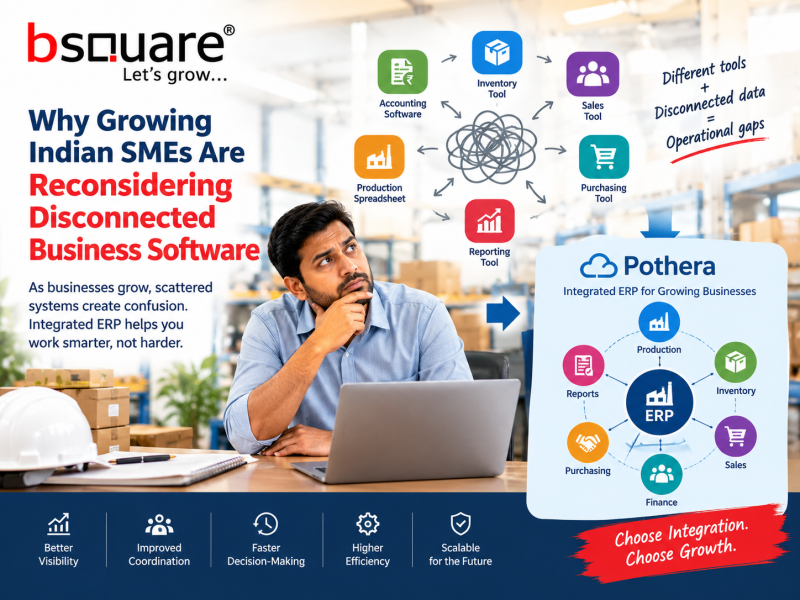
Manufacturers may need to manage production planning, inventory, purchasing, sales, quality, warehouses, approvals, and finance together. When these activities remain in separate systems, coordination can become difficult.
This is where the journey from Tally to ERP becomes relevant.
When Should a Manufacturer Consider ERP?
A business does not need to replace its accounting software simply because it has grown.
The more important question is whether disconnected information is affecting daily operations.
For example, the sales team may have order information in one system, production may maintain separate records, inventory may be tracked elsewhere, and finance may receive the final information later.
This can create delays and reduce operational visibility.
Bsquare Solutions recommends considering ERP when disconnected information starts affecting coordination, reporting, and operational decision-making.
Why Move From Accounting Software to ERP?
Accounting software primarily focuses on financial activities.
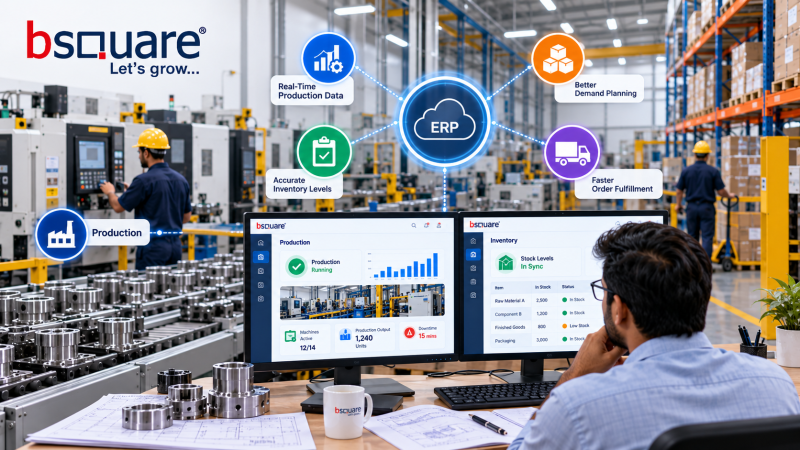
An ERP system can connect finance with other business functions.
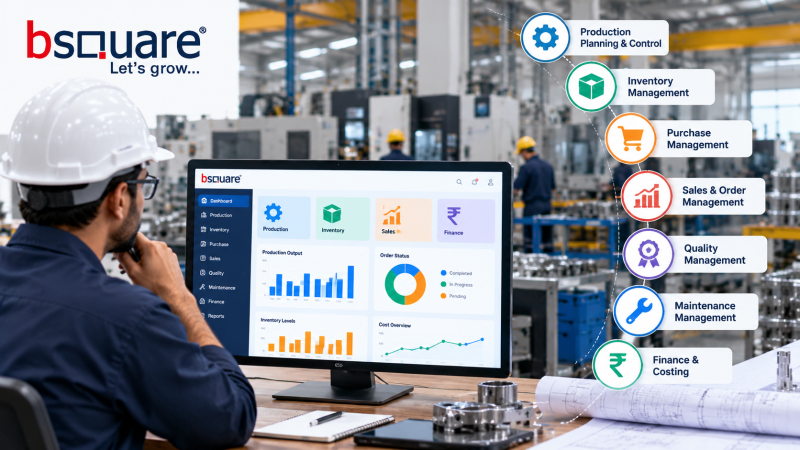
For a manufacturing company, this may include:
- Sales and order management
- Purchase management
- Inventory control
- Production planning
- Bill of Materials
- Quality management
- Warehouse operations
- Finance and accounting
- Business reporting
- Approvals and workflows
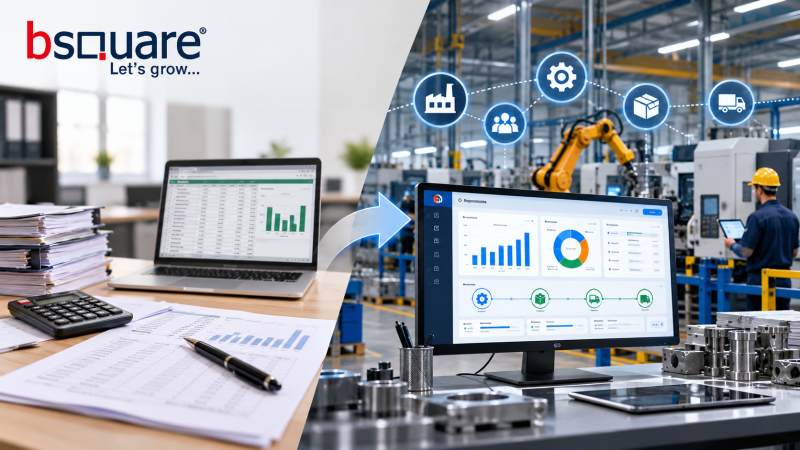
The goal is not simply to replace one software with another.
The goal is to create a connected operating environment.
FAQ: When Should a Manufacturing Business Move From Tally to ERP?
A manufacturer should consider moving from Tally to ERP when disconnected systems create operational delays, limited visibility, duplicate data entry, or difficulty coordinating production, inventory, sales, and finance.
What Does ERP Replacement Actually Mean?
An ERP Software replace project should not be treated as a simple software installation.
It can involve changes to business processes, user responsibilities, data structures, reporting, integrations, and daily workflows.
Before replacing an existing system, management should identify what is working well and what is creating problems.
Not every existing process needs to change.
The objective should be to improve business operations while maintaining important historical and statutory information.
Historical Data Migration Needs Separate Planning
One of the most important areas in a Tally to ERP project is historical data migration.
Businesses may have years of accounting, customer, supplier, item, transaction, and other records.
However, moving every historical record into the new ERP may not always be necessary.
The business should decide which data needs to be migrated, which data should remain archived, and which information needs to be available for reporting.
This should be scoped separately before implementation begins.
FAQ: Should All Historical Tally Data Be Migrated to ERP?
Not necessarily. Businesses should decide which historical records are operationally required, which must be retained for compliance, and which can remain securely archived before migration.
Integration Is Another Important Consideration
Manufacturing businesses often use other applications along with accounting software.
These may include payroll systems, CRM platforms, e-commerce applications, banking tools, machines, logistics platforms, or specialised software.
When moving to ERP, these integrations should be reviewed individually.
The ERP Software Company should clearly identify which integrations are available, which require configuration, and which may need custom development.
Integration requirements should not be left until the final implementation stage.
Plan the Cutover Carefully
Cutover means moving from the existing system to the new ERP for live operations.
It is a critical stage.
Before going live, the business should complete data validation, user training, testing, opening balances, master-data checks, and process approvals.
A proper cutover plan can reduce business disruption.
The company should also decide when the old system will stop being used for new transactions.
FAQ: What Should Be Planned Before ERP Cutover?
Before ERP cutover, businesses should complete data migration, testing, opening balances, user training, master-data validation, integrations, approvals, and a clear plan for switching from the old system.
Choose an ERP Designed Around Manufacturing
Not every ERP system is suitable for manufacturing.
Manufacturers should evaluate whether the software can support their actual processes.
For example, a company may need production planning, BOM management, material requirements, inventory tracking, quality checks, job work, and dispatch management.
A practical demonstration is therefore more useful than a generic product presentation.
Ask the ERP provider to demonstrate your real workflows.
FAQ: What Should Manufacturers Check Before ERP Replacement?
Manufacturers should evaluate production, inventory, purchasing, sales, finance, quality, integrations, historical data migration, implementation responsibilities, user training, and ongoing support before replacing existing software.
How Pothera Can Be Evaluated
Pothera, from Bsquare Solutions, can be evaluated as part of a manufacturer's ERP transition.
Businesses considering a Tally to ERP move should first document their current workflows and identify process gaps.
They can then review how Pothera handles relevant manufacturing, inventory, purchase, sales, finance, reporting, and workflow requirements.
The evaluation should also cover historical data migration, integrations, implementation, testing, training, and cutover.
These areas should be discussed separately rather than assuming that everything is automatically included in the ERP implementation.
FAQ: Is ERP Replacement Only About Changing Software?
No. ERP replacement involves process planning, data migration, integration, testing, user training, cutover, and change management. Software selection is only one part of the overall project.
A Practical Tally to ERP Checklist
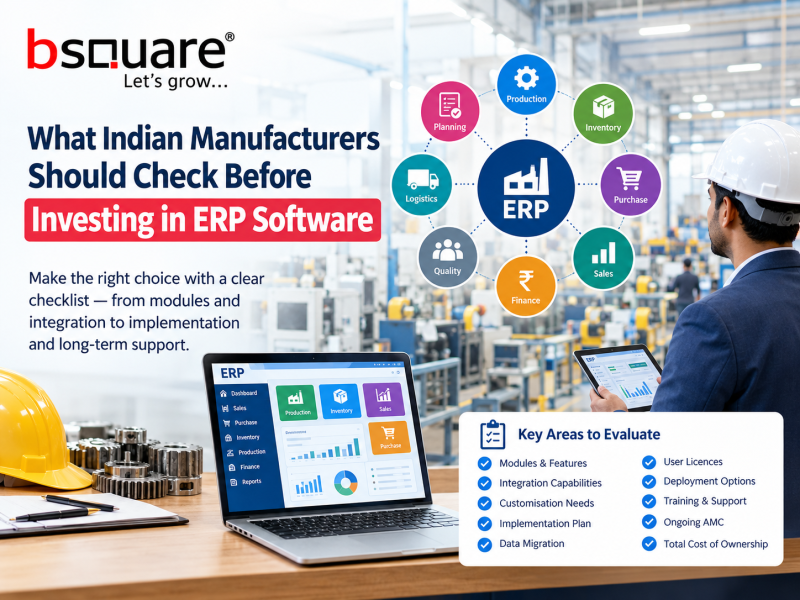
Before starting an ERP project, manufacturers should review:
1. Current processes: Identify disconnected workflows and information gaps.
2. ERP requirements: Define the modules and processes the business actually needs.
3. Historical data: Decide what information should be migrated or archived.
4. Integrations: Identify existing systems that need to connect with the ERP.
5. Data quality: Clean duplicate, outdated, or incorrect master data.
6. Cutover plan: Define how and when the business will move to the new system.
7. Training: Prepare users before going live.
8. Support: Confirm post-implementation support and escalation procedures.
Final Thoughts
Moving from accounting software to an integrated ERP is an important step for a growing manufacturing business.
The right time to consider an ERP replace project is when disconnected information starts affecting visibility, coordination, reporting, and operational control.
A successful Tally to ERP journey requires more than selecting an ERP Software Company. Historical data migration, integrations, implementation, testing, and cutover should all be planned carefully.
Businesses evaluating Pothera and Bsquare Solutions should focus on actual operational requirements and practical demonstrations.
The goal is simple: move from disconnected information to connected operations that help the business work smarter and grow with greater control.
Source:
Click for the: Full Story
You might like