Close Menu
 World
World
 Biography
 Health
 Education
 Business
 Lifestyle
 Sports
 Technology
 Animals
 History
 Food
Food
 Religious
 Startups
 Movies
 Politics
 Fashion
 Covid
Covid
 Diet
Diet
 Fitness
 Marketing
 Travel
 Science
 Reviews
 Social media
 Stories
 Facts
Facts
 Art
Art
 Entertainment
Yatin Samra

Technology
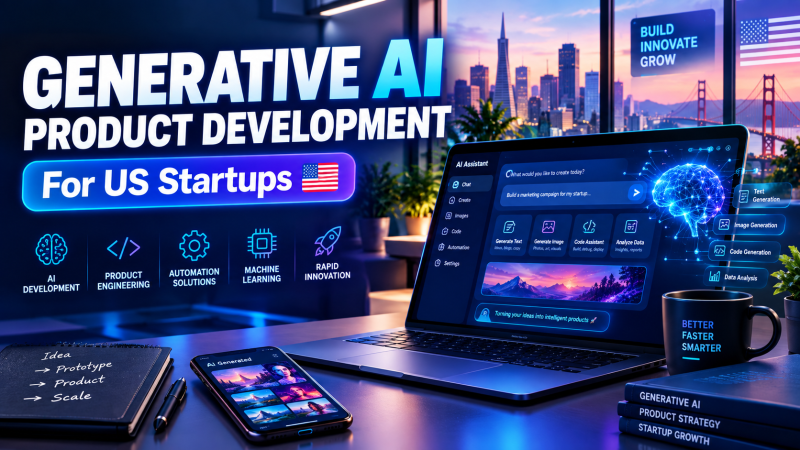
Generative AI Product Development for US Startups: 13 Steps to Build a Scalable AI Solution
 Yatin Samra
There are a lot of possibilities that Generative AI is creating for startups who want to build intelligent applications, automate some processes and provide customers with a unique experience. Startups all over the USA use Generative AI to come up with products for different industries like financial services, healthcare, retail, education, marketing, and enterprise technology. If you think about building your AI startup, then having a good development strategy will help to bring the idea into reality.
There are certain steps that have to be taken during the process of the AI creation which can affect the future performance, cost, and scalability of the product. Here is a list of 13 of such steps.
1. Validate the Problem Before Building the Product
A promising AI idea should begin with a genuine customer problem.
Startups can validate their concept by examining:
- Existing customer pain points
- Current solutions and their limitations
- Potential user demand
- Industry-specific challenges
- Competitor offerings
- Willingness to pay
This research helps establish whether AI can provide meaningful value instead of simply adding another technology layer to an existing application.
2. Define the Minimum Viable AI Experience
Generative AI products can include a large number of capabilities, but launching with a focused feature set can make development more manageable.
An MVP might concentrate on one primary workflow, such as:
- AI-powered document analysis
- Automated content generation
- Conversational customer support
- Intelligent search
- Business process automation
- Personalized recommendations
Once users validate the core experience, additional capabilities can be introduced based on actual product usage.
3. Map the User's AI Interaction
AI products require a slightly different approach to product design because users interact with generated outputs rather than fixed application screens alone.
The user journey should define:
- What information the user provides
- How the AI processes the request
- What result is generated
- How the user reviews the result
- What action the user takes next
This workflow can make the AI experience more predictable and easier to use.
4. Choose Between Existing Models and Custom AI
Startups do not always need to develop an AI model from scratch.
Depending on the product, teams can use:
- Third-party foundation models
- Open-source models
- Fine-tuned models
- Custom-trained models
- Multiple models for different workflows
Using an existing model can accelerate initial development, while custom approaches may be considered when a product requires specialized behavior, proprietary data, or greater control.
5. Create an Effective Prompt Strategy
Prompts influence how generative AI interprets requests and produces results.
A production application may require:
- System instructions
- Structured prompts
- Context injection
- Dynamic user information
- Output formatting
- Prompt versioning
- Fallback instructions
Rather than relying on one static prompt, teams can continuously evaluate and refine prompts as they learn more about user behavior.
6. Connect AI With Trusted Data
Generative AI becomes more useful when it can work with relevant and reliable information.
Depending on the application, the data layer may include:
- Business documents
- Customer information
- Product data
- Knowledge bases
- Databases
- Internal policies
- FAQs
- Industry resources
Retrieval-augmented generation can help an application retrieve relevant information before generating a response, which is particularly useful for knowledge-intensive products.
7. Build Guardrails Into the Product
AI-generated responses can sometimes be inaccurate, incomplete, or inconsistent. Guardrails can help manage these limitations.
Possible controls include:
- Input validation
- Output filtering
- Restricted actions
- Content moderation
- Human approval
- Source attribution
- Permission controls
- Fallback workflows
The appropriate level of control depends on the product's purpose and the consequences of incorrect output.
8. Make Security Part of the Architecture
Generative AI applications may process customer information, internal documents, or other sensitive business data. Security should therefore be incorporated throughout the development lifecycle.
Key considerations can include:
- Identity management
- Encryption
- Role-based access
- Secure APIs
- Data isolation
- Audit trails
- Session management
- Monitoring
- Secure cloud configuration
Startups serving enterprise customers should also evaluate the security and compliance requirements relevant to their target industries.
9. Integrate AI With Business Workflows
An AI product can deliver greater practical value when it performs tasks within the software ecosystem customers already use.
Useful integrations can include:
- CRM systems
- Payment platforms
- Accounting software
- Cloud storage
- Helpdesk applications
- Communication tools
- Enterprise databases
- E-commerce platforms
For instance, an AI solution can analyze information from an existing CRM and help employees generate summaries or prepare customer responses.
10. Develop Industry-Specific AI Solutions
One of the opportunities for US startups is to create specialized AI products for particular industries.
In financial services, for example, startups can combine generative AI capabilities with fintech software development to support workflows such as financial document processing, customer assistance, reporting, and information retrieval.
Other sectors can explore applications such as:
- Healthcare administration
- Legal document analysis
- Retail personalization
- Real estate research
- Education technology
- Marketing automation
- Logistics optimization
Industry specialization can help a startup focus its product around a defined audience and workflow.
11. Establish a Sustainable AI Pricing Model
AI products have operating costs associated with model usage, infrastructure, storage, and integrations. Pricing should therefore be considered alongside the technical architecture.
Possible models include:
- Monthly subscriptions
- Annual subscriptions
- Usage-based pricing
- Credit-based plans
- Freemium offerings
- Enterprise licensing
For usage-heavy products, monitoring the relationship between customer revenue and AI infrastructure costs becomes particularly important.
12. Measure AI Quality After Launch
Traditional application analytics can show how many people use a product, but AI products also need quality evaluation.
Teams can monitor:
- Response accuracy
- Relevance
- User feedback
- Task completion
- Response latency
- Error rates
- Model costs
- Retention
- Conversion rates
Continuous evaluation allows developers to identify whether a problem is caused by the model, prompt, data retrieval, application logic, or user experience.
13. Scale the Product Based on Real Demand
Once the product gains traction, the architecture may need to evolve to support increased usage.
Scaling strategies can include:
- Cloud-based infrastructure
- Load balancing
- API optimization
- Caching
- Database optimization
- Model routing
- Asynchronous processing
- Usage monitoring
- Automated deployment
Startups can also introduce additional AI models or infrastructure components as their requirements become more sophisticated.
A Practical Development Roadmap
A generative AI product can be developed through a structured sequence:
Discovery → Validation → Prototype → MVP → Testing → Launch → Measurement → Optimization → Scaling
This approach allows startups to test assumptions early rather than investing heavily in a complete platform before understanding how customers will use it.
How Much Does Generative AI Product Development Cost?
There is no single development cost for a generative AI product because every project has different requirements.
The overall budget can be influenced by:
- Product complexity
- Number of AI features
- Model selection
- Data requirements
- Customization level
- Platform support
- Third-party integrations
- Security requirements
- Cloud infrastructure
- Testing
- Maintenance
A basic AI-powered application may have a relatively straightforward architecture, while an enterprise-grade platform with multimodal AI, custom workflows, large-scale data processing, and multiple integrations will require significantly more development effort.
Final Thoughts
Generation AI product development allows for startups in the US to design software based on intelligent automation, content creation, information retrieval, and personalization. Nevertheless, technology is just one component of product development.
It is important to validate the problem first and develop an appropriate MVP, AI architecture, data, workflows, user experience, pricing, and evaluation process. Developing products in iterations and scaling as per customer demand will enable startups to deliver products with adequate technology and practical business considerations.
Source:
Click for the: Full Story
You might like