Close Menu
 World
World
 Biography
 Health
 Education
 Business
 Lifestyle
 Sports
 Technology
 Animals
 History
 Food
Food
 Religious
 Startups
 Movies
 Politics
 Fashion
 Covid
Covid
 Diet
Diet
 Fitness
 Marketing
 Travel
 Science
 Reviews
 Social media
 Stories
 Facts
Facts
 Art
Art
 Entertainment
Codezeros

Technology
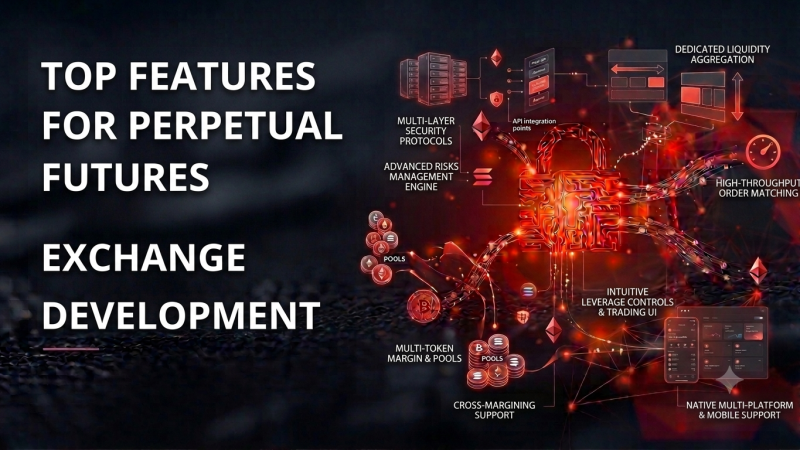
Top Features to Include in Perpetual Futures Exchange Development
 Codezeros
Perpetual futures have become an important part of the digital asset trading ecosystem because they allow traders to speculate on crypto assets without owning the underlying asset or dealing with a fixed contract expiry. As institutional and retail participation grows, businesses exploring a Perpetual Futures Exchange Development project need to focus on more than trading functionality. Liquidity, risk management, automation, wallet connectivity, security, and user experience all influence the platform's long-term usability.
A modern Perpetual Trading Platform should also be designed around changing market expectations. In 2026, automation, agentic AI, advanced analytics, and enterprise adoption are influencing how financial platforms are designed and operated.
What Is a Perpetual Futures Exchange?
A perpetual futures exchange is a trading platform that allows users to open long or short positions on digital assets without an expiration date. Instead of settling contracts at a predefined maturity date, perpetual markets typically use mechanisms such as funding rates to help keep contract prices aligned with the underlying market.
For businesses planning Perpetual Exchange Development, the core objective is to create a reliable environment where users can trade efficiently while the platform manages liquidity, collateral, leverage, liquidation, and risk.
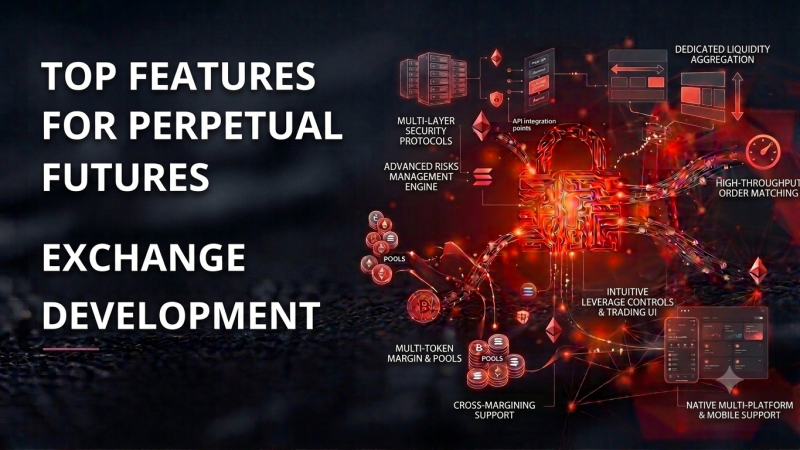
Top Features for Perpetual Futures Exchange Development
1. Advanced Trading Engine
The trading engine is the foundation of a perpetual exchange. It should process orders quickly, maintain accurate market data, and support different order types such as market, limit, stop-loss, and take-profit orders.
A scalable engine should also handle high transaction volumes during periods of market volatility. Matching logic, order processing, trade execution, and position management need to work together without creating unnecessary delays.
2. Leverage and Margin Management
Leverage is a major component of perpetual trading. The platform should provide clear controls for initial margin, maintenance margin, isolated margin, and cross margin.
Real-time margin calculations can help users understand their available collateral and position exposure. Automated liquidation mechanisms are also important when a position falls below the required margin level.
3. Funding Rate Mechanism
Funding rates are essential to perpetual contracts because there is no traditional expiration date. A properly designed funding mechanism helps maintain alignment between the perpetual contract price and the underlying market.
The exchange should display funding rates, countdowns, historical rates, and estimated funding costs clearly so traders can understand the financial implications of maintaining positions.
4. Integrated Crypto Wallet
A secure wallet infrastructure is another important component. Users should be able to deposit, withdraw, and manage supported digital assets without navigating multiple disconnected systems.
Businesses can integrate capabilities associated with a Cryptocurrency Wallet Development Company or develop dedicated wallet infrastructure based on their custody and operational requirements. Wallet support should include transaction monitoring, asset management, address validation, and appropriate security controls.
5. Real-Time Market Data and Analytics
Traders rely on accurate information to make decisions. A modern perpetual exchange should provide live prices, order book depth, trading volume, funding rates, open interest, price charts, and position data.
Advanced analytics can also provide historical performance information and market indicators. In 2026, AI-assisted analytics can help organize large volumes of market data and surface relevant patterns without replacing the user's final decision-making process.
6. Automated Risk Management
Risk management should operate continuously rather than only during manual intervention. Automated systems can monitor account balances, margin ratios, position exposure, liquidation thresholds, and unusual trading activity.
Agentic AI is also becoming relevant in financial technology. When appropriately governed, AI agents can support monitoring workflows, generate operational alerts, summarize market conditions, and assist risk teams with repetitive analysis. Human oversight remains important for high-impact financial actions.
7. Multi-Asset and Multi-Chain Support
Market participants increasingly interact with assets across different blockchain ecosystems. A flexible perpetual trading platform can support multiple assets and, where appropriate, connect with different blockchain networks.
Multi-chain architecture can also support broader wallet compatibility and liquidity access. However, every additional chain introduces technical, operational, and security considerations, so integrations should be selected according to the platform's actual requirements.
8. Security and Compliance Controls
Security should be incorporated across smart contracts, wallets, APIs, authentication systems, and backend infrastructure.
Useful controls include multi-factor authentication, role-based access, transaction monitoring, encryption, smart contract audits, withdrawal controls, and continuous system monitoring. For enterprise adoption, compliance requirements, jurisdictional restrictions, reporting needs, and customer verification processes may also influence the exchange architecture.
How AI Is Shaping Perpetual Exchange Development in 2026
AI is increasingly being applied to financial infrastructure. Automation can reduce repetitive operational work, while agentic AI can assist with monitoring, support workflows, anomaly detection, and internal analytics.
For a DEX Development Company, the opportunity is not simply adding an AI chatbot. AI can be incorporated into operational dashboards, risk monitoring, market intelligence, customer support, and system observability.
The key consideration is governance. AI-driven workflows should have defined permissions, audit trails, human review points, and clear boundaries for automated actions.
What Should Businesses Consider Before Development?
Before selecting an architecture or development approach, businesses should evaluate:
- Target users and supported trading pairs
- Custodial or non-custodial wallet architecture
- Liquidity sourcing and market-making strategy
- Leverage and liquidation methodology
- Blockchain network requirements
- Smart contract and infrastructure security
- Compliance obligations in target jurisdictions
- Scalability and expected transaction volumes
- AI and automation requirements
- Integration with external wallets, oracles, and data providers
These factors help determine whether the platform should use a fully decentralized architecture, hybrid infrastructure, or another technical model.
FAQ’s
1. What are the essential features of a perpetual futures exchange?
The essential features include a trading engine, order management, leverage and margin controls, funding rates, liquidation mechanisms, wallet integration, real-time market data, security controls, and risk management tools.
2. How does AI improve a perpetual trading platform?
AI can support market data analysis, anomaly detection, operational monitoring, customer support, reporting, and workflow automation. Agentic AI can also assist with defined operational tasks when appropriate controls and human oversight are established.
3. Why is wallet integration important for perpetual exchanges?
Wallet integration allows users to manage deposits, withdrawals, collateral, and digital assets through a connected interface. It can also support compatibility with different blockchain networks and asset types.
4. How long does perpetual exchange development take?
Development time varies according to the platform's architecture, number of trading pairs, blockchain integrations, wallet infrastructure, security requirements, compliance scope, and customization level.
Conclusion
Successful Perpetual Futures Exchange Development requires a combination of trading infrastructure, liquidity management, wallet capabilities, risk controls, security, analytics, and scalable architecture. As the market develops in 2026, automation, agentic AI, and enterprise-focused infrastructure are becoming increasingly relevant to platform design.
Businesses evaluating a perpetual exchange project should define their trading model, technical architecture, target markets, and operational requirements before development begins. For organizations planning a specialized Perpetual DEX Development project, Codezeros can be considered when evaluating development capabilities and blockchain infrastructure requirements. For project discussions and technical requirements, contact us today.
Source:
Click for the: Full Story
You might like