Close Menu
 World
World
 Biography
 Health
 Education
 Business
 Lifestyle
 Sports
 Technology
 Animals
 History
 Food
Food
 Religious
 Startups
 Movies
 Politics
 Fashion
 Covid
Covid
 Diet
Diet
 Fitness
 Marketing
 Travel
 Science
 Reviews
 Social media
 Stories
 Facts
Facts
 Art
Art
 Entertainment
Badal

Health
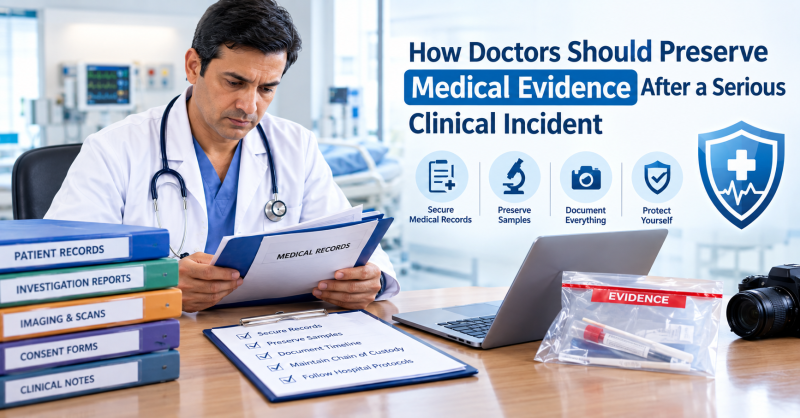
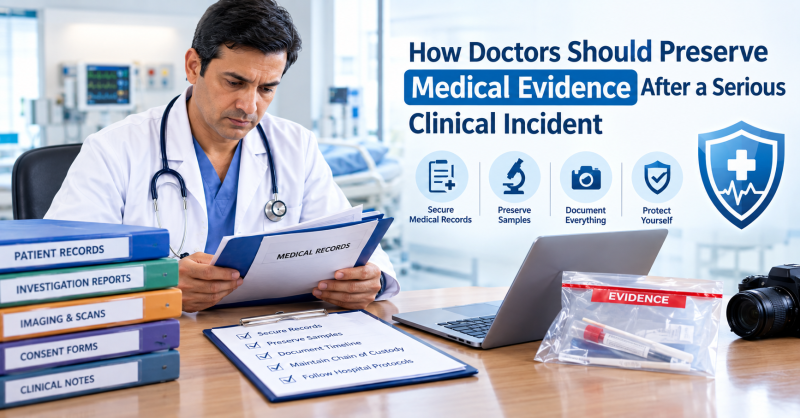
How Doctors Should Preserve Medical Evidence After a Serious Clinical Incident
 Badal
Badal
When a serious clinical incident occurs — an unexpected death, a major complication, or a procedure that did not go as planned — the first few hours matter more than most doctors realize. What gets preserved, recorded, or accidentally altered during this period often determines how well a doctor can later explain what happened. This is why many hospitals now consult the Best Medicolegal consultant in Delhi to build clear protocols for evidence preservation, rather than leaving it to individual judgment during a stressful moment.
This article explains what "medical evidence" means in a clinical context, why its preservation matters, and the practical steps doctors should take immediately after a serious incident.
What Counts as Medical Evidence After an Incident?
Medical evidence is not limited to physical specimens. In most clinical incidents, it includes:
- The patient's complete medical record, including notes made before and during the incident
- Vital sign charts, monitoring strips, and equipment printouts
- Medication administration records
- Consent forms and any related discussions documented separately
- Laboratory and imaging reports relevant to the incident
- Used equipment, devices, or consumables involved, where applicable
- Statements or notes made by staff present at the time
Doctors should understand that "evidence" here does not imply wrongdoing. It simply refers to anything that helps reconstruct an accurate, factual account of what happened — which protects both the patient's interests and the doctor's own position.
Why Evidence Preservation Matters
After a serious incident, memory alone is unreliable. Details fade quickly, and different staff members may recall events differently within days. Medical records and physical evidence created at the time of the incident carry far more weight than statements made later, because they were generated contemporaneously with the event itself.
If a patient complaint or legal notice follows, the completeness and integrity of preserved records often becomes central to how the incident is reviewed. Gaps, missing charts, or unclear documentation can create doubt — even when the actual clinical care provided was appropriate.
Who Is Responsible for Preserving Evidence?
Responsibility is usually shared across several people:
- The treating doctor, who should complete contemporaneous notes as soon as possible after the incident
- Nursing staff, who maintain charts, monitoring records, and medication logs
- Hospital administration, which should secure physical evidence such as devices or consumables
- Department heads, who may need to coordinate an internal review while ensuring records remain unaltered
In smaller clinics without formal protocols, this responsibility often falls entirely on the treating doctor, making individual awareness of proper procedure even more important.
Common Mistakes Doctors Should Avoid
Certain actions — often well-intentioned — can compromise the integrity of evidence after an incident:
- Editing or "cleaning up" notes after the incident instead of adding a clearly timestamped addendum
- Discarding used equipment or devices before they can be examined, if relevant
- Delaying documentation until memory has already started to fade
- Discussing the incident informally without recording an official account
- Allowing charts to be updated by multiple people without clear attribution
- Failing to secure monitoring strips or printouts, which are sometimes discarded as routine waste
Even unintentional errors like these can create the appearance of concealment during a later review, which is often more damaging than the original clinical issue itself.
What Doctors Should Document Immediately After an Incident
As soon as the immediate clinical situation is stabilized, doctors should record:
- A factual, chronological account of events, avoiding assumptions or opinions
- Exact times of key interventions, as best as can be reconstructed
- Names and roles of staff present during the incident
- Any communication with the patient or family immediately following the event
- Follow-up actions taken, including referrals or additional interventions
This note should be factual and objective. It is not the place for self-justification or speculation about cause — only a clear record of what was observed and done.
Informed Consent and Post-Incident Documentation
If the incident occurred during or after a procedure, it's important to revisit the informed consent documentation. The consent record should already reflect the risks discussed before the procedure. Post-incident notes should not attempt to retroactively add information to the consent form — doing so can undermine its credibility. Instead, any additional discussion with the patient or family after the incident should be documented separately, with its own date and time.
Step-by-Step Preventive Actions for Doctors and Hospitals
- Establish a standard incident-response checklist that includes evidence preservation steps
- Secure physical evidence immediately — devices, consumables, or specimens should not be discarded without review
- Complete contemporaneous notes within hours, not days
- Use addendums, not edits, for any information added after the original note
- Restrict casual discussion of the incident outside formal review channels
- Conduct a structured internal review under clinical governance protocols, separate from any external complaint process
These steps also support broader healthcare compliance goals, since organized incident response reflects well-managed risk management practices.
When Should Doctors Seek Medico-Legal Guidance?
Certain situations call for early professional input rather than waiting for a formal complaint:
- The incident involves an unexpected death or major complication
- The family requests copies of records shortly after the incident
- A legal notice is received referencing the incident
- Internal review suggests documentation gaps that need to be addressed carefully
In these cases, doctors often benefit from speaking to a Medico legal consultant in Delhi who can advise on how to handle documentation, communication, and evidence preservation appropriately. A structured resource like this medico-legal guide can also help doctors understand what is generally expected during this process.
A Practical Checklist for Evidence Preservation
- Contemporaneous notes completed as soon as possible
- Physical evidence and devices secured, not discarded
- Monitoring strips and printouts preserved
- Staff present during the incident identified and noted
- Any later additions made as labeled addendums, not edits
- Family communication documented separately from clinical notes
- Internal review conducted through proper clinical governance channels
Conclusion
Preserving medical evidence after a serious clinical incident is not about anticipating litigation — it is about maintaining an accurate, honest record of what happened, for the benefit of the patient, the care team, and the doctor involved. Simple habits like timely documentation, secured physical evidence, and clear addendums can make a significant difference if the incident is later reviewed. Doctors looking to strengthen their incident-response protocols may find it useful to consult the Best Medicolegal consultant in Delhi for practical, situation-specific guidance. Dr. Vimal Kant Goyal's approach to this area emphasizes building sound documentation habits as a routine part of patient safety, rather than a reaction to legal risk.
FAQs
1. Can a doctor add missing details to a note after realizing something was left out?
Yes, but this should be done as a clearly dated and timestamped addendum, never by editing the original entry.
2. Should equipment involved in an incident be discarded after cleaning?
No. If equipment may be relevant to understanding the incident, it should be secured and reviewed before being returned to routine use or disposal.
3. How soon after an incident should documentation be completed?
As soon as the immediate clinical situation allows — ideally within hours, while details are still accurate and clear.
4. When should a doctor consult a Medico legal expert in Delhi after a serious incident?
Early consultation is often useful when the incident involves a serious outcome, a family request for records, or any indication that a formal complaint may follow.
5. Is it necessary to inform hospital administration about every serious incident?
Most hospitals have internal reporting protocols for serious incidents, and following these ensures evidence is preserved consistently and reviewed appropriately.
Source:
Click for the: Full Story
You might like