Close Menu
 World
World
 Biography
 Health
 Education
 Business
 Lifestyle
 Sports
 Technology
 Animals
 History
 Food
Food
 Religious
 Startups
 Movies
 Politics
 Fashion
 Covid
Covid
 Diet
Diet
 Fitness
 Marketing
 Travel
 Science
 Reviews
 Social media
 Stories
 Facts
Facts
 Art
Art
 Entertainment
Sakshi Padiyar

Education
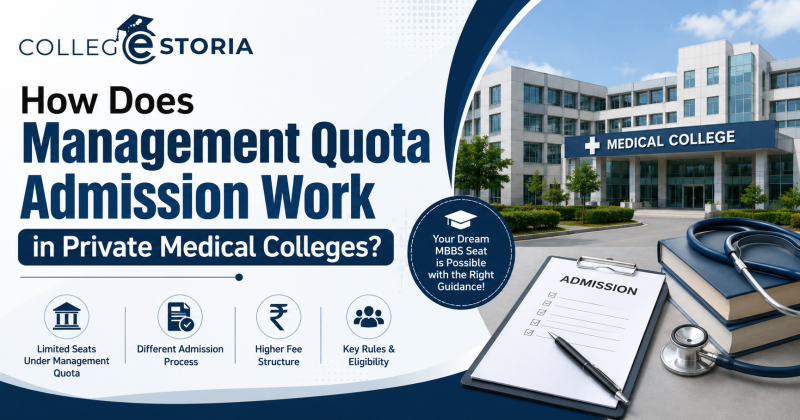
How Does Management Quota Admission Work in Private Medical Colleges?
 Sakshi Padiyar
For many NEET aspirants, securing an MBBS seat in a government medical college can be challenging because of high competition and limited seats. Private medical colleges provide another option, including seats offered under the management quota. Understanding how these seats work can help students and parents make informed admission decisions.
Management Quota Admission in India generally refers to admission to designated seats in eligible private or deemed medical institutions, subject to applicable regulations, NEET qualification, counselling requirements, and the rules of the concerned authority. It is not a separate route to bypass NEET or medical admission regulations.
What Is Management Quota in Medical Colleges?
Management quota refers to a category of seats in certain private medical institutions that are not filled through the same state government quota process. The exact number of seats, fee structure, counselling authority, and admission procedure can differ depending on the type of institution and state regulations.
For MBBS admission, candidates still need to meet the prescribed eligibility requirements. Most importantly, qualifying NEET-UG is a fundamental requirement for admission to an MBBS course in India.
Therefore, management quota should not be confused with direct admission without NEET.
How Does Management Quota Admission Work?
The process usually involves several important stages:
1. Qualify NEET-UG
The first step is to appear for NEET-UG and meet the qualifying requirements prescribed for the admission year. A student cannot normally use management quota as a way to avoid the NEET requirement.
Your NEET score and rank can also influence the range of colleges and seats available during counselling.
2. Understand the Applicable Counselling Process
The next step is to identify which authority conducts counselling for the particular category of seats.
Depending on the institution and state, admissions may be handled through state counselling authorities, MCC counselling, or another officially prescribed process.
Students should therefore verify the current year's counselling notification rather than relying on information from previous admission cycles.
3. Check the Seat Matrix
Before making choices, candidates should review the available seat matrix. It can provide information about the number and category of seats offered by participating institutions.
This is particularly important because seat categories and availability can change from one counselling round to another.
4. Register and Fill Choices
Eligible candidates generally need to complete the relevant counselling registration and submit their college preferences within the specified timeline.
When preparing choices, students should consider factors such as:
- College recognition and approvals
- Tuition fees
- Hospital facilities
- Clinical exposure
- Hostel availability
- Location
- Infrastructure
- Academic environment
- Previous counselling trends
A higher fee does not automatically mean better academic or clinical facilities.
5. Seat Allotment
After choice filling, the counselling authority processes candidates according to the applicable rules, merit, preferences, seat availability, and category.
If a seat is allotted, students need to follow the instructions for accepting the seat and completing admission formalities.
6. Complete College Admission
After allotment, candidates generally need to report to the allotted institution within the prescribed deadline and submit the required documents.
The college may verify academic records, identity documents, NEET-related documents, and other admission requirements before completing the admission process.
What Are the Fees Under Management Quota?
One of the biggest differences students notice is the fee structure.
Management quota fees at private medical colleges can be considerably higher than government-quota fees. However, there is no single management quota fee applicable throughout India.
Fees depend on factors such as:
- State regulations
- Type of medical institution
- University or deemed university status
- Seat category
- Course
- Applicable government notifications
Students should always check the latest official fee notification before making financial commitments.
Documents Usually Required
The exact list can vary, but students may be asked to provide documents such as:
- NEET-UG scorecard
- NEET admit card
- Class 10 certificate
- Class 12 marksheet and certificate
- Date-of-birth proof
- Identity proof
- Passport-size photographs
- Counselling registration documents
- Category certificate, where applicable
- Migration or transfer certificate, where required
- Medical fitness certificate
- Other documents specified by the counselling authority or college
Keeping original documents and multiple copies ready can make the admission process smoother.
Is Management Quota Admission the Same in Every State?
No. This is an important point for students considering Quota Admission in India.
The rules governing private medical colleges can vary between states and institutions. The counselling authority, seat categories, fee structure, eligibility conditions, and admission timelines may therefore differ.
For this reason, students should not assume that a process followed in one state will automatically apply to another.
What Should Students Check Before Taking Admission?
Before paying fees or accepting a seat, verify:
- Whether the college is appropriately recognised and permitted to conduct the course.
- Whether the admission is being processed through the prescribed counselling mechanism.
- The official fee structure and other charges.
- Refund and withdrawal rules.
- Hostel and other institutional expenses.
- Hospital and clinical training facilities.
- Documents required for admission.
- The deadline for reporting and fee payment.
Students should be cautious about anyone promising an MBBS seat without NEET qualification or asking for unofficial payments.
Final Takeaway
Management quota can provide an additional pathway for eligible NEET-qualified students seeking MBBS Admission in India, particularly when government seats are highly competitive. However, it does not mean bypassing NEET, counselling rules, or regulatory requirements.
The safest approach is to understand the applicable state or institutional counselling process, compare colleges carefully, verify the official fee structure, and complete admission only through the prescribed procedure. With proper research, students can make a more informed decision about whether a management quota seat is suitable for their academic and financial situation.
Source:
Click for the: Full Story
You might like