Close Menu
 World
World
 Biography
 Health
 Education
 Business
 Lifestyle
 Sports
 Technology
 Animals
 History
 Food
Food
 Religious
 Startups
 Movies
 Politics
 Fashion
 Covid
Covid
 Diet
Diet
 Fitness
 Marketing
 Travel
 Science
 Reviews
 Social media
 Stories
 Facts
Facts
 Art
Art
 Entertainment
Badal

Education
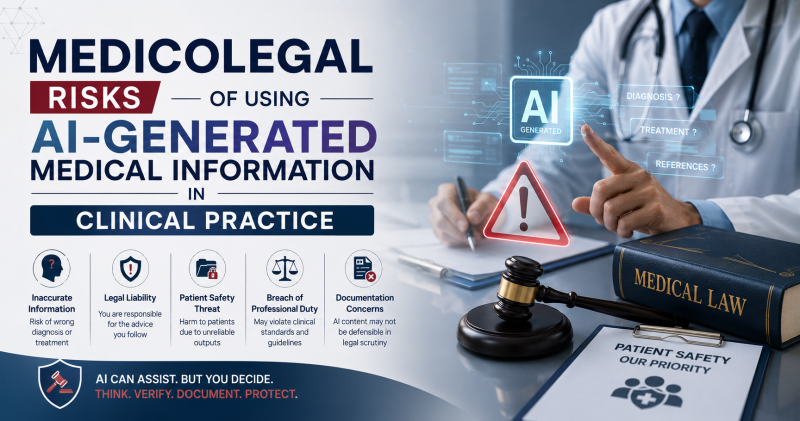
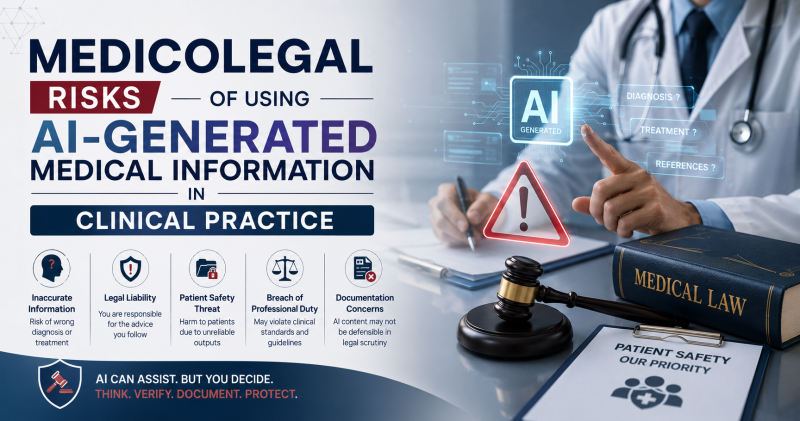
Medicolegal Risks of Using AI-Generated Medical Information in Clinical Practice
 Badal
Badal
Artificial intelligence is becoming increasingly common in healthcare. Doctors may use AI tools for research, summarizing information, drafting patient education material, organizing notes, or supporting administrative tasks.
However, AI-generated information should not automatically be treated as medically accurate or suitable for direct clinical use. AI systems can produce incorrect, incomplete, outdated, or misleading information. Using such information without professional verification may create clinical, ethical, privacy, and medico-legal concerns.
Understanding these risks is increasingly important for modern medical practice. A Medico legal advisor in Delhi can help doctors assess the professional implications of using emerging technologies in appropriate circumstances.
Can Doctors Rely Completely on AI-Generated Medical Information?
No. AI should not replace a doctor's professional judgment.
An AI tool may generate a confident answer even when the underlying information is incomplete or incorrect. The doctor remains responsible for applying clinical knowledge, evaluating the patient, and making appropriate professional decisions.
India's telemedicine guidance similarly emphasizes that professional judgment of the Registered Medical Practitioner should guide healthcare decisions and that technology should not compromise quality of care.
1. Risk of Incorrect Information
Generative AI can sometimes produce what is commonly called a "hallucination"—information that appears plausible but is incorrect.
In healthcare, an incorrect drug detail, contraindication, diagnostic suggestion, or treatment recommendation can have serious consequences.
Doctors should therefore independently verify clinically important information using reliable medical sources before incorporating it into patient care.
2. AI Does Not Replace Clinical Judgment
A patient's medical condition cannot always be understood through a standard text prompt.
Clinical decisions may require physical examination, medical history, investigations, specialist consultation, and consideration of individual risk factors.
AI-generated suggestions should therefore be treated as an informational aid rather than an automatic clinical decision-maker.
3. Patient Privacy Is a Major Concern
Doctors should be extremely careful about entering identifiable patient information into third-party AI systems.
Patient records may contain names, contact details, diagnoses, investigation results, images, and other sensitive information.
India's data-protection framework places requirements around the processing of personal data, including principles concerning informed consent and specified purposes where consent is the applicable basis.
Doctors and healthcare organizations should therefore understand what information an AI tool collects, how it is processed, where it is stored, and what privacy safeguards apply.
4. Documentation and Accountability
If AI contributes to a clinical workflow, doctors should maintain appropriate professional accountability.
The question should not simply be, "What did the AI recommend?" It should be, "What did the doctor evaluate, verify, and decide?"
Clinical documentation should accurately reflect the patient's assessment and the doctor's professional decision-making.
5. AI-Generated Patient Information Requires Review
AI can be useful for creating patient-friendly educational material, but such content should be reviewed before being shared.
Incorrect explanations, unrealistic claims, or missing warnings can confuse patients.
Doctors should ensure that educational material is medically appropriate, understandable, and consistent with the patient's actual clinical situation.
6. Beware of Outdated Information
Healthcare guidance can change over time.
An AI system may not always provide the latest guideline, regulatory requirement, drug information, or professional recommendation.
Doctors should verify important information against current authoritative sources rather than relying solely on an AI response.
The National Medical Commission maintains an official rules and regulations section where current professional and regulatory materials can be checked.
7. Who Is Responsible for the Final Decision?
AI does not become the treating doctor simply because its output influenced a decision.
Where an AI tool is used as part of a doctor's workflow, the medical professional still needs to exercise appropriate judgment within their professional role.
If a doctor is uncertain about the medico-legal implications of a particular AI application, consulting a Top medicolegal advisor Delhi may help identify potential risks and appropriate safeguards.
How Can Doctors Use AI More Safely?
Doctors can reduce avoidable risks by following practical safeguards:
- Do not blindly accept AI-generated clinical recommendations.
- Verify important medical information using reliable sources.
- Avoid entering unnecessary identifiable patient information.
- Review AI-generated patient education before sharing it.
- Maintain appropriate clinical documentation.
- Keep human professional judgment at the center of patient care.
- Understand the privacy terms of AI platforms used in practice.
- Follow current professional and regulatory requirements.
Conclusion
AI has the potential to support healthcare, but it should be used carefully. Incorrect information, privacy concerns, outdated content, weak documentation, and over-reliance on automated recommendations can create avoidable medico-legal risks.
Doctors should keep professional judgment and patient safety at the center of every clinical decision. When questions arise about the appropriate use of AI in medical practice, Medico legal advice for doctors in Delhi can help professionals understand potential risks and develop sensible safeguards.
A practical Medico legal guide in Delhi should therefore view AI as a tool that requires human oversight—not as a replacement for professional medical judgment.
FAQs
1. Can AI replace a doctor's professional judgment?
No. AI can support certain tasks, but clinical decisions require professional assessment and judgment appropriate to the patient's circumstances.
2. Is it safe to enter patient information into an AI tool?
Not automatically. Doctors should understand the tool's privacy, security, data-processing, and retention practices and avoid sharing unnecessary identifiable information.
3. Can a doctor be responsible for an incorrect AI-generated recommendation?
The legal position depends on the specific facts, the use of the tool, the doctor's role, applicable standards, and other circumstances. Doctors should independently verify clinically significant information before relying on it.
4. Should doctors stop using AI because of medico-legal risks?
Not necessarily. AI may provide useful support for appropriate tasks. The key is responsible use, human oversight, privacy protection, verification, and compliance with applicable professional requirements.
Source:
Click for the: Full Story
You might like