Close Menu
 World
World
 Biography
 Health
 Education
 Business
 Lifestyle
 Sports
 Technology
 Animals
 History
 Food
Food
 Religious
 Startups
 Movies
 Politics
 Fashion
 Covid
Covid
 Diet
Diet
 Fitness
 Marketing
 Travel
 Science
 Reviews
 Social media
 Stories
 Facts
Facts
 Art
Art
 Entertainment
Badal

Education
Medicolegal Issues in Treating an Unconscious or Incapacitated Patient
 Badal
Badal
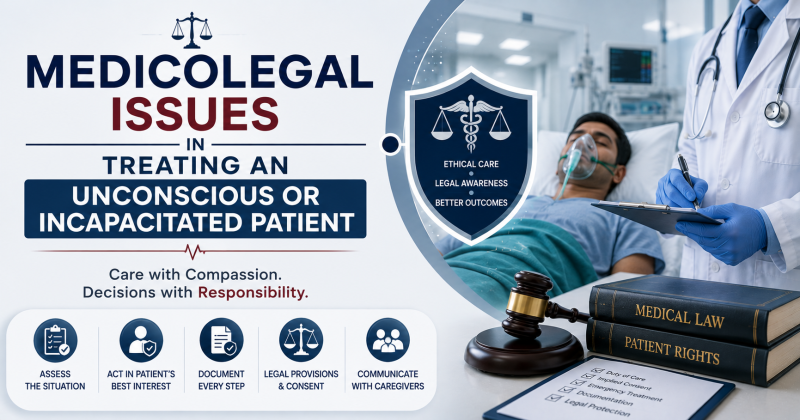
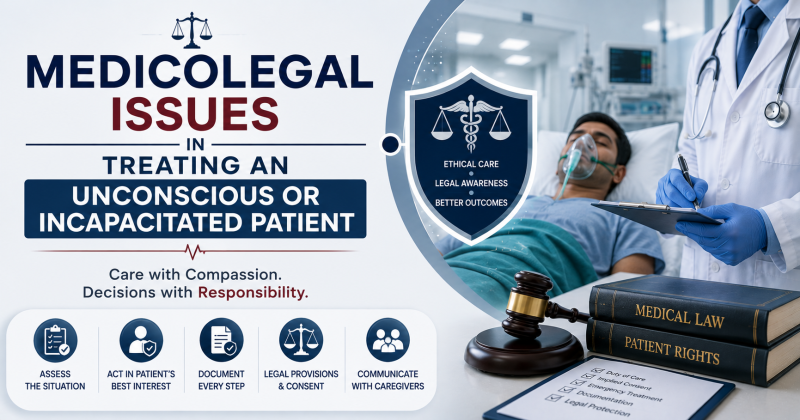
Treating an unconscious or incapacitated patient can be one of the most challenging situations in medical practice. The doctor may need to make urgent clinical decisions when the patient cannot communicate or provide consent.
These cases require careful attention to emergency care, decision-making, documentation, communication with relatives, and professional responsibilities. Understanding the medico-legal aspects can help doctors make decisions that are both clinically appropriate and properly documented.
A Medico legal advisor in Delhi may be consulted when an incapacitated patient's treatment raises difficult legal or ethical questions.
What Makes These Cases Different?
A conscious adult patient can generally communicate preferences and participate in treatment decisions. An unconscious or otherwise incapacitated patient may not be able to do so.
In an emergency, waiting for a normal consent process may not always be practical. Doctors therefore need to consider the patient's immediate medical needs and the applicable legal and professional framework.
1. Emergency Treatment May Require Immediate Action
When a patient requires urgent medical attention, doctors may need to provide necessary emergency care without being able to obtain the patient's usual form of consent.
The circumstances should be carefully documented.
Records should, where relevant, explain the patient's condition, urgency, clinical assessment, treatment decisions, and why immediate intervention was necessary.
2. Identify the Patient and Relevant History
When possible, doctors should establish the patient's identity and obtain relevant medical history from available sources.
Family members, attendants, previous records, medication lists, investigation reports, or other reliable information may assist clinical decision-making.
However, information received from relatives should be distinguished from confirmed medical findings where appropriate.
3. Communicating With Relatives
Relatives may play an important role in providing information and participating in communication about the patient's condition.
Doctors should explain the situation honestly and avoid giving unrealistic assurances about recovery or outcomes.
The NMC's professional conduct framework emphasizes that physicians should communicate appropriately about a patient's condition and act in the patient's best interests.
4. Document the Patient's Condition Carefully
Documentation becomes particularly important when the patient cannot communicate personally.
Doctors should maintain appropriate records of:
- Initial clinical condition
- Relevant examination findings
- Investigations
- Emergency interventions
- Treatment decisions
- Changes in the patient's condition
- Communication with relatives or representatives
- Specialist consultations
- Transfer or referral decisions
Accurate records can help demonstrate the clinical reasoning behind important decisions.
5. Be Careful With Treatment Decisions
Doctors should make treatment decisions according to the patient's medical condition, professional judgment, and applicable standards.
If specialist input is required, appropriate consultation should be considered.
The NMC's professional-conduct material recognizes the importance of consultation in serious, difficult, or doubtful cases and emphasizes that consultation should be in the patient's interest.
6. Understand the Role of Family Members
Family members can provide valuable information and may be involved in decisions depending on the circumstances. However, their role should not automatically be assumed to be identical in every medical or legal situation.
Doctors should identify the appropriate person or authority for decision-making according to the patient's circumstances and applicable law.
Where the situation is particularly complex, a Top medicolegal advisor in Delhi can help identify questions that may require specialized legal attention.
7. Consider Transfer When Appropriate
A patient may need transfer to another hospital or specialist facility because advanced treatment or critical-care resources are required.
The reason for transfer, the patient's condition, treatment already provided, and relevant communication should be documented appropriately.
The receiving facility should receive necessary clinical information to support continuity of care.
Why Documentation Matters
An unconscious patient's case may later be reviewed because of an unexpected outcome, family disagreement, or complaint.
Good documentation does not guarantee protection from legal action. However, it provides an important record of what happened and why particular clinical decisions were made.
Doctors should never create, alter, or backdate records simply because a dispute has developed.
Conclusion
Treating an unconscious or incapacitated patient requires clinical judgment as well as careful attention to professional and legal responsibilities. Emergency care, documentation, communication, consultation, and continuity of treatment should all be handled thoughtfully.
Doctors should not rely on assumptions when a case involves complicated consent or decision-making questions. Medico legal advice for doctors in Delhi can provide useful guidance when the circumstances are legally sensitive.
A reliable Medico legal guide in Delhi should ultimately focus on one principle: decisions should be patient-centered, clinically justified, appropriately documented, and consistent with the applicable legal and professional framework.
FAQs
1. Can emergency treatment be provided when an unconscious patient cannot give consent?
Emergency circumstances can require immediate treatment when the patient cannot communicate. Doctors should follow applicable professional and legal requirements and document the circumstances and clinical reasoning carefully.
2. Should doctors involve the patient's family?
Where appropriate, relatives or authorized representatives can provide medical history and participate in communication. The exact role depends on the patient's condition and applicable legal requirements.
3. Why is documentation especially important in unconscious patients?
Because the patient cannot explain what happened, the medical record may become particularly important in establishing the clinical timeline, treatment provided, and decisions made.
Source:
Click for the: Full Story
You might like