Close Menu
 World
World
 Biography
 Health
 Education
 Business
 Lifestyle
 Sports
 Technology
 Animals
 History
 Food
Food
 Religious
 Startups
 Movies
 Politics
 Fashion
 Covid
Covid
 Diet
Diet
 Fitness
 Marketing
 Travel
 Science
 Reviews
 Social media
 Stories
 Facts
Facts
 Art
Art
 Entertainment
Badal

Health
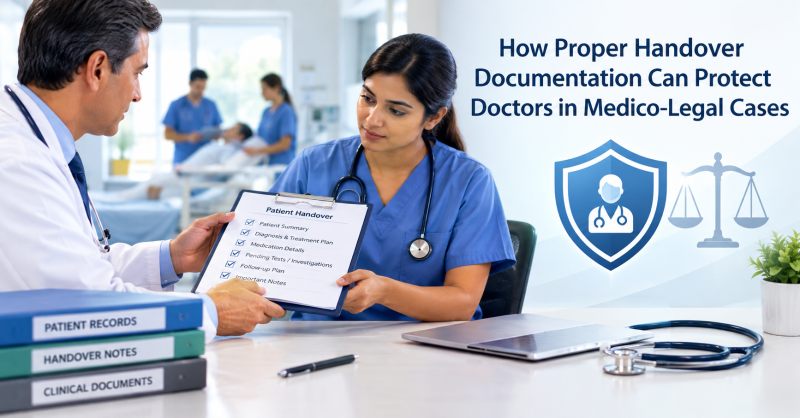
How Proper Handover Documentation Can Protect Doctors in Medico-Legal Cases
 Badal
Badal
Patient handovers happen constantly in hospitals — between shifts, departments, on-call teams, and referring physicians. Yet many doctors treat handover documentation as a formality rather than a legal safeguard. When something goes wrong during a transition of care, incomplete handover notes are often among the first records scrutinized. This is one of the reasons doctors increasingly consult the Best Medicolegal consultant in Delhi before finalizing internal handover protocols, especially in busy multi-specialty settings where responsibility can blur between teams.
This article explains why handover documentation matters, what it should include, and how doctors can reduce medico-legal risk through simple, consistent practices.
Why Handover Documentation Matters in Medico-Legal Cases
A patient handover is the point where clinical responsibility shifts from one doctor or team to another. If information is lost, misunderstood, or never recorded, the resulting gap can directly affect patient safety.
In medico-legal cases, investigators and legal teams often ask a simple question: what did the receiving doctor actually know at the time of taking over care? If the medical records don't answer this clearly, the treating doctor may struggle to demonstrate that appropriate clinical judgment was exercised based on available information.
Proper documentation does not guarantee a favorable outcome in a dispute, but it does provide an accurate, contemporaneous account of decision-making — which is often the strongest form of protection a doctor has.
Who Is Affected by Poor Handover Practices?
Weak handover documentation creates risk for multiple parties:
- Junior doctors and residents, who may inherit incomplete clinical pictures during night shifts
- Consultants, who remain professionally accountable even when a case is managed by their team
- Nursing staff, who rely on physician handover notes to plan ongoing care
- Hospitals, which may face institutional liability if handover protocols are absent or inconsistent
- Patients, whose safety depends on continuity of accurate information
Because so many people are involved, handover documentation is not just an individual doctor's responsibility — it is a matter of clinical governance for the entire department.
What Should Be Documented During a Handover?
A defensible handover note typically includes:
- Patient identification and current diagnosis
- Vital signs and clinical status at the time of handover
- Treatment already administered, including medications and dosages
- Pending investigations or results awaited
- Specific instructions or concerns flagged by the outgoing doctor
- Any changes in the patient's condition during the shift
- Time and date of handover, with names of both outgoing and incoming doctors
Verbal handovers, while common, are difficult to prove later. Wherever possible, verbal communication should be backed by a written or electronic note, even if brief.
Common Mistakes Doctors Should Avoid
Several recurring errors increase medico-legal exposure during handovers:
- Relying solely on verbal communication without any written record
- Using vague language such as "stable, continue same treatment" without specifics
- Failing to document pending results that require follow-up action
- Omitting the exact time of handover, which matters in time-sensitive cases
- Not naming the receiving doctor, leaving accountability unclear
- Copy-pasting previous notes without updating them to reflect current status
Each of these mistakes may seem minor in isolation, but together they can create a documentation gap that is difficult to explain months or years later when a complaint arises.
Informed Consent and Continuity of Care
Handover documentation also intersects with informed consent. If a patient's treatment plan changes after a handover — for example, a decision to proceed with a procedure — the incoming doctor must ensure that consent discussions are consistent with what was previously communicated to the patient or family.
Any doctor consulted as a Medico legal consultant in Delhi will often point out that consent-related disputes frequently arise not because consent was never taken, but because handover notes failed to capture what the patient had actually been told before the transition. Aligning consent records with handover notes reduces this risk considerably.
Step-by-Step Preventive Actions for Doctors
To strengthen handover practices, doctors and departments can consider the following steps:
- Standardize handover formats (structured tools such as SBAR — Situation, Background, Assessment, Recommendation — are widely used)
- Make written handovers mandatory, even in fast-paced units
- Encourage two-way confirmation, where the receiving doctor repeats back key points
- Audit handover records periodically as part of internal clinical governance
- Train new and junior doctors specifically on handover documentation, not just clinical skills
- Escalate unclear handovers immediately, rather than assuming information will follow later
These steps align with broader healthcare compliance expectations and are relatively simple to implement without disrupting clinical workflow.
When Should Doctors Seek Medico-Legal Guidance?
Not every documentation gap leads to a legal notice, but certain situations warrant early professional advice:
- A patient complaint specifically references confusion during a shift change
- A poor outcome occurred shortly after a handover with incomplete notes
- Legal notices or complaints request handover-related records
- Internal audits repeatedly flag the same handover deficiencies
In such situations, doctors often benefit from speaking to a Medico legal expert in Delhi who can review documentation practices objectively and suggest corrective action before minor gaps become larger liabilities. Resources such as this medico-legal guide can also help doctors understand documentation expectations in more detail.
A Practical Handover Checklist
Doctors can use this quick checklist during shift changes:
- Patient details and diagnosis confirmed
- Current clinical status recorded
- Treatments given and pending actions listed
- Investigation results awaited, clearly noted
- Specific concerns or red flags highlighted
- Time, date, and names of both doctors documented
- Receiving doctor has acknowledged the handover
Conclusion
Handover documentation is often overlooked until a dispute forces doctors to revisit exactly what was recorded — and what wasn't. Building consistent, structured handover habits protects patients through better continuity of care, and protects doctors by creating a reliable account of clinical decision-making. For doctors seeking to strengthen these practices further, consulting the Best Medicolegal consultant in Delhi can provide practical, department-specific guidance suited to real clinical settings. Dr. Vimal Kant Goyal's work in this area reflects a broader emphasis on proactive documentation as a core part of everyday patient safety, not just a response to legal risk.
FAQs
1. Is verbal handover legally acceptable if no written record exists?
Verbal handovers happen routinely, but without written backup, it becomes difficult to prove what information was actually shared if a dispute arises later.
2. Who is responsible if a mistake happens due to an incomplete handover?
Responsibility can be shared between the outgoing and incoming doctor, depending on what was communicated and documented at the time. This is often assessed case by case.
3. Does electronic handover documentation offer better protection than paper records?
Electronic records generally offer better time-stamping and consistency, but the real protection comes from the completeness and clarity of the content, not just the format.
4. When should a doctor consult a Medico legal consultant in Delhi about documentation practices?
It is advisable to seek guidance when complaints reference handover confusion, when outcomes are poor following a transition of care, or when reviewing department-wide documentation standards.
5. Can good handover documentation prevent legal action entirely?
No documentation practice can guarantee that a complaint or legal notice will never arise. However, clear, contemporaneous records make it considerably easier to demonstrate that appropriate care and communication took place.
Source:
Click for the: Full Story
You might like